Difference Between Mixtures and Compounds: A GCSE Guide
A mixture is two or more substances physically combined with no chemical bonds between the components, so each keeps its own properties and can be separated physically, while a compound is two or more elements chemically bonded in a fixed ratio, forming a new substance that only a chemical reaction can break down.
You're revising chemistry, the mock is getting closer, and salt water somehow looks as though it should count as a compound. You know the definitions, but choosing the right one under exam pressure is another matter.
The useful skill is diagnosing a sample from evidence. Look at what its formula tells you, what happens during separation and whether its composition can change. That gives you something stronger than a memorised sentence.
Mixtures and Compounds Side by Side
Mixture vs compound on every key criterion
| Feature | Mixture | Compound |
|---|---|---|
| Definition | Two or more substances mixed together, not chemically joined | Two or more elements chemically bonded in a fixed ratio |
| Bonding | No chemical bonds between the components; each keeps its own chemical identity | Atoms of different elements joined by chemical bonds |
| Composition | Variable; proportions can change. Air can contain slightly more or less nitrogen between samples | Fixed; water always has two hydrogen atoms for every oxygen atom |
| Formula | No single formula for the whole mixture | Has a formula, such as H₂O or NaCl |
| Properties | Each component keeps its own chemical properties | New properties, unlike the elements that form it |
| Melting and boiling points | Usually melts or boils over a range of temperatures | A pure compound has sharp, characteristic melting and boiling points at a given pressure |
| How it forms | Substances are mixed; no reaction is needed | A chemical reaction forms it |
| How it is separated | Physical methods, such as filtration or distillation | Needs a chemical reaction to break it into elements |
| Number of substances | Two or more substances | One compound, which counts as a pure substance |
The difference between mixtures and compounds isn't about whether something looks uniform. Air looks uniform, but it contains separate gases. A sample of pure sodium chloride contains different elements, yet it is a single substance.
What the curriculum expects
England's national curriculum science programmes of study require this distinction from Key Stage 3 onward, including four physical separation techniques: filtration, evaporation, distillation and chromatography. At GCSE level, pupils also need to connect a compound's fixed composition with its formula.
That means definitions alone aren't enough. You need to explain why chemical reactions form or break compounds, while physical processes separate mixtures. You also need to distinguish the new properties of a compound from the retained chemical properties of mixture components.
For temperature-based questions, the AQA GCSE pure substances study guide gives focused revision on using melting and boiling evidence.
Revision habit: Cover a column and explain each entry aloud. If you can give a reason rather than repeat a phrase, you're closer to being able to use it in an unfamiliar question.
Every example below can be checked against this comparison. Bookmark the table for revision, especially if you tend to confuse composition with appearance.
Why Bonding Decides Whether a Mix or a Compound
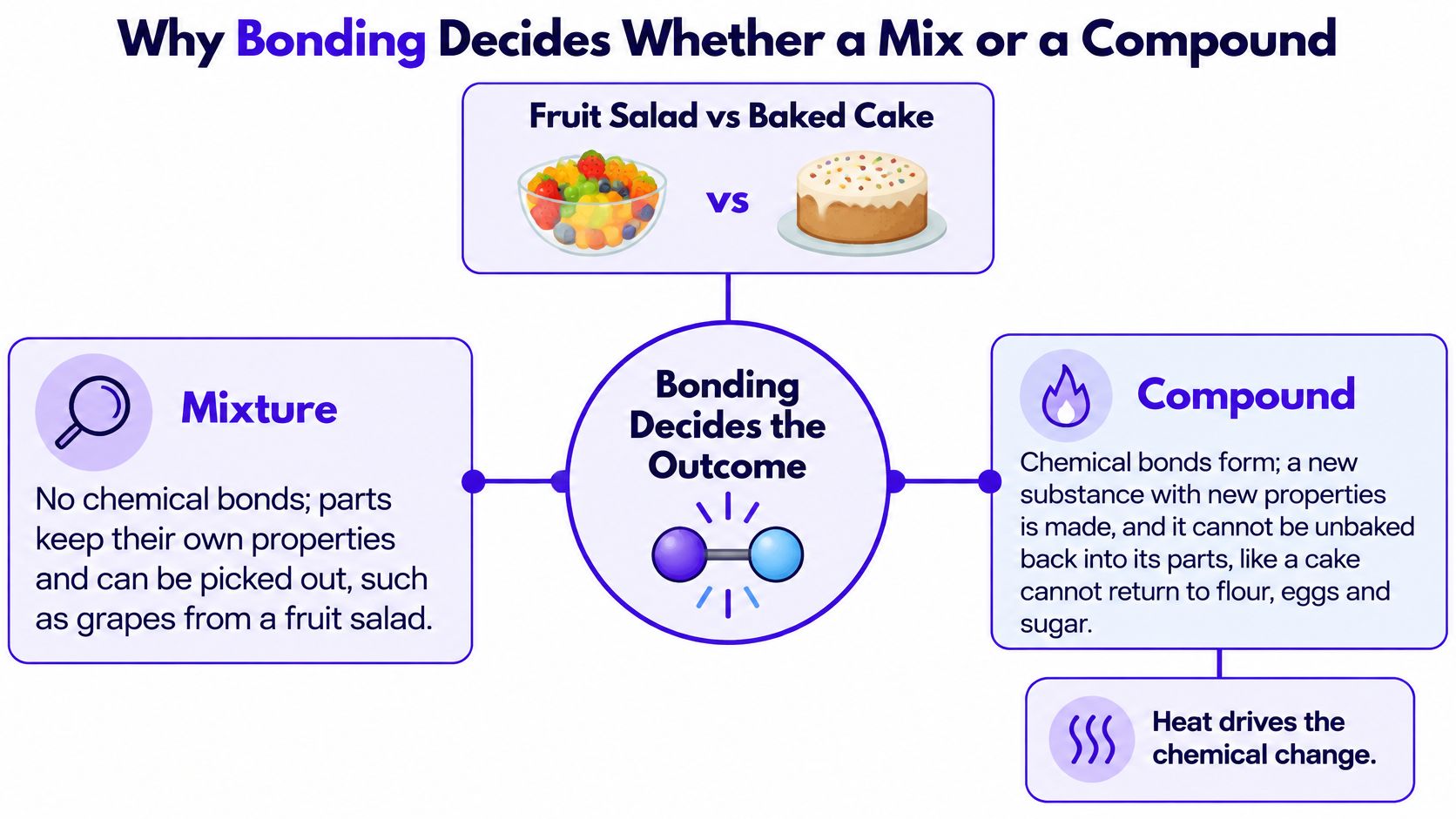
A fruit salad contains grapes, apple and other fruit. Pick out a grape and it's still a grape. You've separated part of the mixture without changing what that part is.
A baked cake behaves differently. You can't pick the original eggs, flour and sugar back out because baking causes chemical changes as well as physical ones. This makes a useful analogy for chemical change, but there's an important limit: a cake is still a mixture, not a single compound.
Where the analogy helps
In a mixture, the components keep their chemical identities. You could make a hypothetical salt solution using 10 g of salt, then make another using 30 g with the same amount of water. You'd change the concentration, not create a new compound.
In a compound, the proportions aren't a recipe you can adjust freely. The formula specifies how the elements combine. BBC Bitesize's explanation of compounds and mixtures uses H₂O and NaCl to illustrate fixed composition: water has two hydrogen atoms for every oxygen atom, while sodium chloride has equal numbers of sodium and chlorine ions.
The analogy below helps visualise the contrast between physical mixing and chemical transformation. Read the cake as an example of ingredients undergoing reactions, not as a literal example of a pure compound.
What changing the proportions does
Add more salt to water and you may change concentration, density or electrical conductivity. The components haven't become different substances just because their proportions changed.
You can't make a more hydrogen-rich version of water by changing its formula and still call it water. A different elemental ratio means a different substance, or a formula that doesn't correctly represent the substance you intended.
Sodium chloride makes the property change memorable. Sodium is a soft metal that reacts violently with water. Chlorine is a poisonous green gas. Their compound is ordinary table salt, with properties unlike either starting element.
For the particle-level explanation, use exam-aligned bonding revision for GCSE students.
A formula in a question is a useful clue, but read it carefully. A formula containing different element symbols can identify a compound; a formula containing only the symbol for oxygen still represents an element. Also check whether the question describes a pure sample or that substance mixed with something else.
Separation Methods and What Each One Proves
A physical separation changes where substances are, not their chemical identities. Breaking a compound into its elements requires a chemical reaction.
Choose the method by identifying the property that makes the components different. Don't start by naming your favourite piece of laboratory equipment.
Match the method to the sample
Separation methods, examples and what they show
| Method | Separates | Example | Works because |
|---|---|---|---|
| Filtration | An insoluble solid from a liquid | Sand from water | Solid particles are too large to pass through the filter paper; sand remains as residue |
| Crystallisation | A dissolved solid from its solution | Salt from salt water | Evaporating some solvent and cooling allows crystals to form |
| Simple distillation | A solvent from a solution, or a volatile liquid from a non-volatile solid | Pure water from salt water | The solvent vaporises and is condensed; the dissolved solid stays behind |
| Fractional distillation | Liquids with close boiling points | Ethanol from water in a mixture | A fractionating column allows repeated evaporation and condensation, producing an ethanol-rich fraction |
| Chromatography | Dissolved substances that move at different rates | Black ink into coloured dyes | Dyes interact differently with the paper and solvent, so separate spots appear |
| Magnetism | A magnetic substance from a non-magnetic one | Iron filings from sulfur powder | Iron is attracted to a magnet; sulfur isn't |
| Decomposition | A compound into simpler substances, including its elements | Water into hydrogen and oxygen by electrolysis | A chemical reaction breaks and rearranges chemical bonds |
The final row is deliberately different. Electrolysis isn't another physical separation technique. It uses electrical energy to cause chemical change.
Why filtering salt water fails
Filter sand and water, and the sand stays on the paper. The liquid passes through and is called the filtrate. Those observations show that you've separated the insoluble solid from the liquid.
Salt water passes through filter paper because dissolved ions aren't trapped by it. That doesn't make salt water a compound. It means filtration is the wrong method.
Choose the method according to what you want to keep:
- Keep the salt: Evaporate some water, then allow crystals to form. Crystallisation is useful when you want to collect the dissolved solid.
- Keep the water: Use simple distillation. Water boils at 100°C at standard atmospheric pressure, then its vapour cools in the condenser and becomes liquid again.
- Separate liquid components: Use fractional distillation when their boiling points are close. Don't claim that ordinary fractional distillation always produces completely pure ethanol from water.
For mixed samples, you may need several stages. Sand and salt in water would need filtration followed by crystallisation if you wanted to recover both solids.
The iron and sulfur test
The classic example in BBC Bitesize's separation guide compares iron and sulfur before and after heating. Before reaction, a magnet removes the iron from the mixture; after reaction, the iron sulfide compound can't be pulled apart that way.
The important observation isn't merely that heating happened. It's that the original components have chemically reacted, so the iron no longer behaves as separate iron filings.
Use MasteryMind's guide to separating mixtures alongside practical notes on apparatus and observations.
Successful physical separation into different substances establishes that the original sample was a mixture. Failed separation only tells you that the method didn't work. Check the formula and purity evidence before deciding anything further.
Exam Misconceptions That Cost Easy Marks
Writing that pure means clean or uncontaminated can cost an otherwise straightforward mark. In chemistry, a pure substance is a single element or compound.
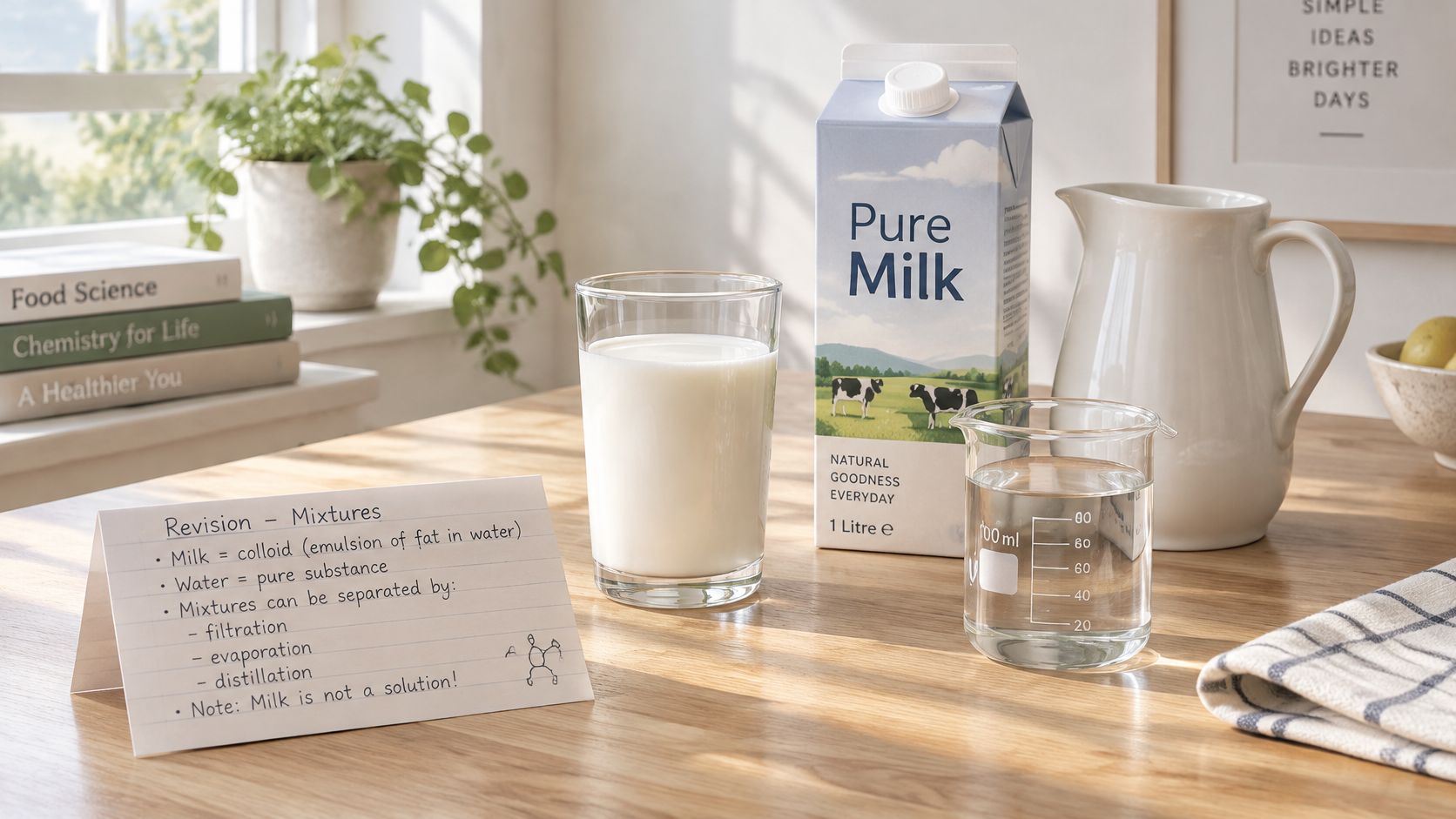
Milk may be described as pure in everyday conversation, but it contains water, fat, proteins and sugars. It's chemically a mixture, even if nothing unwanted has been added.
The everyday objects below make a useful reminder that food labels and chemistry classifications answer different questions.
Replace the tempting answer with the precise one
| Tempting idea | Why it sounds reasonable | Wording to use instead |
|---|---|---|
| An element contains only a single atom | Particle diagrams often begin with isolated circles | An element contains only one type of atom. |
| Any substance containing many atoms is a compound | Compound sounds like something made from several parts | A compound contains two or more different elements chemically bonded in a fixed ratio. |
| Air is a compound because it contains gases | You can't see separate components | Air is a mixture of nitrogen, oxygen and other gases, which aren't chemically bonded to each other and can change in proportion. |
| Clear salt water must be a compound | It looks like a single substance | Salt water is a solution, so it is a mixture. |
| A colour or temperature change proves a compound formed | Both can accompany reactions | The observation may suggest a reaction, but it isn't sufficient evidence by itself. |
| A pure substance must be an element | Pure sounds like it contains nothing combined | A pure substance can be an element or a compound. |
The Department for Education chemistry remote education lesson plan identifies the confusion between an element containing only a single atom and a compound containing multiple atoms. The correction is about types of atom and bonding, not the total number of atoms present.
Translate between representations
Particle diagrams, formulae and everyday descriptions can look like separate topics. They're different ways of describing the same sample.
In a particle diagram, check which circles represent different elements and which are joined. Don't assume that touching circles always mean chemical bonds unless the diagram's key supports that reading.
For an explanation answer, connect these forms of evidence:
- Particle diagram: Identify whether different particles are separate or whether different elements are chemically joined.
- Formula: Explain what the element symbols and subscripts show about composition.
- Experimental evidence: Use separation results or characteristic melting and boiling behaviour to support the classification.
A colour change alone can't do all that work. Nor can a clear appearance: dissolved substances can be invisible while remaining present.
Classify Any Sample and Write a Full-Mark Answer
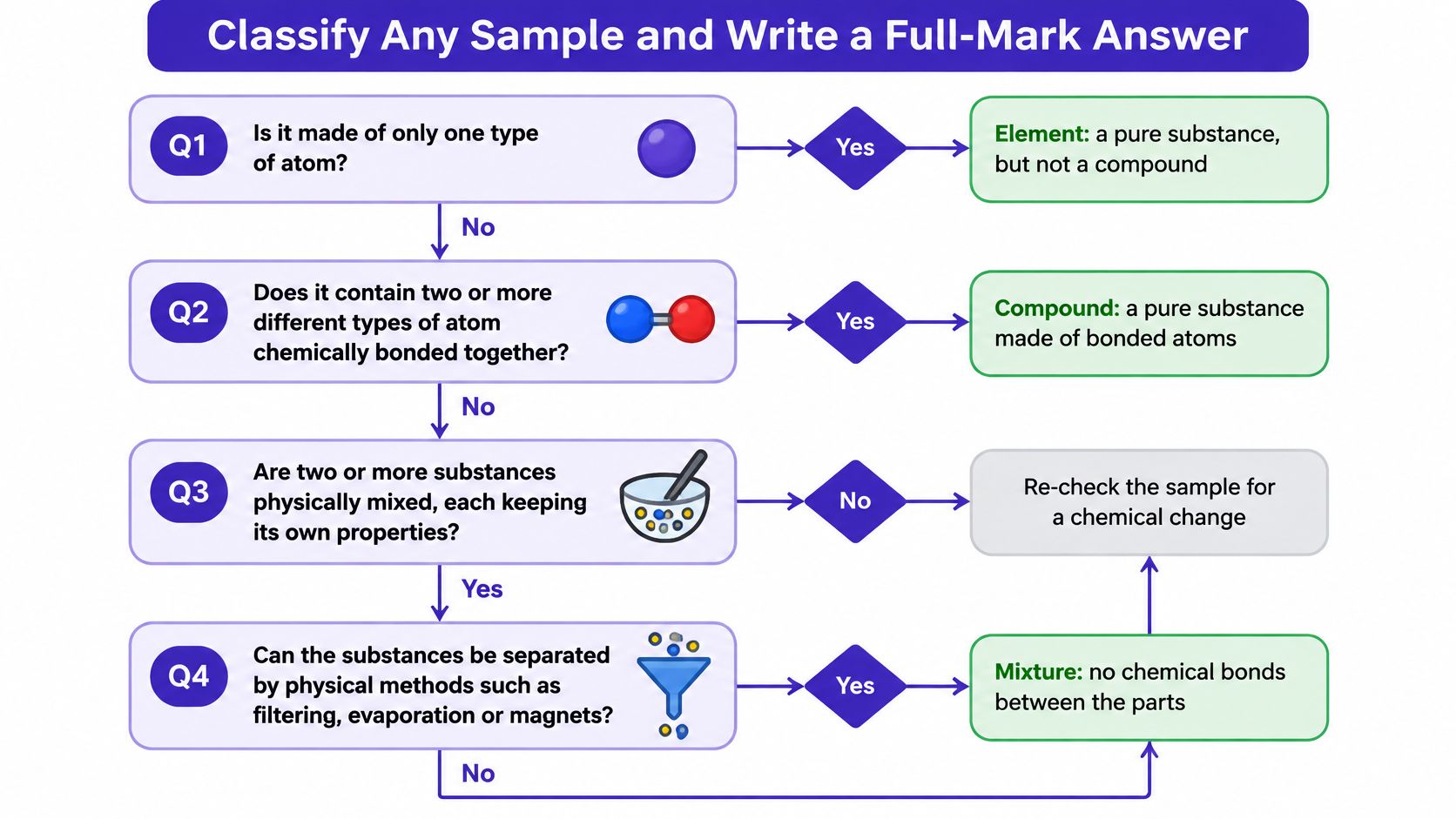
Use a question routine rather than guessing from the substance's name. Start with the whole sample, not just a particle inside it.
- Is it made of only one type of atom? In the usual GCSE classification questions, that identifies an element. It can be pure without being a compound.
- Does it contain different elements? If so, establish whether they belong to a single compound or to separate substances present together.
- Can a physical method separate different substances without a reaction? If yes, classify the sample as a mixture.
- Does the evidence identify a single substance with a fixed formula and characteristic melting and boiling points? If different elements are chemically bonded within that substance, classify it as a compound.
The flowchart gives a visual starting point. Apply an important qualification: a mixture can contain bonded atoms inside its component compounds, so finding chemical bonds somewhere in a sample doesn't prove the whole sample is a pure compound.
Build an answer from evidence
Try this practice question, worth 4 marks:
Explain why sodium chloride is a compound but salt water is a mixture.
Build your response in a sensible order. Name each classification, explain its bonding or composition, add separation evidence and connect the reasoning to the substances' properties.
Model answer: Sodium chloride is a compound because sodium and chlorine are chemically bonded in a fixed 1:1 ratio. It has its own properties, and a chemical reaction is needed to decompose it. Salt water is a mixture because salt is dissolved in water without forming a new compound between them. Its proportions can change, and salt can be recovered by evaporation.
That's an answer to practise, not a guarantee of a particular mark from every board. The precise allocation depends on the question and its mark scheme.
Exam technique: Use because to connect a classification to evidence. Naming the substance correctly isn't the same as explaining why the classification fits.
Test the awkward examples
Classifying common substances in exam questions
| Substance | Classification | Reason |
|---|---|---|
| Air | Mixture | Nitrogen, oxygen and argon aren't chemically bonded to each other, and their proportions can change |
| Salt water | Mixture | Salt is dissolved in water and can be recovered by evaporation |
| Sodium chloride | Compound | Sodium and chlorine are bonded in a fixed 1:1 ratio |
| Brass | Mixture | Copper and zinc occur in variable proportions, without forming a single fixed-ratio compound |
| Carbon dioxide | Compound | Carbon and oxygen are bonded in a fixed 1:2 ratio |
| Milk | Mixture | Water, fat, proteins and sugars are present together, not chemically joined into a single substance |
| Sucrose (table sugar) | Compound | Carbon, hydrogen and oxygen are bonded in the fixed ratio represented by C₁₂H₂₂O₁₁ |
| Diamond | Element, a pure substance but not a compound | It contains only carbon atoms |
Brass is the useful alloy example. Its solid appearance doesn't make it a compound, and you wouldn't expect to separate its components with filter paper.
Diamond is the bonding trap. It contains a bonded structure, but all the atoms are carbon. Bonding alone doesn't make a compound; different elements must be involved.
For another explanation to compare with your notes, use this video.
In a compound answer, chemically bonded states the necessary relationship. Writing only mixed together doesn't establish that relationship and can lose the mark intended for bonding.
Practice Questions for GCSE and A-Level Boards
Cover each answer before you try the question. These are practice mark allocations, not reproductions of a particular board's marking instructions.
Recall and explanation
Q1. State which substance is a compound: air, brass, water or nitrogen gas. (1 mark)
Command word: state. Give the answer directly.
Answer: Water.
Q2. Explain why a compound can't be separated into its elements by filtration. (2 marks)
Command word: explain. Give the reason and connect it to how the method works.
Answer: Its different elements are chemically bonded. Filtration traps sufficiently large particles but doesn't break chemical bonds.
Q3. Explain why seawater can boil over a range of temperatures while pure water boils at 100°C at standard atmospheric pressure. (2 marks)
Command word: explain. Connect composition to the observed behaviour.
Answer: Seawater contains dissolved salts. As water boils off, the remaining solution becomes more concentrated and its boiling temperature changes; pure water keeps the same composition.
Observations and extended reasoning
Q4. Describe the evidence that black ink is a mixture when chromatography produces several spots. (3 marks)
Command word: describe. State what is observed and what it indicates; evidence means the observation supporting your conclusion.
Answer: Several separated spots appear. They indicate that the ink contains different dyes, which move at different rates because they interact differently with the paper and solvent.
Q5. Explain why hydrogen and oxygen gases mixed in a balloon form a mixture, but the water they produce is a compound. (4 marks)
Command word: explain. Compare the samples using bonding, composition and properties.
Answer: In the balloon, hydrogen and oxygen remain separate substances, with no chemical bonds between the different gases, and their proportions can change. In water, hydrogen and oxygen are chemically bonded in a fixed 2:1 atom ratio. Water has new properties. Splitting it into its elements requires chemical decomposition, such as electrolysis, rather than physical separation.
Don't try the balloon reaction yourself. Hydrogen and oxygen mixtures can react explosively.
Check against your board
AQA, Edexcel, OCR and WJEC don't always frame command words and marking points identically. Use GCSE Past Papers alongside your board's official mark schemes, and check what each question requires rather than counting sentences.
Before your next mock, classify five substances from memory using the decision procedure. Then practise explaining the awkward ones without looking: the aim is to justify the answer, not recognise it on the page.
MasteryMind offers topic-based quizzes, repeated practice and examiner-style feedback for GCSE and A-Level revision. Alongside your class notes and official past papers, visit MasteryMind to practise mixtures, compounds and separation methods until you can explain your choices without checking the answers.
Choose your next course task
Use this idea with Chemistry. Confirm the qualification, awarding organisation and course version before choosing practice, assignment preparation or evidence planning.
Choose your Chemistry course