GCSE Quantitative Chemistry Questions with Worked Answers
You've got the equation in front of you, a calculator, a ruler and about four minutes of exam time left. The question says 4.8 g of magnesium burns in oxygen, find the mass of magnesium oxide. You know the chemistry. The moles lesson made sense in class, you nodded along, and now the numbers won't sit still.
That gap between knowing the topic and picking up the marks is where most GCSE quantitative chemistry questions are won and lost. Not in the theory, in the working.
So here's how this page works. Every worked answer shows the correct line, then names the slip that costs marks on the line beside it, so you learn from the wrong route as well as the right one. Read a section, cover the answers, try the question yourself, then compare line by line. Teachers can follow the same structure and check each step against the specification.
Quantitative Question Types at a Glance
Think of this table as the map of the whole question bank. GCSE quantitative chemistry doesn't live in one neat corner of the paper. The same skills resurface inside rates questions, electrolysis, titrations and practical write-ups, which is why one shaky method can drain marks from four different topics.
| Question type | What it tests | Formula or method | Typical marks |
|---|---|---|---|
| Relative formula mass | Adding atomic masses in a formula | Mr = sum of the Ar values | 1-2 |
| Percentage composition | Share of an element by mass | (mass of element ÷ Mr) × 100 | 2-3 |
| Moles from mass | Converting grams into amount of substance | moles = mass ÷ Mr | 2-3 |
| Concentration | Amount of solute per volume of solution | concentration = moles ÷ volume in dm³ | 2-4 |
| Gas volume | Volume of a gas from its moles | volume = moles × 24 dm³ at room temperature and pressure | 2-3 |
| Reacting masses | Mass produced or used, from a balanced equation | coefficient ratio, then moles × Mr | 4-6 |
| Percentage yield | How much product was actually collected | (actual mass ÷ theoretical mass) × 100 | 2-3 |
| Atom economy | Share of reactant atoms that end up in the desired product | (Mr of desired product ÷ total Mr of reactants) × 100 | 2-3 |
| Heating to constant mass | Mass lost from a hydrated sample | (mass lost ÷ original mass) × 100 | 3-5 |
The order matters. Reacting masses need moles. Moles need relative formula mass. Concentration needs moles and a unit conversion. If the bottom row of a calculation is wobbling, the problem usually started two rows higher up.
Typical marks here mean just that: typical. AQA, OCR, Edexcel and WJEC weight things differently, and Higher tier papers usually stretch a two-mark mole question into a five-mark sequence with a unit change planted in the middle. Check the paper you're sitting before you plan revision around a mark count.
How to use the table. Find the row that matches the question in front of you, read the method column, then jump to the worked answers for that type further down this page. Before you close the tab, note the row you trust least. One weak type, such as concentration or atom economy, tends to reappear three or four times across a paper.
Formula Mass, Percentage Composition and Moles
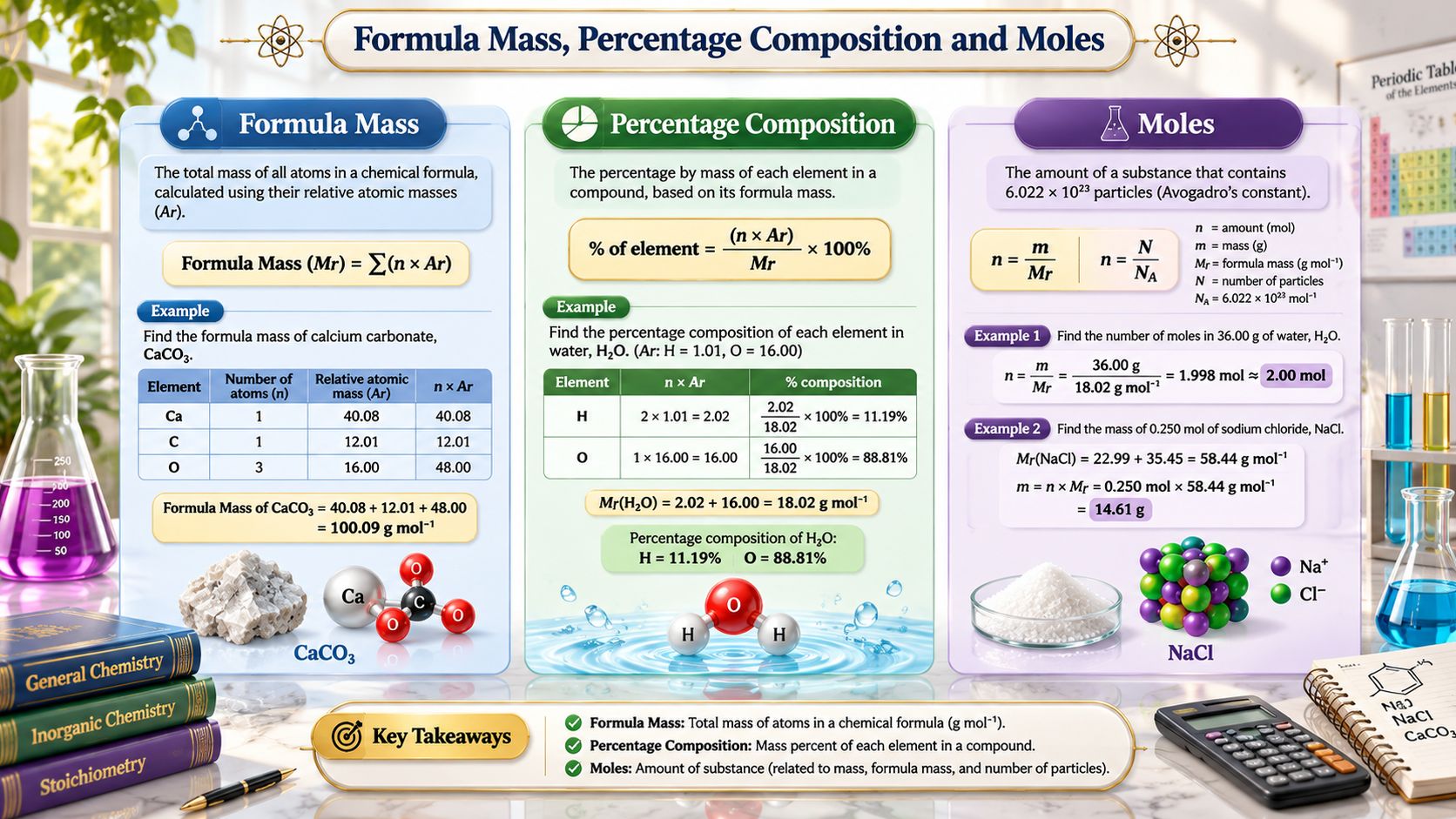
Start with a compound you've met a hundred times: calcium carbonate, CaCO₃. It's chalk, limestone, the fizz in an indigestion tablet. The atomic masses you need are printed on most exam papers: Ca 40, C 12, O 16.
Q1. Find the relative formula mass of CaCO₃.
- Calcium: 1 × 40 = 40
- Carbon: 1 × 12 = 12
- Oxygen: 3 × 16 = 48
- Mr = 40 + 12 + 48 = 100
Slip beside this line: writing 40 + 12 + 16 and stopping. The subscript 3 belongs to the oxygen only, and it multiplies that oxygen's mass. A second version of the same slip is multiplying the whole formula by 3.
Here's the whole idea in one picture, including where percentage composition and moles fit around it.
Q2. Find the percentage of oxygen by mass in CaCO₃.
Oxygen's share is 48 out of a total of 100, so (48 ÷ 100) × 100 = 48%. The denominator is always the Mr of the whole compound, never the mass of the element you're asking about.
Q3. Find the percentage of iron by mass in iron(III) oxide, Fe₂O₃.
Iron gives 2 × 56 = 112. Oxygen gives 3 × 16 = 48. Mr = 112 + 48 = 160. Then (112 ÷ 160) × 100 = 70%.
Slip beside this line: dividing 112 by 48 because those were the two numbers on the page. The percentage always divides by the total Mr, so the answer can never exceed 100%.
Q4. How many moles are in 10 g of sodium hydroxide, NaOH?
NaOH has Mr 40. Moles = mass ÷ Mr = 10 ÷ 40 = 0.25 mol. Notice the unit. Moles, not grams, not "0.25" on its own.
Q5. What is the mass of 0.5 mol of magnesium chloride, MgCl₂?
MgCl₂ has Mr 95, so mass = moles × Mr = 0.5 × 95 = 47.5 g. The slip here is dividing by Mr when the question hands you moles and asks for mass. Check the direction: are you going grams to moles, or moles to grams?
These three skills are a chain, and examiners test them in that order. The CCEA GCSE Science Double Award examiner report for the March 2024 series/2024/GCSE%20Science%20Double%20Award%20(2017)-March2024-Report.pdf) records that quantitative questions were generally well answered, with many candidates picking up credit for calculating formula mass and percentage composition. The marks that went missing sat in the linked steps afterwards: choosing the right denominator, scaling a ratio, and converting mass into amount of substance.
If the mass-to-moles conversion still feels like a rule you're reciting rather than a relationship you understand, MasteryMind's moles study guide works through why one mole of a substance in grams is numerically equal to its relative formula mass. Home educators planning this topic across a term often pair that explanation with Kuraplan's chemistry planning for home educators, which sequences the practical work alongside the calculations.
Teacher's rule: never move to the next line until the current line has a unit on it. Moles, grams, dm³, mol/dm³. A number without a unit is a guess wearing a suit.
Concentration and Gas Volume Questions
Concentration questions use one relationship, and it only works if the volume is in dm³. Concentration = moles ÷ volume in dm³. Read that again with the unit attached, because the unit is where the marks go.
Q1. 0.5 mol of solute is dissolved to make 250 cm³ of solution. Find the concentration.
Step one, on its own line: 250 cm³ ÷ 1000 = 0.25 dm³. Step two: 0.5 ÷ 0.25 = 2 mol/dm³.
Q2. How many moles are in 25 cm³ of 0.1 mol/dm³ hydrochloric acid?
25 cm³ ÷ 1000 = 0.025 dm³. Then moles = concentration × volume = 0.1 × 0.025 = 0.0025 mol.
Slip beside this line: substituting 25 straight in and getting 2.5 mol. That answer is a thousand times too big, which is the sort of clue that should make you stop and re-read your own working.
Q3. A solution holds 5 g of solute in 500 cm³. Find the concentration in g/dm³.
500 cm³ = 0.5 dm³, so 5 ÷ 0.5 = 10 g/dm³. Same relationship, different units on top. Read whether the question wants g/dm³ or mol/dm³ before you start.
Gas questions rest on one fact worth memorising: at room temperature and pressure, one mole of any gas occupies 24 dm³.
Q4. Find the volume of 0.5 mol of carbon dioxide at room temperature and pressure.
0.5 × 24 = 12 dm³.
Q5. How many moles are in 240 cm³ of gas?
240 cm³ = 0.24 dm³. Then 0.24 ÷ 24 = 0.01 mol.
The cm³ to dm³ step is the single most common lost mark in this whole topic, and it isn't only a GCSE problem. The WJEC GCE Chemistry examiner report for the Summer 2022 series describes candidates losing marks because they failed to scale a result correctly from 10 cm³ to 60 cm³, and because they miscalculated the number of moles of iron in a single tablet. Those students were two years past GCSE and making the same move.
Scaling is the underlying skill. If 10 cm³ contains a certain amount, 60 cm³ contains six times as much, and the ratio has to survive every line of the working. Write the conversion first, before any division, and the ratio stays visible.
Reacting Masses From Balanced Equations
Reacting masses is where the whole topic comes together, and it's worth one fixed routine every time, no improvising.
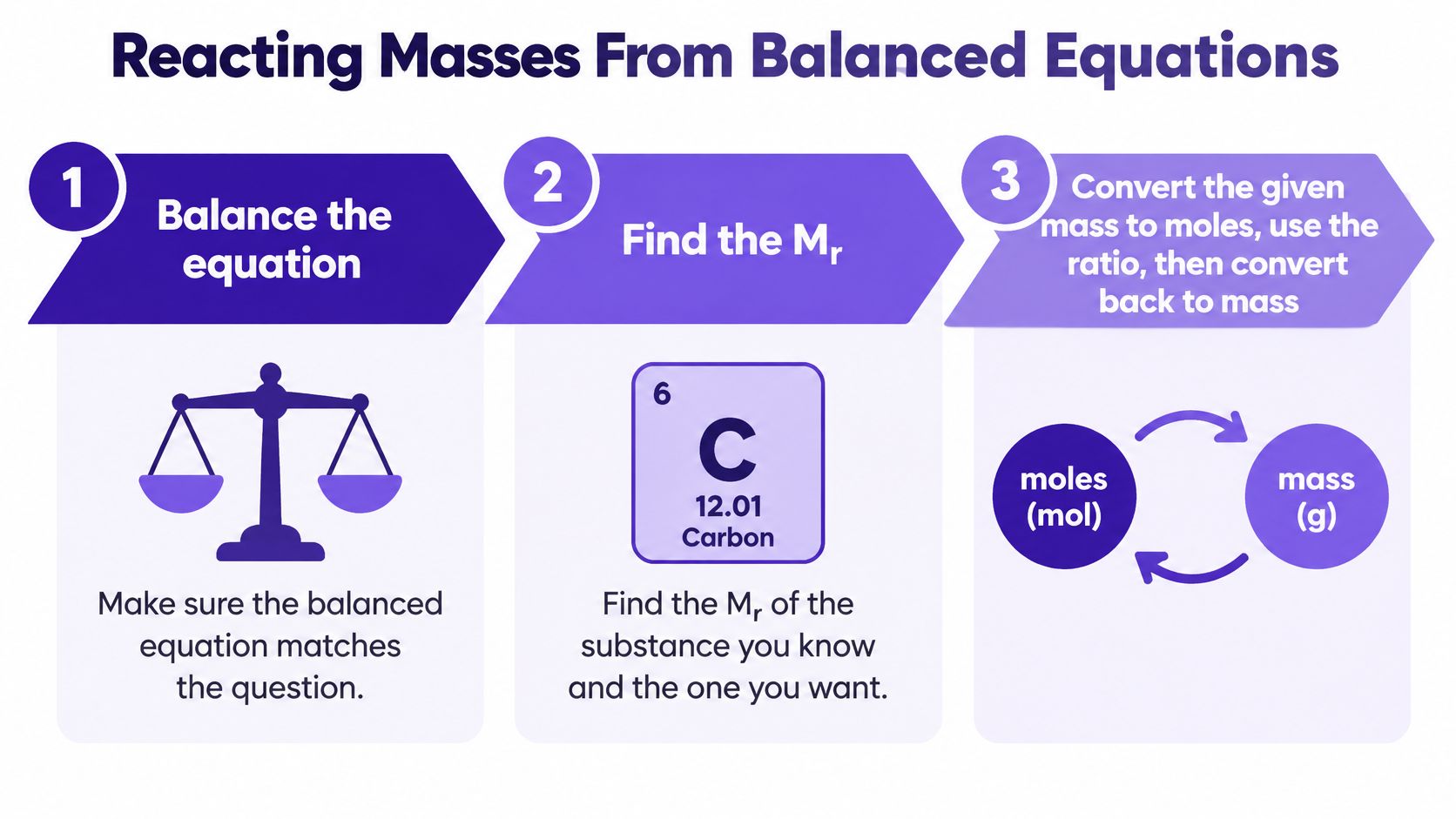
- Balance the equation. Nothing downstream works if this is wrong.
- Find the Mr of the substance you know and the substance you want.
- Convert the given mass into moles.
- Use the coefficient ratio to find the moles of the substance you want.
- Convert back to mass or volume, with units.
The AQA GCSE Chemistry 8462 specification treats these as one connected chain rather than separate arithmetic tricks. It expects students to apply conservation of mass when balancing equations, read the coefficients as mole ratios, calculate Mr, and use a balanced equation to work out reactant or product masses. It also expects rearrangement, substitution with correct units, and an estimate of the answer's size before you commit to it.
Here is the routine as a picture, then two questions run through it.
Worked example 1. 2Mg + O₂ → 2MgO. Find the mass of magnesium oxide formed from 4.8 g of magnesium.
Ar of Mg is 24, so moles of Mg = 4.8 ÷ 24 = 0.2 mol. The ratio is 2:2, which is 1:1, so 0.2 mol of MgO forms. MgO has Mr 40, so mass = 0.2 × 40 = 8.0 g.
Slip beside this line: using a 2:1 ratio because the equation shows 2Mg and 1O₂. The coefficients only compare the substances they sit in front of. Mg and MgO are both 2, so their ratio is 1:1.
There's a size check available for free. Magnesium gains oxygen here, so the product must weigh more than 4.8 g. An answer of 2.4 g is not a small slip, it's a signal that something upstream broke.
Worked example 2. CaCO₃ → CaO + CO₂. Find the volume of carbon dioxide from 10 g of calcium carbonate, at room temperature and pressure.
CaCO₃ has Mr 100, so moles = 10 ÷ 100 = 0.1 mol. The ratio is 1:1, so 0.1 mol of CO₂ forms. Volume = 0.1 × 24 = 2.4 dm³. In mass terms, CO₂ has Mr 44, so 0.1 × 44 = 4.4 g.
A balancing error doesn't stay on its own line. If you write CaCO₃ → CaO + CO₂ and then decide the ratio is 1:2, every later number doubles and the examiner can't award the final mark even though your arithmetic was clean. That's why the revision guide on conservation of mass is worth a look before you drill calculations: balancing underneath the working is what keeps everything else honest.
For a full-speed walkthrough of the same five steps, watch this.
Practical rule: the decomposition product always weighs less than what you started with, because a gas has left. Use that to catch a reversed calculation before the examiner does.
Tick these off on your own working before you hand it in:
- Balanced: the equation is balanced and the state symbols, if asked for, are there.
- Mr checked: you used the right Ar values and multiplied by the subscripts.
- Units converted: cm³ to dm³, or g to kg, done before substitution.
- Ratio used: the coefficients were read, not assumed to be 1:1.
- Rounded once: two or three significant figures, at the end.
Percentage Yield and Atom Economy Questions
These two look like siblings and get treated as one, but they answer completely different questions. Percentage yield is about what happened in the lab. Atom economy is about the chemistry itself, before anyone picks up a spatula.
| Measure | Question it answers | Formula |
|---|---|---|
| Percentage yield | How much product was actually collected | (actual mass ÷ theoretical mass) × 100 |
| Atom economy | How much of the reactant mass ends up as the desired product | (Mr of desired product ÷ total Mr of reactants) × 100 |
Percentage yield, worked. The theoretical yield of MgO from 4.8 g of magnesium is 8.0 g. If you collect 6.4 g in the lab, the yield is (6.4 ÷ 8.0) × 100 = 80%.
Atom economy, worked. Take CaCO₃ → CaO + CO₂ with calcium oxide as the product you want. CaO has Mr 56 and CaCO₃ has Mr 100, so the atom economy is (56 ÷ 100) × 100 = 56%.
Notice what each one ignored. The yield didn't care about carbon dioxide at all. The atom economy didn't care how much you collected, or whether the reaction ran to completion. Put the two side by side on the same equation and the difference becomes obvious: one is about your technique, the other is about the design of the reaction.
The check that catches most errors: a percentage yield above 100%, or an atom economy above 100%, always means the working is wrong. There is no experiment and no reaction where either is possible.
Why does atom economy get asked at all? Because a low figure means a large share of the reactant atoms leave as waste, and waste has to be separated, disposed of or sold. A process that turns most of its starting material into something unwanted costs more and uses more feedstock for the same product.
Percentage yield falls short of 100% for reasons you can name in an exam: the reaction is reversible, so some product turns back into reactant; the reaction doesn't go to completion; product is lost during filtering, transfer or evaporation; and some product stays behind on the glassware.
Here's one to try on paper before you scroll. The reaction is 2H₂ + O₂ → 2H₂O, and water is the desired product. Work out the total Mr of the reactants, then the Mr of the water produced, and take the percentage. You'll find the answer in the practice set below, but only after you've written your own two lines.
Heating to Constant Mass and Practical Data
A student heats a hydrated salt, weighs it, then heats and weighs it again. The mass is still falling. What should happen next, and which readings belong in the calculation? The method answers both questions.
- Weigh the empty crucible. Record the mass without rounding.
- Add the hydrated salt and weigh again. Subtract the crucible's mass to find the sample's mass.
- Heat the sample, let it cool, then weigh it. A hot crucible can give a false balance reading.
- Repeat the heating, cooling and weighing until two consecutive masses agree. The sample has reached constant mass.
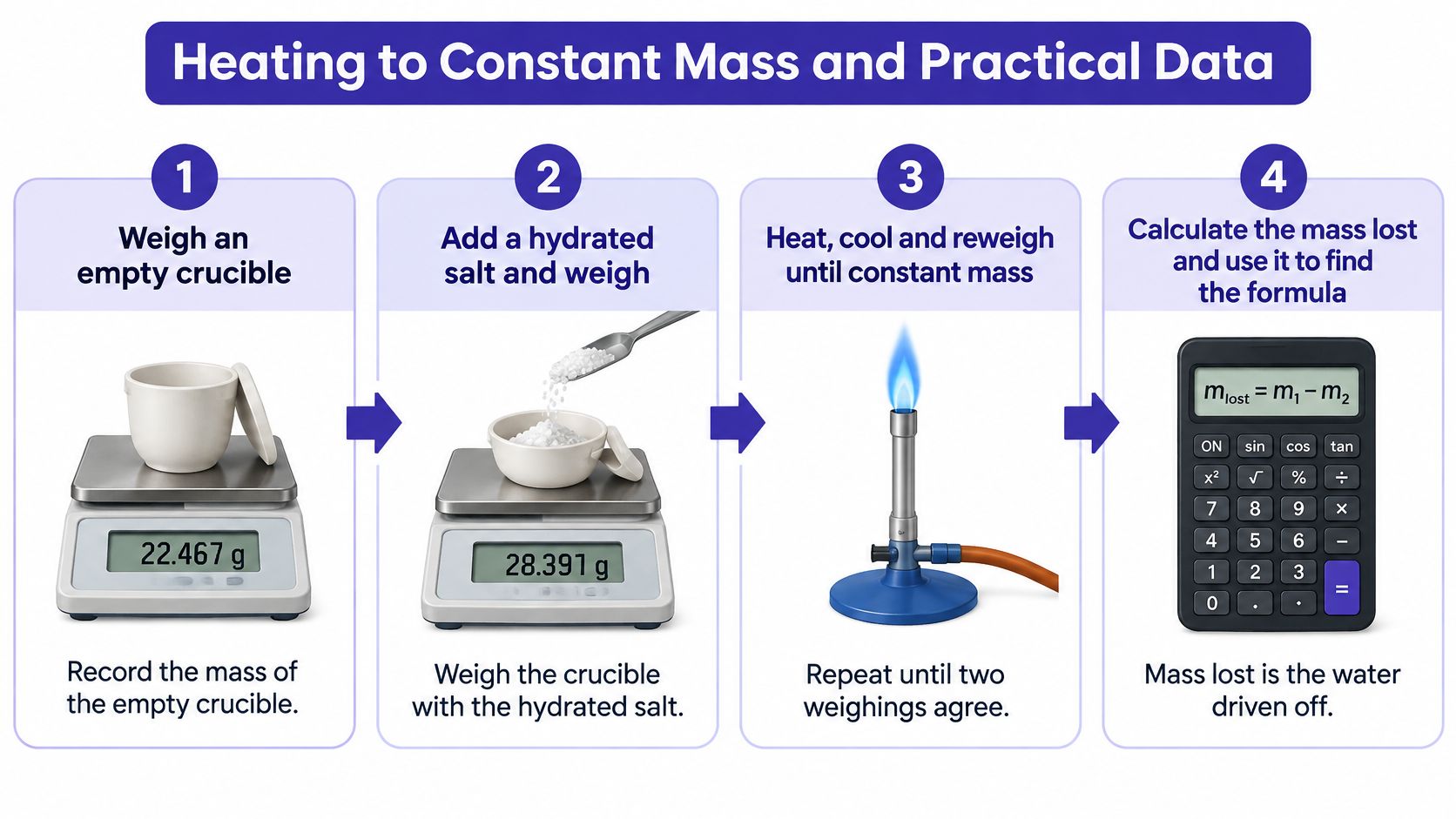
Worked example. An empty crucible weighs 20.00 g. The crucible and hydrated salt together weigh 22.00 g, so the salt's mass is 22.00 − 20.00 = 2.00 g. After repeated heating, the crucible and anhydrous salt weigh 21.27 g. The water lost is 22.00 − 21.27 = 0.73 g. The percentage lost is (0.73 ÷ 2.00) × 100 = 36.5%.
The key is choosing the correct readings. Subtract the final mass from the initial mass of the crucible and contents to find the water lost. Then divide by the original salt mass, not the mass of the crucible.
Repeated heating checks whether water is still escaping. If the mass continues to fall, the sample is not yet dry, so using that reading would underestimate the water lost.
AQA's June 2025 Foundation report describes weak understanding of heating to constant mass. Some students omitted mass from their answers, calculated in the wrong direction, or did not use the experimental method to support their reasoning (AQA June 2025 Foundation report.
A useful answer names both the step and its consequence: “Repeat heating until the mass is constant. If the mass is still decreasing, water remains in the sample, so the measured mass loss is incomplete.”
To revise AQA chemistry practical methods, practise linking each instruction to the measurement it protects. The same habit helps with questions on titration, electrolysis and temperature change.
Common Mistakes and How to Fix Them
A calculation can look tidy and still lose marks if one step uses the wrong unit or operation. Before moving on, check four things: have you converted the units, chosen the right operation, labelled what each result represents, and saved rounding for the final answer?
AQA's June 2025 Higher Chemistry report identifies unit conversion and misapplied operations among the common failures on multi-step calculations (AQA June 2025 Higher report). Treat each calculation like a chain: if one link is wrong, the final answer may look plausible but will not follow from the chemistry.
Labelling matters too. A bare answer such as “0.2” does not say what has been calculated. Writing “0.2 mol of MgO” makes the quantity and substance clear, so the examiner can follow your working.
| Symptom | Likely cause | Fix |
|---|---|---|
| Concentration far too big or too small | cm³ not converted to dm³ | Divide the volume in cm³ by 1000 to get dm³, then divide the amount in moles by that volume |
| Moles far too big | Mr multiplied by the mass instead of divided | Moles = mass ÷ Mr |
| Mass far too small | Moles divided by Mr instead of multiplied | Mass = moles × Mr |
| Reacting mass wrong despite a correct method | Equation not balanced, so the ratio is wrong | Balance the equation first, then use the coefficients |
| Right number, no mark | Intermediate value not labelled | Write what it represents, for example, moles of CO₂ |
| Percentage yield over 100% | Actual and theoretical masses swapped | Percentage yield = (actual ÷ theoretical) × 100 |
| Final answer off by a small amount | Rounding in the middle of the working | Keep full values during the calculation and round only at the end |
Try the Practice Set and Check Each Step
Six questions, mixed, no headings telling you which method to use. That's deliberate, because a real paper won't label them either. Write every step on paper, run the four-question self-check, and only then compare with the answers below.
- Find the Mr of aluminium oxide, Al₂O₃.
- Find the percentage of carbon by mass in carbon dioxide, CO₂.
- How many moles are in 36 g of water, H₂O?
- What is the concentration of a solution containing 2 mol of solute in 500 cm³?
- What is the mass of 0.25 mol of sodium chloride, NaCl?
- What is the atom economy of 2H₂ + O₂ → 2H₂O when water is the desired product?
Answers, with the working you should have written:
- Al 2 × 27 = 54, O 3 × 16 = 48, so Mr = 102.
- Carbon is 12 out of 44, so (12 ÷ 44) × 100 = 27.3%.
- Mr of H₂O is 18, so 36 ÷ 18 = 2 mol.
- 500 cm³ = 0.5 dm³, so 2 ÷ 0.5 = 4 mol/dm³.
- Mr of NaCl is 58.5, so 0.25 × 58.5 = 14.6 g.
- Reactants total 2 × 2 + 32 = 36, product total 2 × 18 = 36, so (36 ÷ 36) × 100 = 100%.
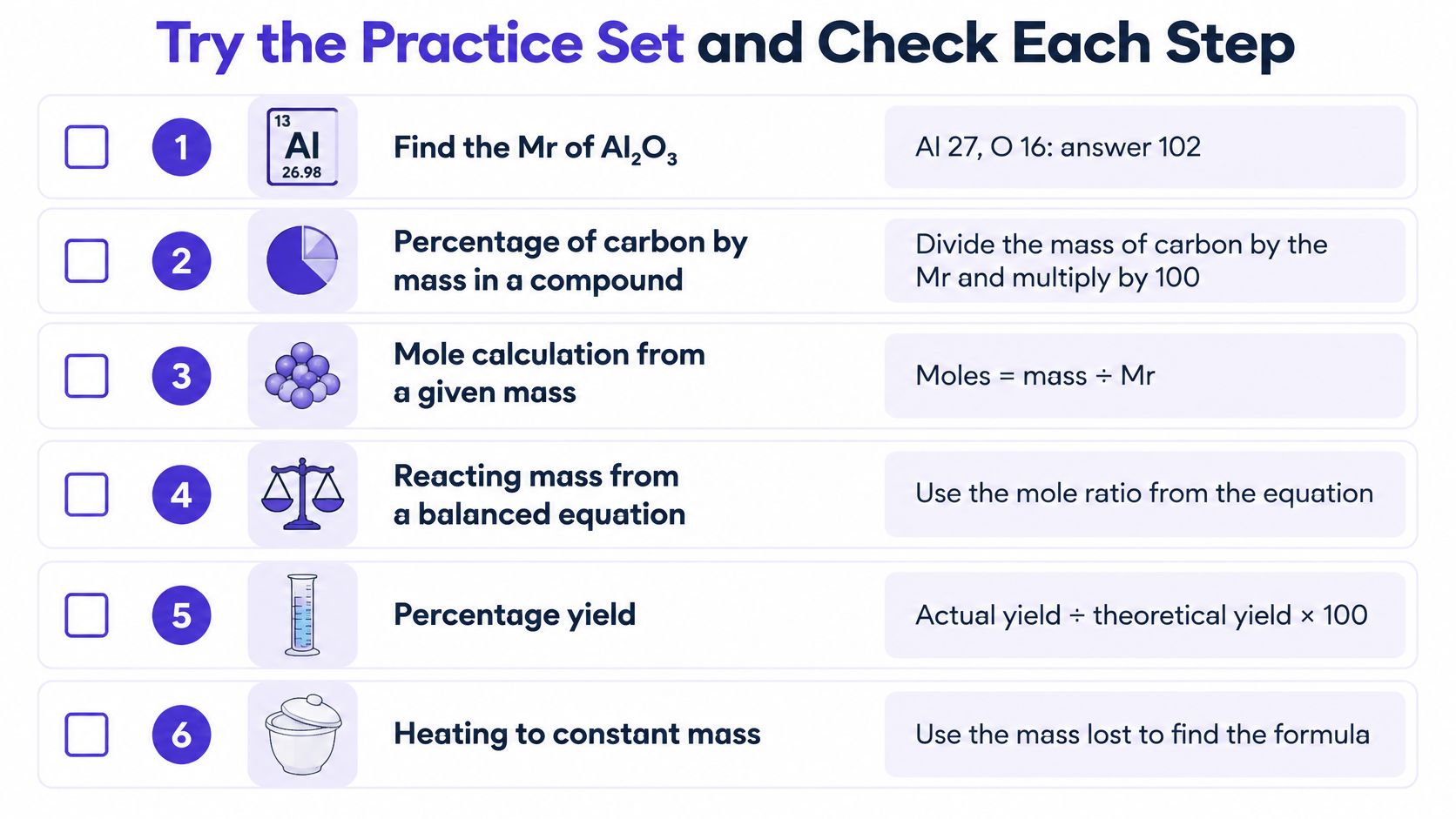
When an answer is wrong, find the first wrong line, not the last one. The last line is just where the mistake became visible. If you slipped on the cm³ conversion in question 4, that's a unit problem, not a concentration problem, and the fix is to practise conversions until they're automatic. If question 6 caught you out, revisit atom economy, because a 100% answer feels almost too neat and students often second-guess it into 50%.
Practice questions on MasteryMind are labelled foundation, standard or challenging, and each one comes with a hint, so you can start below your target level and climb rather than guessing at random. For timed, exam-condition practice with marking against the mark scheme, Exam Practice for GCSE is the closer match.
Whatever your scores, finish by writing down the question type you were weakest on. One shaky row in the table at the top of this page can cost marks in three or four separate questions on the same paper.
How These Questions Were Checked
Teachers reading this deserve to know where the questions and the error patterns came from, so here it is plainly.
The question types map onto the skills stated in the AQA GCSE Chemistry 8462 specification: balancing equations, reading coefficients as mole ratios, calculating Mr, using balanced equations for reacting masses, rearranging expressions and estimating the size of an answer. Each worked example is built to require those steps in order, which is why the sillier arithmetic errors get caught by the estimate check rather than the final mark.
The error patterns come from published examiner reports, not from guesswork. The June 2025 AQA Higher report supplied the unit-conversion and operation errors, along with the failure to label intermediate quantities. The June 2025 Foundation report supplied the practical-method findings behind the heating-to-constant-mass section. Both are cited where they're used, in the sections above.
The WJEC Summer 2022 GCE report is a post-16 document, deliberately chosen because it shows the same scaling mistake surviving into A-level, which is useful evidence that this isn't just an exam-day wobble. The CCEA March 2024 report confirms that formula mass and percentage composition are usually answered well, which is exactly why the practice here pushes towards the harder linked steps instead of drilling the easy ones.
Two honest limitations. The examples use the most common Ar values (Ca 40, C 12, O 16, Mg 24, Fe 56), and some papers print slightly different ones in their own data sheet, so use the values on the paper in front of you. Mark ranges also vary by board and tier, so a five-mark sequence on one paper can be a three-mark item on another.
If you've read this far, you've probably spotted the one question type that keeps catching you out, and MasteryMind is built to drill exactly that: exam-style GCSE quantitative chemistry questions aligned to AQA, Edexcel, OCR and WJEC, with instant feedback that checks your working line by line rather than just marking the final number. You get step-by-step verification on calculations, worked answers that name the slip, and hints you can call on when a question stalls you. Visit MasteryMind and start with the question type you trust least.
Choose your next course task
Use this idea with Chemistry. Confirm the qualification, awarding organisation and course version before choosing practice, assignment preparation or evidence planning.
Choose your Chemistry course