War and Conflict Poems: Your GCSE & A-Level Ace Guide
You've probably had this moment already. You open the anthology, see war and conflict poems piled together, and suddenly every poem seems to blur into mud, blood, memory, anger, and someone staring into the distance looking traumatised.
That's normal.
Most students don't struggle because they're “bad at poetry”. They struggle because they've been taught to revise poems as separate little islands. One quote for this poem. Three themes for that poem. A comparison list somewhere else. Then the exam asks a sharp question and the whole thing falls apart.
The fix is simpler than people think. Stop treating war and conflict poems as a memory test. Start treating them as a craft test. Examiners want to see that you can explain how a poet builds meaning through language, form, structure, and context. They also want to see that your comparison has a reason behind it, not just “both poems are about war”.
If you're trying to rescue a grade, that shift gives you control. If you're aiming high, it's also the move that gets you out of formula writing and into top-band analysis.
Your Guide to Nailing War and Conflict Poems
A lot of students revise war and conflict poems in the least helpful way possible. They make a giant grid, copy in themes, memorise two quotes per poem, and hope the exam question lands kindly. Sometimes that works for a basic response. It usually doesn't work for a strong one.
A better approach starts with one idea. Poems about conflict are arguments, not just descriptions. The poet isn't only showing you violence, fear, guilt, patriotism, grief, or power. They're shaping your response to those things. That's where the marks are.
What examiners actually reward
Top answers tend to do three things well:
- They make a clear argument about the poem, rather than listing techniques.
- They connect method to meaning, so form and structure matter as much as quote-spotting.
- They compare with purpose, showing why poets present conflict differently.
That means you need more than “the poet uses imagery”. You need something closer to this:
Conflict becomes more disturbing when the poet makes the speaker sound unstable, because the fractured voice suggests that war continues in the mind long after the event itself.
That kind of sentence gives you somewhere to go.
A better mental model
Think of each poem through four questions:
- What kind of conflict is this? Physical, psychological, ideological, social?
- How does the poet make it feel real? Language choices, voice, imagery, sound.
- How is the poem built? Repetition, shifts, circularity, contrast, order, disruption.
- Why might the poet present conflict this way? Historical moment, audience, attitude, purpose.
If you can answer those four questions, you can write a serious paragraph on almost any poem in the cluster.
Practical rule: Don't revise poems as isolated summaries. Revise them as patterns of choices.
Why These Poems Still Matter and How to Use That
Students often treat context as the bit you bolt on at the end. A date. A war. A quick sentence about the poet's background. That usually sounds forced because it is forced. In strong essays, context isn't decoration. It explains why the poem sounds the way it does.

The emotional force behind British war poetry makes more sense when you grasp the scale of loss. The First World War cost the lives of around 886,000 British and Irish military personnel, while the Second World War added about 383,000 UK military deaths, and this scale helped shape a tradition obsessed with trauma, disillusionment, remembrance, and the gap between patriotic language and battlefield reality, as outlined in Our World in Data's war and peace overview.
That matters because it changes your reading. Wilfred Owen doesn't only write sad war poems. He writes from within a literary and historical moment where the language of glory and honour had become highly suspect. If you understand that, your analysis sharpens.
Context should explain choices
Here's the mistake. A student writes, “Owen fought in WWI, so the poem is about war.” That adds almost nothing.
A stronger move sounds like this:
- The brutality of industrial warfare helps explain the poem's bitterness.
- The poet resists heroic language because the lived experience of war undermined old patriotic ideals.
- The poem's bleak tone reflects a culture struggling to process mass death and suffering.
Notice the difference. Context isn't floating in the paragraph. It's doing a job.
Why this still feels relevant
War and conflict poems don't stay alive in classrooms just because they're old or famous. They keep landing because they deal with pressure points that still feel current. Trauma. Memory. Public language versus private suffering. The distance between people who witness conflict directly and people who consume it from safety.
That's why modern poems often hit students hard. They don't just say war is violent. They ask what happens afterwards. What guilt does. What memory does. What the media does.
If you want a strong model for linking ideas rather than collecting random techniques, Analysing GCSE poems for Grade 9 is useful because it focuses on building interpretations that effectively hold together.
Context works best when it answers “why this method?” rather than “what year was this?”
The examiner's version of AO3
AO3 isn't a history quiz. Examiners don't need a mini lecture on every conflict. They need to see that you understand how a poem emerges from a particular set of pressures.
A quick comparison helps:
| Weak context use | Strong context use |
|---|---|
| “This poem was written after a war.” | “The poem's sceptical tone reflects a period when idealised views of war had become harder to sustain.” |
| “The poet is showing sadness.” | “The poet presents emotional damage as long-lasting, which makes conflict feel psychological rather than confined to the battlefield.” |
| “This was a difficult time.” | “The harsh presentation of suffering challenges any romantic version of war.” |
That's the shift. Context should power your interpretation, not sit beside it.
Unlocking the Code of Key Themes and Contexts
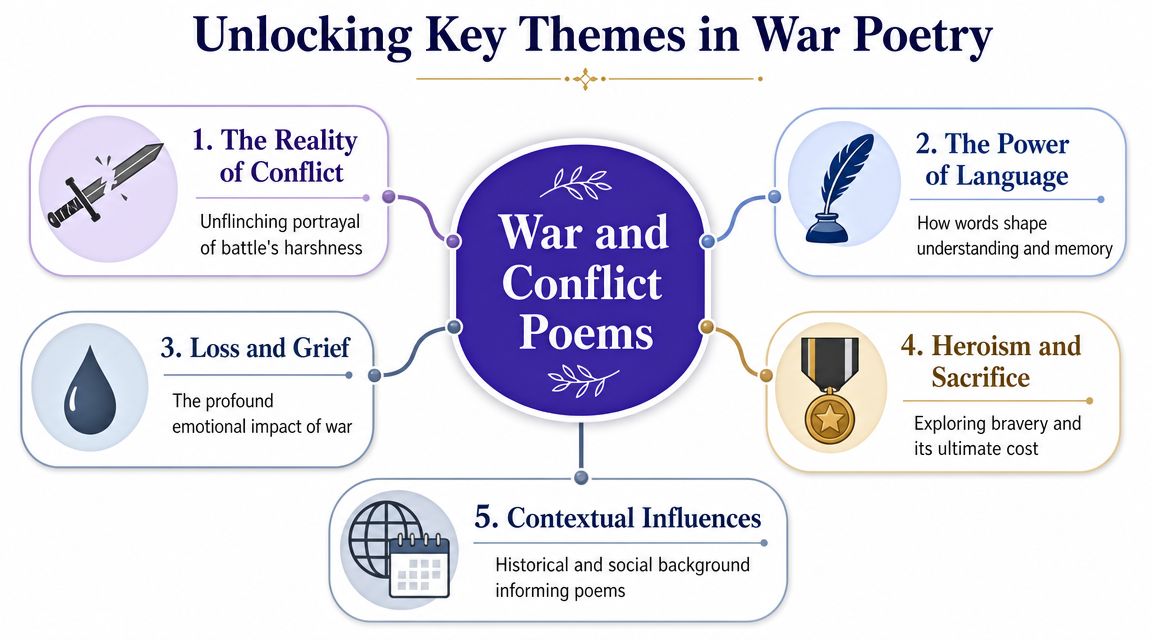
The fastest way to write a forgettable poetry essay is to use themes as labels. “This poem is about conflict.” “This poem is about loss.” “This poem is about power.” True, but thin.
Themes become useful when they act like questions. They help you dig into method and meaning instead of naming the obvious.
The reality of conflict
Don't stop at “war is bad”. Ask:
- What makes the conflict feel immediate or chaotic?
- Does the poem glorify violence, or strip it of glamour?
- How does the poet control pace to create panic, dread, or exhaustion?
A student writing on Bayonet Charge might say the soldier is frightened. Fine. A better answer would explore how violent verbs, instability, and abrupt movement throw the reader into confusion, making conflict feel bodily and immediate rather than noble.
Memory and aftermath
In such instances, many war and conflict poems become far more interesting. The conflict itself may be over, but the mind keeps replaying it.
Ask:
- Does the poem show memory as clear, fragmented, intrusive, or unreliable?
- Is the speaker trapped by the past, or trying to control it?
- How does the structure mimic flashback, repetition, or emotional return?
That line of thinking helps with poems where the conflict is internal. It also stops you writing as if war only matters on the battlefield.
A useful classroom reminder sits below. Watch it after you've tried your own thinking first, not before.
Identity, ideology, and wider conflict
This is the bit many students miss. Conflict poetry isn't only about soldiers, guns, and explosions. UK exam board guidance shows that high-level responses go beyond battlefield imagery into colonial legacy, civil war, identity, and post-war reconstruction, and that strong analysis links devices such as irony and juxtaposition to wider causes and consequences, as explained in OCR's guidance on conflict.
That means a poem can be about conflict even if nobody is charging across a field.
Consider the kinds of pressure a poem might explore:
Conflict within a self
Shame, guilt, divided identity, moral confusion.Conflict within a society
Oppression, inherited injustice, political violence, damaged communities.Conflict between public myth and private truth
Heroic language versus broken reality.
Good analysis often starts when you ask, “What kind of conflict is happening here apart from the obvious one?”
A theme toolkit that actually helps
Use this grid when planning a paragraph:
| Theme area | Better question | What to look for |
|---|---|---|
| Reality of conflict | How does the poem remove glamour? | Violent imagery, unstable rhythm, blunt diction |
| Lasting effects | How does conflict continue after the event? | Repetition, fragmented voice, intrusive memory |
| Power and control | Who controls the story? | Perspective, tone, irony, silences |
| Identity | How does conflict reshape the speaker? | Pronouns, shifts in voice, self-division |
| Public versus private | What's hidden beneath official language? | Contrast, understatement, tension between voices |
That's far more useful than memorising “themes” as headings in a notebook.
From Page to Paragraph Analysing a Single Poem
Let's get concrete. If you can analyse one poem well, you can transfer that skill to the rest. Exposure is a strong poem to practise on because it forces you to talk about structure, not just quotation.
The key insight is this. In Exposure, the suffering isn't presented as one dramatic clash. It's stretched out, delayed, and made repetitive. That's what gives the poem its power.
Start with structure, not just imagery
A high-value reading strategy is to track how the poem's structure embodies conflict. In Exposure, the cyclical repetition of “but nothing happens” creates a closed form that mirrors the psychological attrition of stalemate, as highlighted in The Dean Academy's knowledge organiser.
That sentence already contains a strong paragraph plan:
- repetition
- circular structure
- emotional effect
- link to the reality of war
A weaker student sees repetition and says it emphasises boredom. True, but incomplete. A stronger student asks why a poet would make a poem feel stuck.
Build the paragraph in layers
Try this sequence:
Make the claim
Owen presents war as a slow, grinding force rather than a scene of sudden heroism.Select the method
The recurring line “but nothing happens” creates circularity.Analyse the effect
That circularity traps both soldiers and readers in delay and helplessness.Interpret
The lack of movement becomes its own form of suffering.Link to context or purpose
This challenges any patriotic view of war as exciting or glorious.
Here's what that looks like in a paragraph:
Owen presents conflict as psychologically exhausting rather than dramatically heroic. The repeated refrain “but nothing happens” creates a cyclical structure, making the poem feel trapped in waiting. That closed pattern matters because the soldiers are not only threatened by battle, but worn down by inaction, cold, and uncertainty. Owen therefore turns stalemate into a form of violence, which helps explain the poem's rejection of romantic war narratives.
That's already much stronger than device-spotting.
Zoom in without losing the big point
Students often panic and either go too broad or too microscopic. The trick is to zoom in briefly, then come back out.
For example, if you comment on sound and silence, don't leave it at “sibilance is used”. Explain why that matters to the poem's experience of conflict. Sound can create menace, tension, or eerie suspension. Silence can become threatening.
Examiner move: Name the technique only if it helps your explanation. “Sibilance” alone gets you little. “The hissing sound makes the scene feel tense and hostile” gets you somewhere.
A paragraph frame that doesn't sound robotic
You don't need PEEL written on your forehead. But you do need shape. Use this instead:
| Part | What it does |
|---|---|
| Argument sentence | Says what the poet is doing |
| Evidence | Gives a precise word, phrase, or structural feature |
| Analysis | Explains how that choice creates meaning |
| Zoom out | Connects to purpose, theme, or context |
If you want to practise that paragraph shape across different texts, A-Level English Lit revision guide is handy for training the same analytical habits at a more advanced level.
The Art of Comparison Connecting Poems Smartly
Comparison is where a lot of essays drop marks. Students often write one chunky paragraph on Poem A, then another chunky paragraph on Poem B, and add “similarly” in the middle as if that counts.
It doesn't.
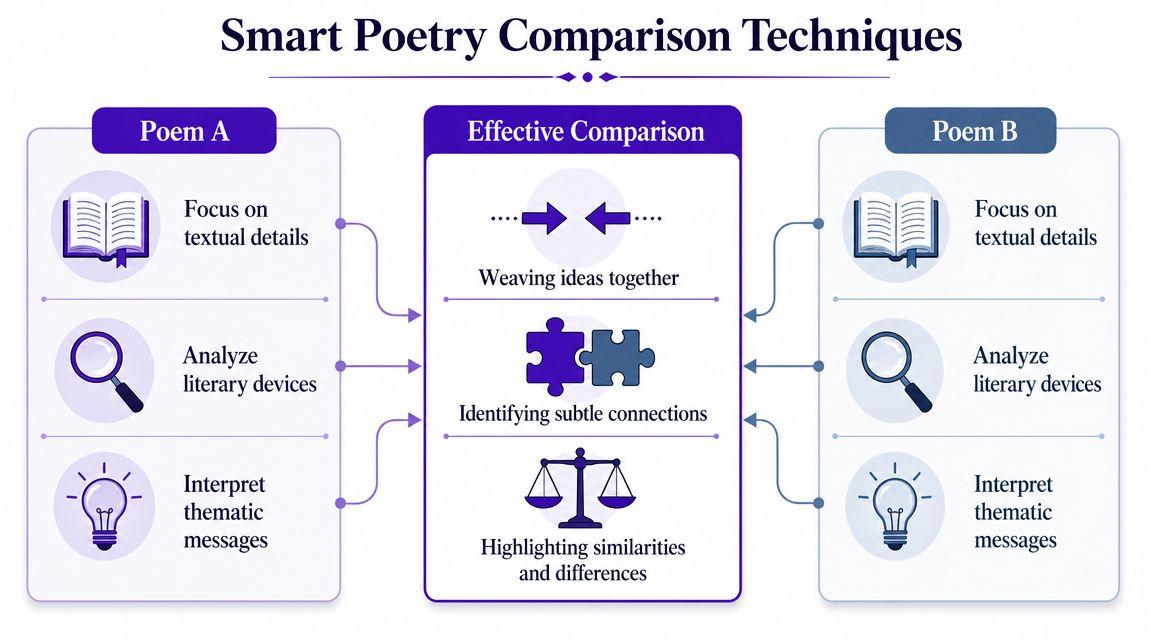
Strong comparison is woven, not bolted together. The poems should be in conversation with each other from the start.
Start with a meaningful basis for comparison
Don't begin with “both poems show conflict”. That's usually too broad to be useful. Start with a more exact idea.
For example:
- both poems present trauma as lasting beyond the event
- both poems explore distance from violence, but from different perspectives
- both poets question how conflict is represented
- both poems show attempts to control chaos
That instantly gives your essay more shape.
A smart comparison with Remains and War Photographer
These two poems can be compared through aftermath, but the best responses notice that they handle trauma differently.
One speaker sounds conversational and unstable. The other poem is more controlled on the surface. That contrast matters. One poem feels like a mind leaking distress. The other shows a professional trying to impose order on horror.
Here's the sort of comparison line that works well:
While both poems explore the lingering effects of conflict, Remains makes trauma sound immediate and invasive through a voice that feels difficult to contain, whereas War Photographer presents an attempt to organise suffering through ordered form, suggesting a tension between control and emotional damage.
That sentence compares:
- theme
- method
- effect
- interpretation
That's why it works.
Compare purpose and audience, not just techniques
GCSE English assessment is becoming more knowledge-rich, with greater emphasis on understanding why poems differ in purpose and audience across periods rather than solely identifying devices. That means students need to explain shifts in attitudes to war, such as the contrast between patriotic Victorian writing and First World War disillusionment, as discussed in this GCSE poetry revision guide.
So when you compare, ask:
- Are these poets trying to do the same thing?
- Do they trust the language of heroism, or challenge it?
- Does one poem speak from experience while another reflects from a distance?
- Would their original audiences respond differently?
Those questions take comparison beyond surface links.
A simple method for integrated comparison
Use this pattern:
Shared idea
Name the common issue.Poem A method and effect
Show how one poet presents it.Poem B method and effect
Compare directly.Why the difference matters
Link to attitude, purpose, or context.
Example:
Both poets explore how conflict continues after the moment of violence, but they shape that aftermath differently. In Remains, the speaker's unsettled voice suggests that memory keeps breaking back into the present. In contrast, War Photographer uses tighter organisation, which can suggest an effort to contain scenes of suffering within a professional routine. The contrast matters because one poem exposes raw personal disturbance, while the other questions whether order, art, or media can ever fully manage the reality of war.
That's the sort of paragraph that sounds thoughtful because it is thoughtful.
Compare verbs as well as themes. If one poem “bursts”, “breaks”, or “spills” while another “arranges”, “frames”, or “orders”, you're already seeing a meaningful contrast in method.
Writing the Grade 9 Answer with Sample Paragraphs
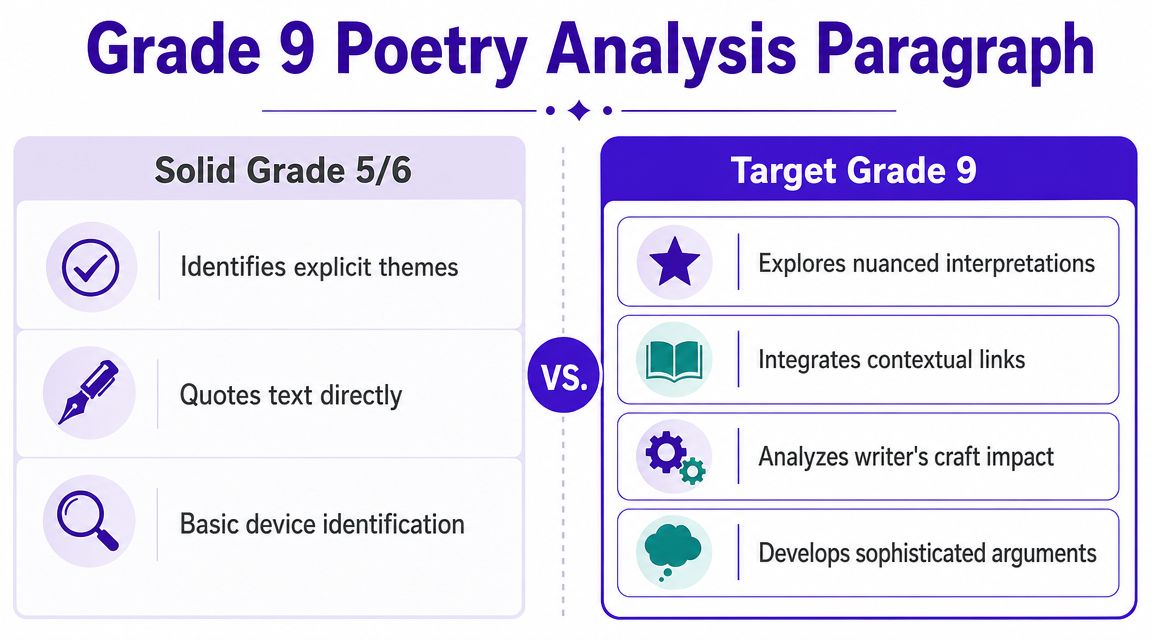
A Grade 5 or 6 response often knows the poem. A Grade 9 response knows what to do with the poem.
That difference usually isn't about longer quotations or fancier words. It's about precision, depth, and control.
A solid paragraph
Here's a decent mid-level paragraph on trauma:
In Remains, Armitage shows that conflict has lasting effects on the soldier. The speaker remembers the shooting and cannot move on from it. This shows that war causes guilt and suffering. The repeated memories make it clear that the soldier is haunted by what happened.
Nothing here is wrong. But it's broad. The ideas aren't pushed far enough, and the method is barely explored.
The upgraded version
Now look at the same core idea handled more sharply:
Armitage presents trauma as something that keeps invading ordinary life, rather than staying fixed in the past. The speaker's voice sounds conversational, but that apparent informality makes the return of violent memory more disturbing because it erupts into an everyday register. Instead of presenting conflict as finished when the event ends, the poem suggests that moral damage continues internally, which turns the real battlefield into the speaker's mind. Read this way, the poem is not just about a soldier remembering war, but about the difficulty of living with an act that cannot be mentally undone.
That second paragraph does more. It:
- focuses on how the voice works
- interprets the effect of that choice
- moves from theme to method
- pushes toward a conceptual reading
What lifts a paragraph into top-band territory
Use this checklist when editing your own writing:
- Have I explained why this technique matters?
- Have I linked the writer's choice to a bigger idea?
- Have I avoided empty phrases like “this makes the reader want to read on”?
- Have I considered a more subtle interpretation?
- Have I shown what kind of conflict is really being explored?
A useful distinction is below.
| Mid-level habit | Higher-level habit |
|---|---|
| Spots a technique | Explains why that method suits the poem's purpose |
| Gives one clear meaning | Allows for complexity or tension |
| Adds context separately | Integrates context into interpretation |
| Compares theme only | Compares methods, effects, and attitudes |
Bringing in modern relevance without forcing it
One strong way to deepen evaluation is to connect some poems to present-day concerns. To achieve a top grade, students can link poems like Remains and Poppies to modern discussions of trauma, moral injury, and the continuing resonance of PTSD and emotional strain in the UK, as noted in this discussion of poetry and contemporary relevance.
That doesn't mean turning your essay into a social affairs piece. It means making a careful evaluative point such as:
The poem still resonates because it presents trauma as psychologically intrusive and morally complicated, not as a neat lesson from the past.
That sort of comment shows maturity. It suggests you understand literature as alive, not sealed in a museum case.
How to practise writing this way
Don't just reread notes. Write short paragraphs and improve them.
Try this routine:
- choose one quote or structural feature
- write a basic paragraph in four sentences
- rewrite it with one stronger interpretation
- add one purposeful contextual link
- cut any sentence that only labels a technique
If you want a place to test responses under pressure, A-Level Past papers can help you practise planning and writing against real exam-style demands. MasteryMind is one revision option that also gives curriculum-aligned practice and feedback across UK exam boards, which is useful when you want to move from remembering notes to producing timed analysis.
Upgrade test: If your paragraph would still make sense after removing the poem's name, it's probably too generic.
Your Turn Practice Prompts and Final Tips
The best revision for war and conflict poems is active. Plan. Write. Compare. Redraft. Don't wait until you “feel ready”. Readiness usually arrives halfway through practice, not before it.
Try these prompts:
- Compare how poets present the reality of conflict in Bayonet Charge and one other poem from the anthology.
- Compare how poets present the effects of conflict on individuals in Remains and one other poem.
- Explore how poets present anger in London and one other poem from the Power and Conflict cluster.
Keep three rules in your head when you answer:
- Link method to meaning
- Use context to explain choices
- Compare by weaving poems together, not separating them
If you want timed, exam-style practice, use Exam Practice for GCSE and focus on writing fewer, better paragraphs rather than pages of vague commentary.
MasteryMind is an AI-powered revision platform for UK learners studying GCSEs and A-Levels. If you're revising English Literature, it can help you practise exam-style questions, work with past papers, and get structured feedback tied to the assessment objectives, which is especially useful for topics like war and conflict poems where technique, comparison, and interpretation all need to work together.
Ready to master this topic?
Practise with quizzes, blurt exercises and exam questions on MasteryMind.
7 days Premium · Then free forever · No card, no charge