Pearson Edexcel · A-Level · Art and Design
Developing students' knowledge, skills and understanding in art and design
Drawing is the foundational skill of GCSE Art and Design, serving as your primary tool for visual thinking, recording observations, and exploring ideas. This guide covers the essential techniques, assessment objectives, and practical strategies needed to maximize your marks across all portfolio and exam components.
- 7 min read
- 3 worked examples
- 4 practice questions
- 6 key terms
Study Notes
Overview
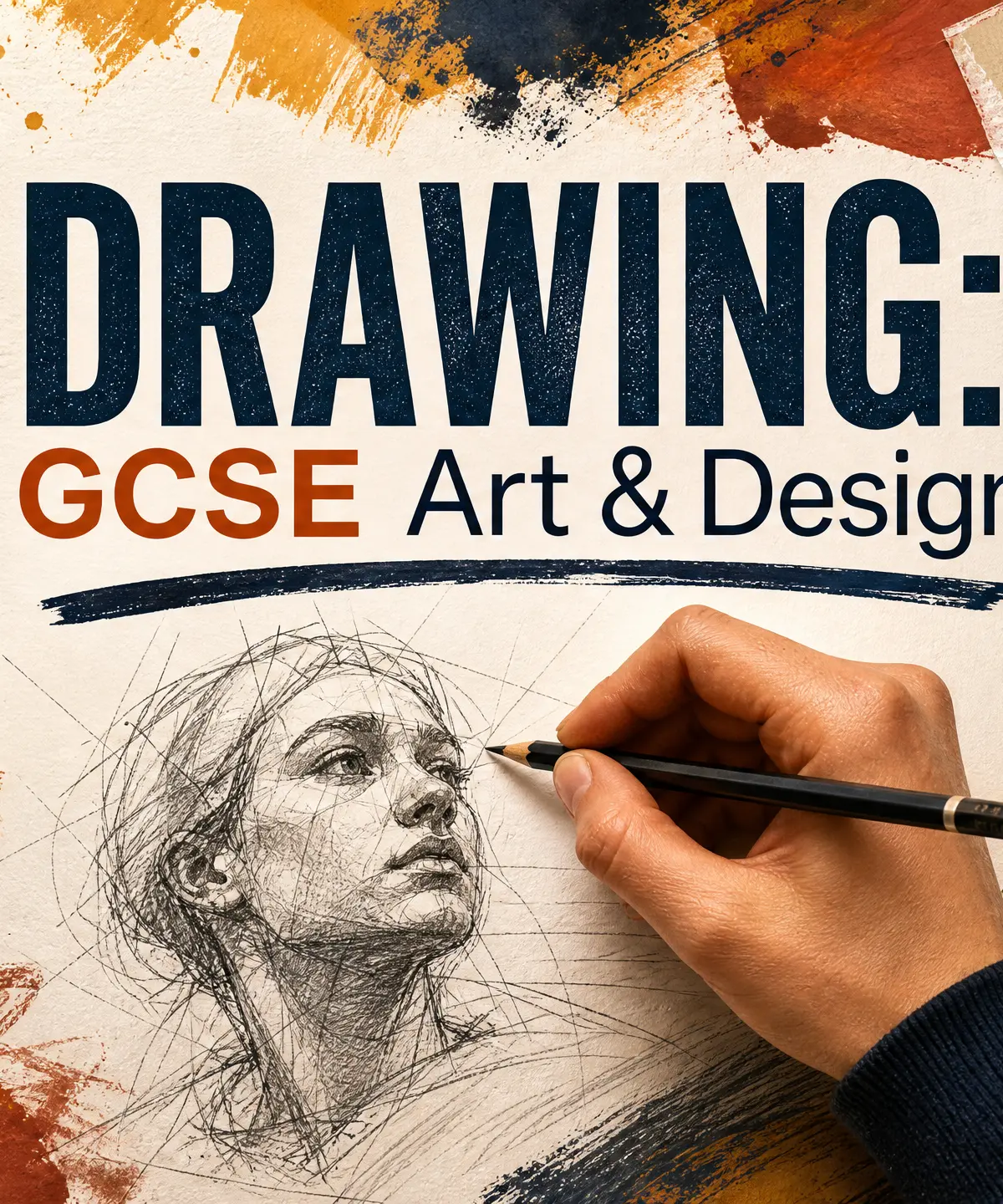
Drawing is defined as an essential skill for art and design practice, serving as a core element for artists, craftspeople, and designers. It encompasses recording the observed world, exploring ideas visually through mark-making, investigating new ways to express feelings or observations, and experimenting with various tools, materials, and techniques in two, three, or time-based dimensions. In the context of your GCSE, drawing is not just about producing a final, polished illustration; it is the engine that drives your entire creative process.
Key Knowledge & Theory
Core Concepts
To succeed in GCSE Art and Design, you must understand drawing not merely as an action, but as a multi-purpose tool that satisfies specific Assessment Objectives (AOs):
- Recording the Observed World (AO3): This involves looking closely at your subject matter—whether a still life, a figure, or an environment—and translating what you see onto paper. It requires an understanding of proportion, perspective, and the play of light and shadow.
- Exploring Ideas Visually (AO1 & AO2): Drawing is a way of thinking. Thumbnail sketches, compositional plans, and rapid gestural marks allow you to test out concepts before committing to a final piece.
- Expressing Feelings and Observations (AO4): Mark-making can be inherently emotional. The quality of your line—whether jagged and aggressive or smooth and flowing—communicates your personal response to the subject.
- Experimentation (AO2): Examiners look for evidence that you have pushed the boundaries of your media. This means trying out unconventional tools, mixing wet and dry media, and drawing on different surfaces.
Key Practitioners/Artists
Studying how established artists use drawing will elevate your own practice. Here are key figures to reference in your annotations:
| Name | Period/Style | Key Works | Relevance |
|---|---|---|---|
| Leonardo da Vinci | High Renaissance | Anatomical studies, Vitruvian Man | Demonstrates drawing as a tool for intense observation, scientific inquiry, and understanding form. |
| Käthe Kollwitz | Expressionism | Charcoal self-portraits, The Weavers | Shows how bold, aggressive mark-making and stark tonal contrast can convey deep emotion and suffering. |
| Egon Schiele | Early 20th Century Expressionism | Figure drawings in pencil and gouache | Exemplifies the use of continuous, expressive, and sometimes distorted line to create psychological tension. |
| Bridget Riley | Op Art | Preparatory geometric sketches | Illustrates drawing as a meticulous planning and design tool for complex compositions. |
Technical Vocabulary
To access the higher mark bands, you must use subject-specific terminology in your portfolio annotations:
- Formal Elements: The basic building blocks of art: line, tone, texture, colour, shape, form, pattern, and space.
- Mark-making: The different lines, dots, marks, patterns, and textures created in an artwork.
- Chiaroscuro: The use of strong contrasts between light and dark to achieve a sense of volume in modelling three-dimensional objects and figures.
- Cross-hatching: The use of overlapping parallel lines to create tone and texture.
- Gestural Drawing: A loose, energetic style of drawing that captures the movement, feeling, and overall essence of a subject rather than its fine details.
- Negative Space: The empty space around and between the subject(s) of an image.
Practical Skills
Techniques & Processes
Mastering a variety of drawing techniques is crucial for AO2 (Explore and Select).
- Continuous Line Drawing: Keep your pen or pencil on the paper for the entire drawing. This forces you to look closely at the subject and improves hand-eye coordination.
- Blind Contour Drawing: Draw the outline of your subject without looking at your paper. This builds your observational skills and prevents you from drawing what you think is there.
- Tonal Modelling: Use hatching, cross-hatching, stippling, or blending to build up a range of values from the brightest highlight to the darkest shadow. Always establish your light source first.
- Sgraffito/Sgraffiato: Apply a layer of dark media (like oil pastel or wax crayon) over a lighter layer, then scratch through the top layer to reveal the colour beneath.
Materials & Equipment
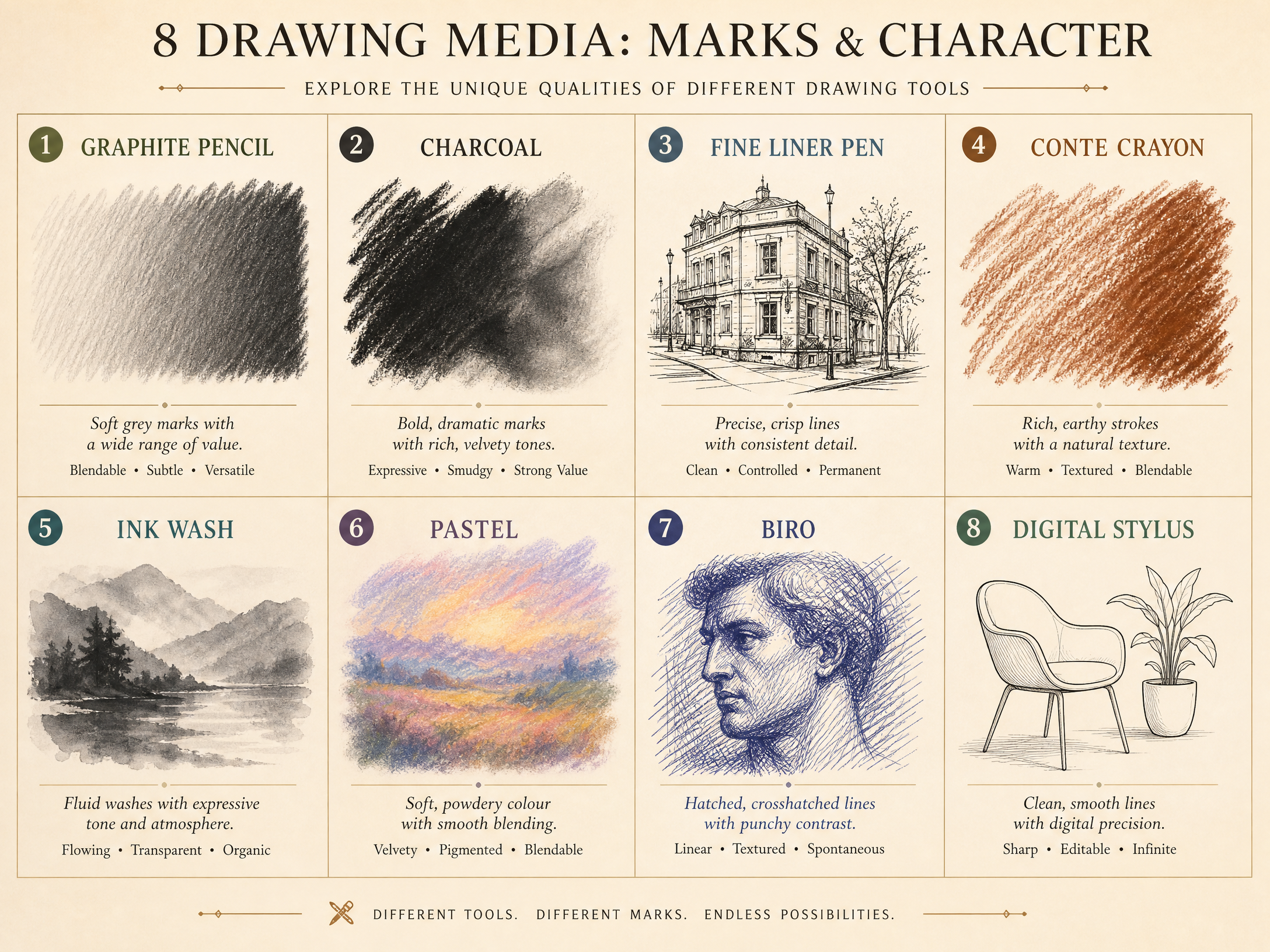
Your sketchbook should demonstrate proficiency with multiple media:
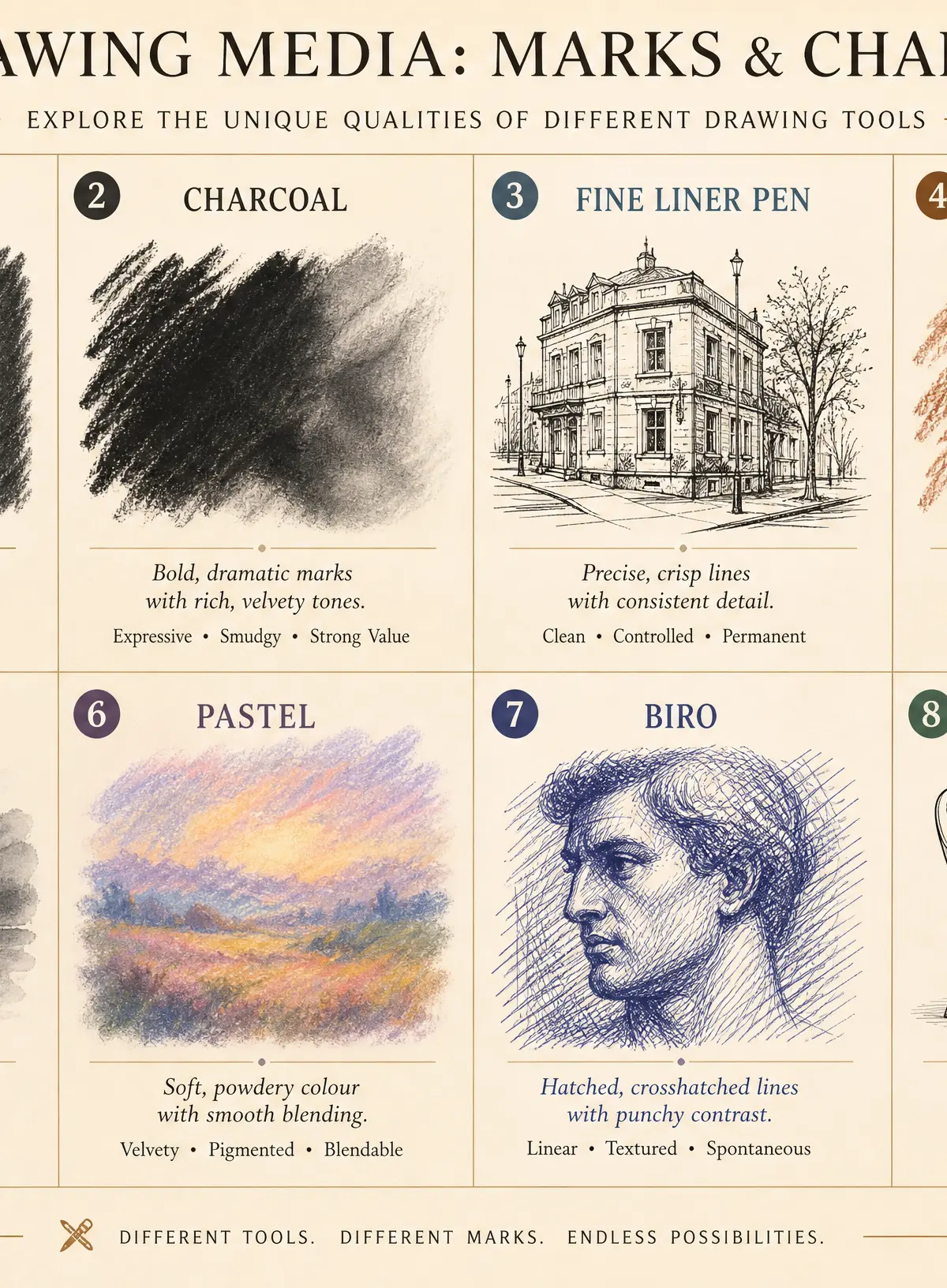
- Graphite (Pencil): Ranging from hard (H) for precise lines to soft (B) for dark, smudgy tones. Highly versatile and erasable.
- Charcoal: Available in willow (soft, easily blended) and compressed (darker, harder to erase). Excellent for large-scale, expressive tonal work.
- Ink and Wash: Applied with a dip pen, brush, or stick. Offers high contrast and fluidity. Great for atmospheric studies.
- Fine Liner / Biro: Permanent ink requires confident mark-making. Excellent for cross-hatching and detailed architectural or botanical studies.
- Pastels (Chalk and Oil): Allow for the integration of colour into drawing. Chalk pastels are easily blended; oil pastels are rich and resist water.
Portfolio/Coursework Guidance
Assessment Criteria
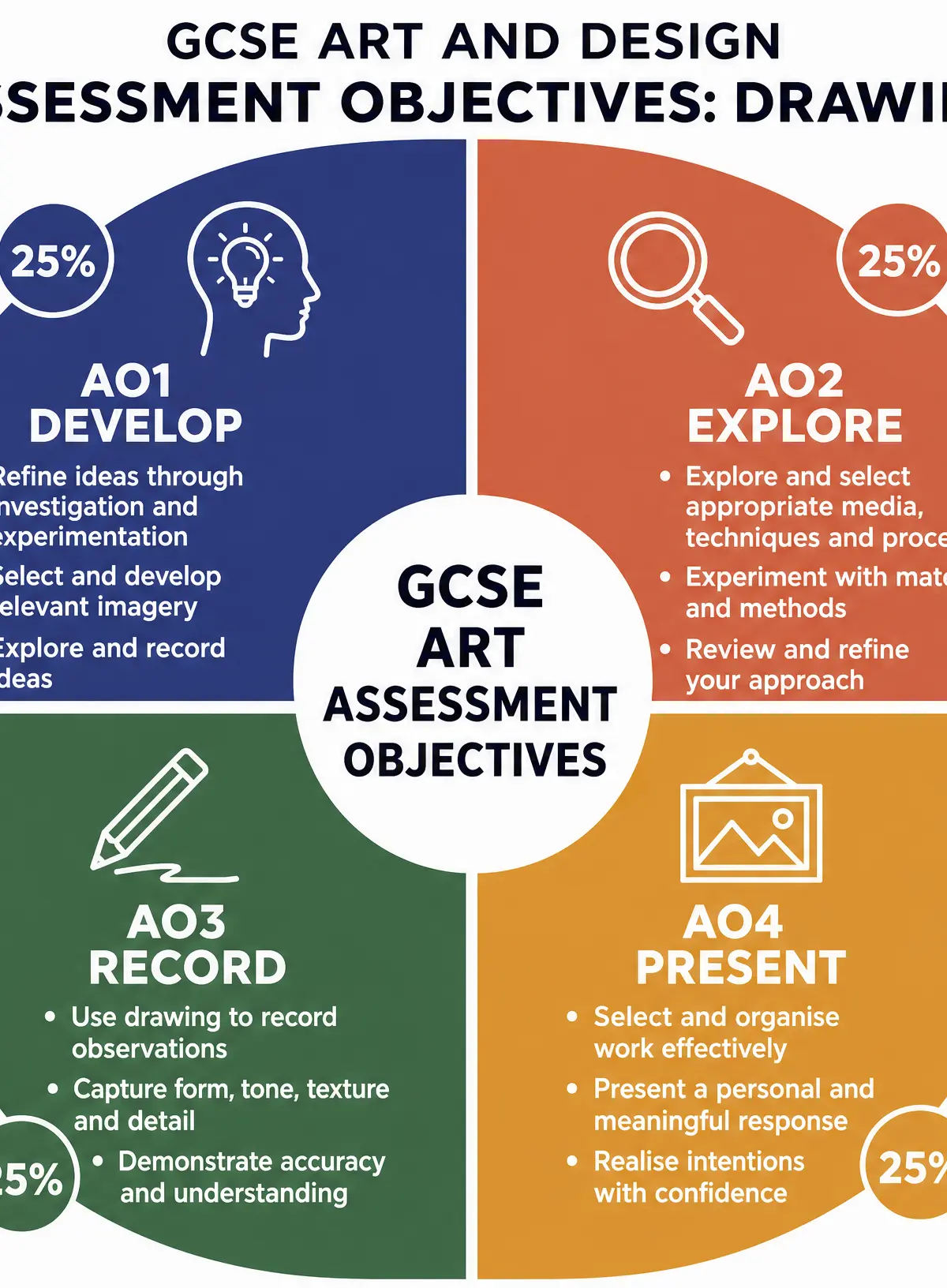
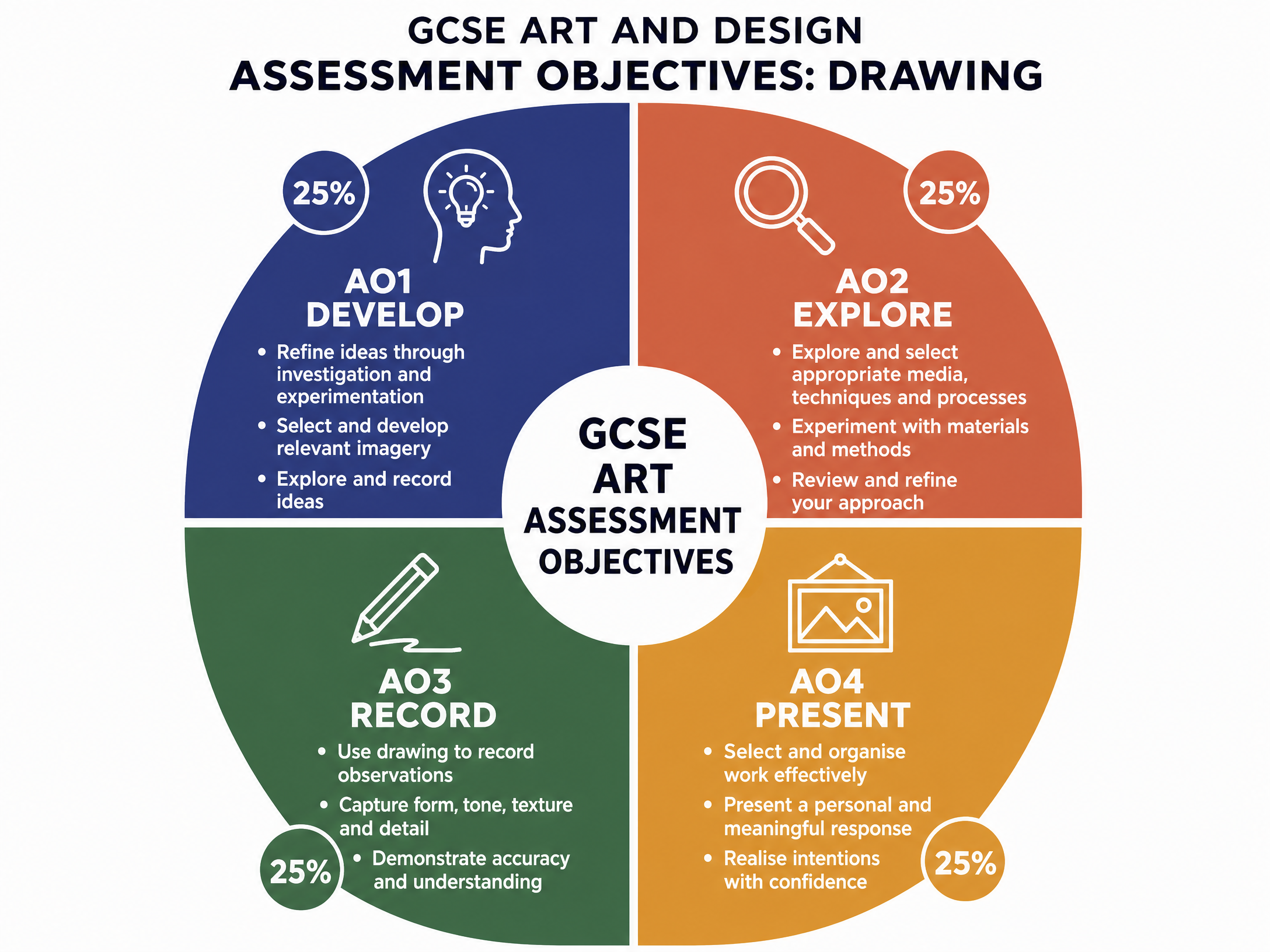
Examiners assess your portfolio across four equally weighted Assessment Objectives (25% each):
- AO1: Develop ideas through investigations, demonstrating critical understanding of sources.
- AO2: Refine work by exploring ideas, selecting and experimenting with appropriate media, materials, techniques, and processes.
- AO3: Record ideas, observations, and insights relevant to intentions as work progresses.
- AO4: Present a personal and meaningful response that realises intentions and demonstrates understanding of visual language.
Building a Strong Portfolio
To build a high-scoring portfolio, your sketchbook must be a visual diary of your thinking process:
- Show the Journey: Don't just present finished pieces. Include your initial thumbnails, your failed experiments, and your tests of different media.
- Annotate Analytically: Do not write "I drew a skull in pencil." Write: "I used a 4B graphite pencil to build deep tonal contrast in the eye sockets, aiming to emphasize the dramatic lighting and capture a sense of decay, inspired by the vanitas still lifes of Pieter Claesz."
- Draw from Life: Relying solely on secondary sources (internet photos) limits your marks for AO3. Set up your own still life, take your own reference photos, and draw directly from observation.
Exam Component
Written Exam Knowledge
While GCSE Art is primarily practical, your annotations and any required written evaluations must demonstrate theoretical understanding. You must be able to analyse artworks using the formal elements and explain how a practitioner's techniques have influenced your own practical decisions.
Practical Exam Preparation
For the Externally Set Assignment (the timed practical exam):
- Plan Meticulously: Use drawing to plan your final composition thoroughly before the timed period begins. Create multiple compositional thumbnails.
- Test Your Media: Know exactly how your chosen materials will behave on your final surface. Do not try a new technique for the first time during the exam.
- Time Management: Allocate your time based on the complexity of your planned piece. Ensure you have practiced producing work of that scale within the given timeframe.
Listen to the Podcast
For a deep dive into these concepts, exam tips, and a quick-fire recall quiz, listen to our revision podcast:

Interactive Diagrams
1 interactive diagram to visualise key concepts
Conceptual Flow Outline
The Iterative Drawing Process across Assessment Objectives
Worked Examples
3 worked examples — open one to explore the question and available guidance.
Practice Questions
Test your understanding — click to reveal model answers
Look at a complex object (like a crumpled piece of paper or a crushed can). Produce a 10-minute continuous line drawing of the object.
Hint: Do not take your pen off the paper. Focus entirely on the edges and contours of the object, not the shading.
Select one of your observational drawings. Write a short annotation (approx. 50 words) explaining how you used tone to create a sense of form.
Hint: Use formal elements vocabulary. Explain the specific technique you used (e.g., cross-hatching, blending) and where the light source is.
Analyse how Egon Schiele uses line to communicate emotion in his self-portraits.
Hint: Think about the quality of the line (is it smooth or jagged? thick or thin?) and how that physical mark relates to a psychological feeling.
Explain how you would plan a final composition for the theme 'Mechanisms', detailing how drawing would be used at each stage.
Hint: Structure your answer chronologically. Show how drawing fulfills AO1, AO2, AO3, and AO4 throughout the process.