Pearson Edexcel · A-Level · Art and Design
Knowledge, skills and understanding — Content for both components
This comprehensive guide explores Drawing as a core skill in GCSE Art and Design, moving beyond pencil sketches to encompass a wide range of media and techniques. It covers the four key functions of drawing—observation, exploration, investigation, and communication—and provides practical advice on how to use drawing to maximize your marks across all Assessment Objectives.
- 6 min read
- 3 worked examples
- 4 practice questions
- 6 key terms
Study Notes
Overview
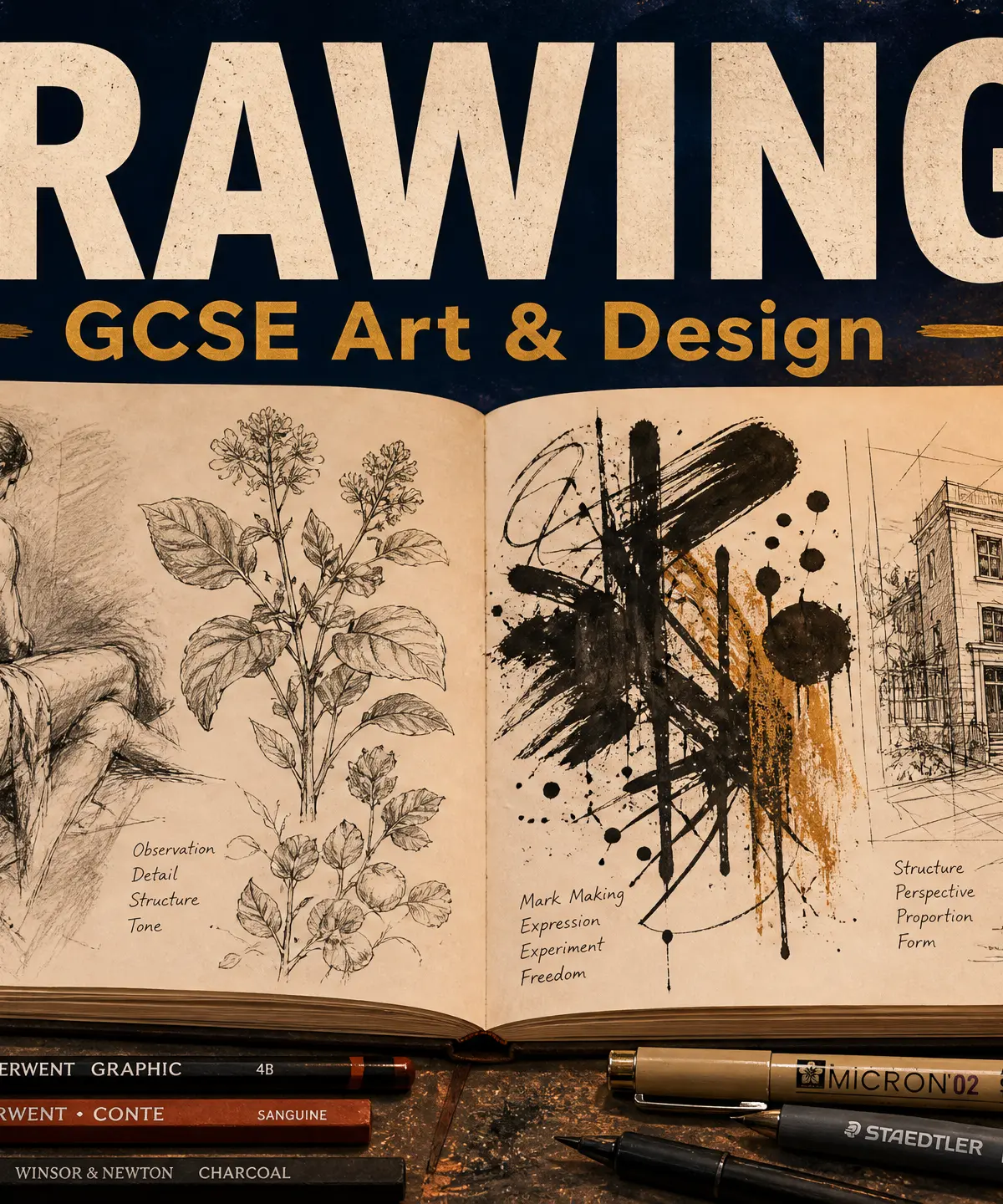
Drawing is the foundational skill at the heart of GCSE Art and Design. It is far more than just creating a realistic pencil sketch; it is a vital visual language used to record the world, explore new ideas, investigate materials, and communicate your creative intentions. The specification explicitly defines drawing as an essential skill for artists, craftspeople, and designers. Examiners are looking for sustained evidence of drawing throughout your entire portfolio, from initial research to final outcome, across two dimensions, three dimensions, and even time-based media.
Key Knowledge & Theory
Core Concepts
Drawing in GCSE Art and Design serves four primary functions:
- Observation: Recording what you see accurately and sensitively from primary sources (real life) and secondary sources (photographs). This demonstrates your ability to perceive form, light, texture, and proportion.
- Exploration: Using mark-making to generate and develop ideas. This is the 'thinking' stage where you use drawing to work out compositions, test viewpoints, and ask "what if?"
- Investigation: Experimenting with different media, tools, and techniques to discover new possibilities and effects. This shows examiners your willingness to take risks and push boundaries.
- Communication: Expressing your ideas, feelings, and intentions clearly. This includes planning drawings, design layouts, and the annotations that accompany your visual work.
Key Practitioners
| Name | Period/Style | Key Works | Relevance |
|---|---|---|---|
| Leonardo da Vinci | High Renaissance | Vitruvian Man, anatomical sketches | Demonstrates drawing as rigorous scientific and observational investigation. |
| Käthe Kollwitz | Post-Impressionism | Charcoal self-portraits | Shows how drawing (especially charcoal) can communicate profound emotion and psychological depth. |
| David Hockney | Contemporary | Large-scale iPad drawings | Illustrates that drawing is constantly evolving and that digital media is a valid and powerful drawing tool. |
| Cy Twombly | Abstract Expressionism | Large, scribbled, calligraphic canvases | Highlights drawing as an expressive, gestural, and almost physical act of mark-making. |
Technical Vocabulary
To achieve top marks, you must use subject-specific terminology in your annotations and evaluations. Key terms include: Mark-making, Tonal range, Chiaroscuro, Cross-hatching, Gestural, Contour line, Foreshortening, Negative space, Proportion, Scale, Viewpoint, Composition, Mixed media, Resist technique, Observational study.
Practical Skills
Techniques & Processes
- Continuous Line Drawing: Drawing an object without lifting your pen from the paper. This builds hand-eye coordination and forces you to look closely at the subject rather than the paper.
- Blind Contour Drawing: Drawing while looking only at the subject, never at the paper. This improves observational skills and often results in expressive, energetic marks.
- Tonal Modeling: Using shading (hatching, cross-hatching, stippling, or blending) to create the illusion of three-dimensional form through light and shadow.
- Gestural Mark-Making: Using quick, energetic strokes to capture the movement, energy, or essence of a subject, rather than precise details.
Materials & Equipment
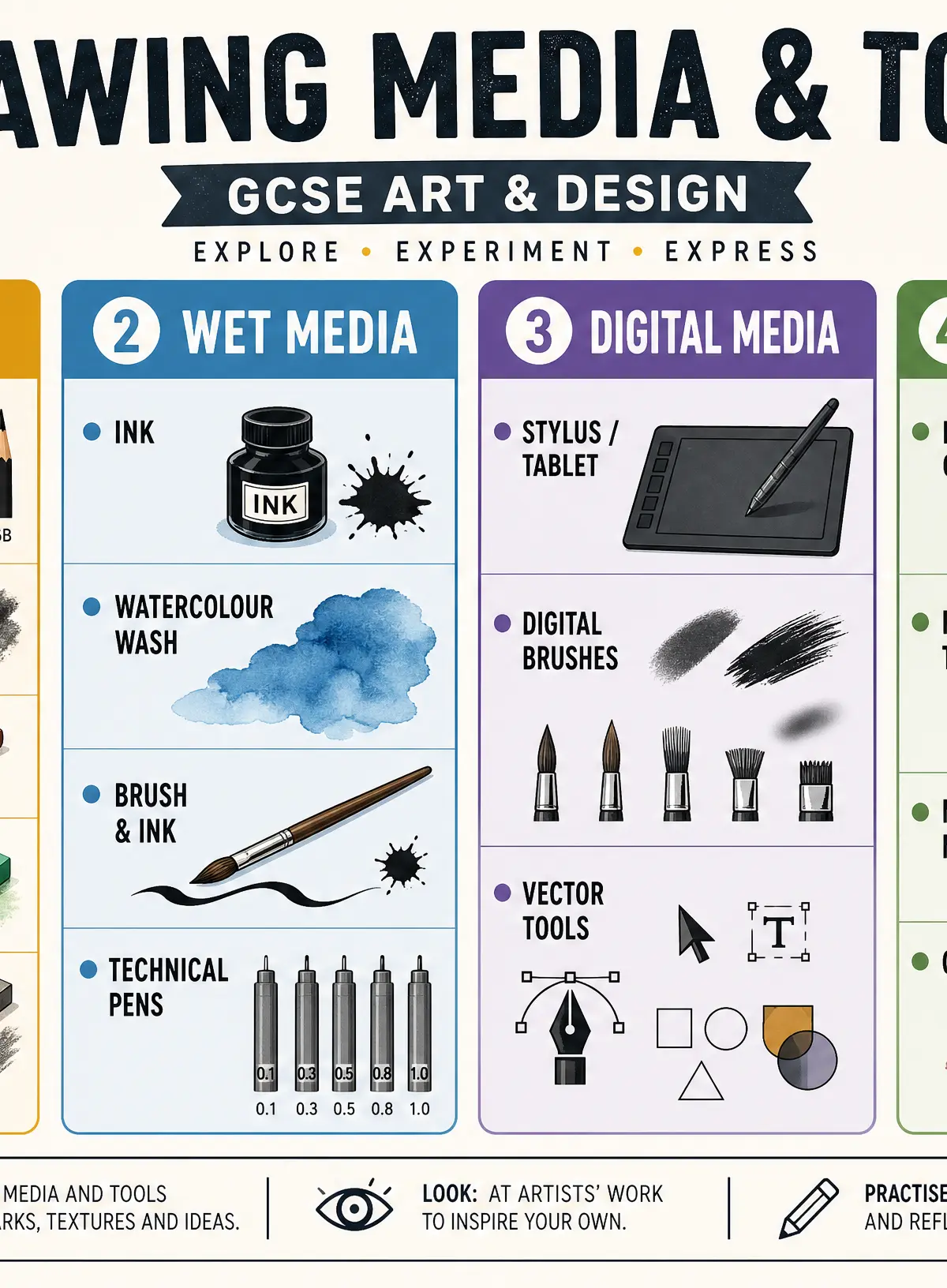
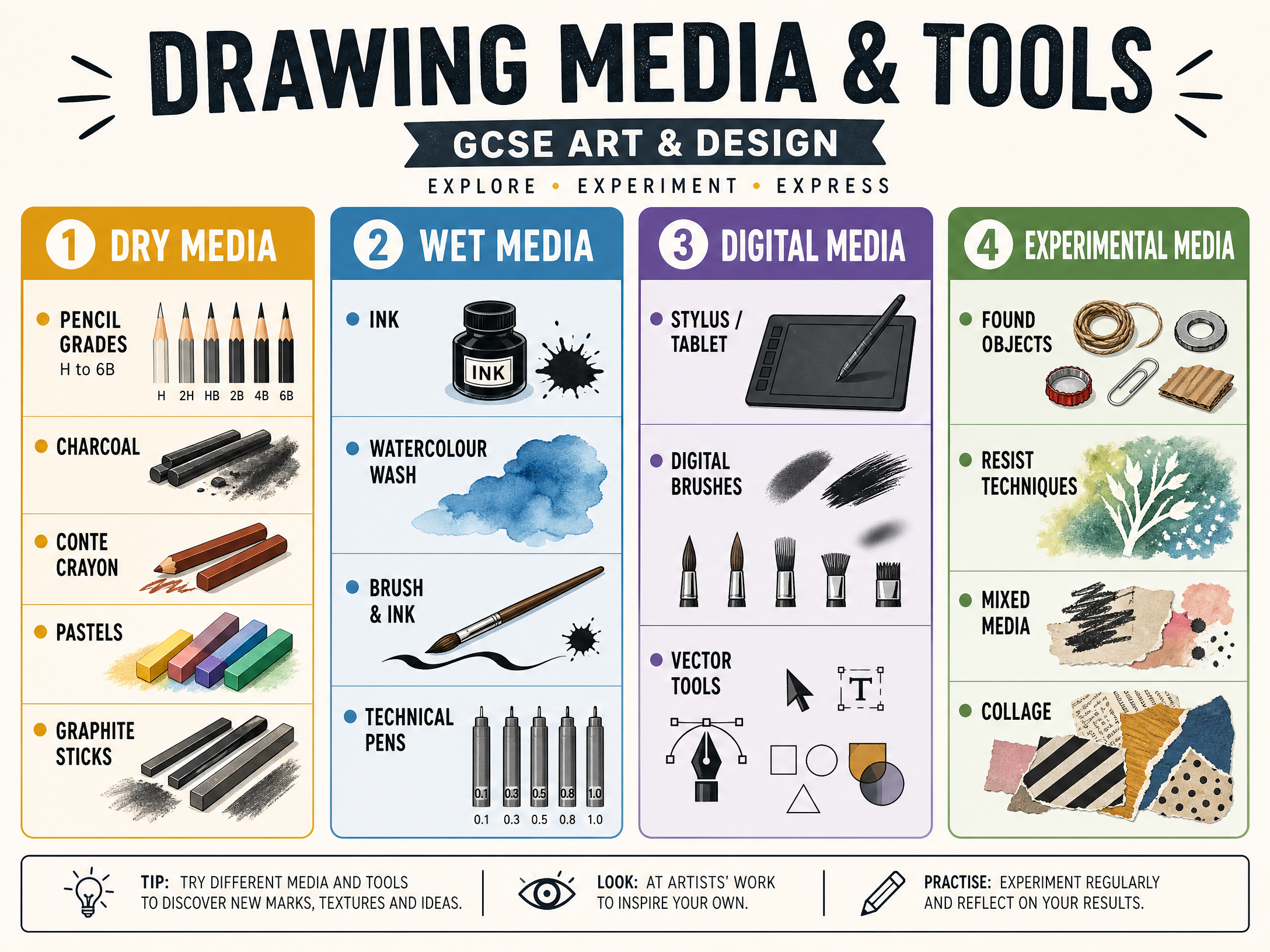
Do not limit yourself to a single HB pencil. You must demonstrate competence across a range of media:
- Dry Media: Graphite pencils (use the full range from hard H to soft B grades), charcoal (willow and compressed), chalk pastels, oil pastels, and conte crayons.
- Wet Media: Indian ink (applied with dip pens, sticks, or brushes), watercolour washes, fine liners, and markers.
- Digital Media: Drawing tablets, styluses, and software (like Procreate or Photoshop).
- Experimental Media: Drawing with wire, thread, found objects, or using resist techniques (like wax and ink).
Portfolio/Coursework Guidance
Assessment Criteria
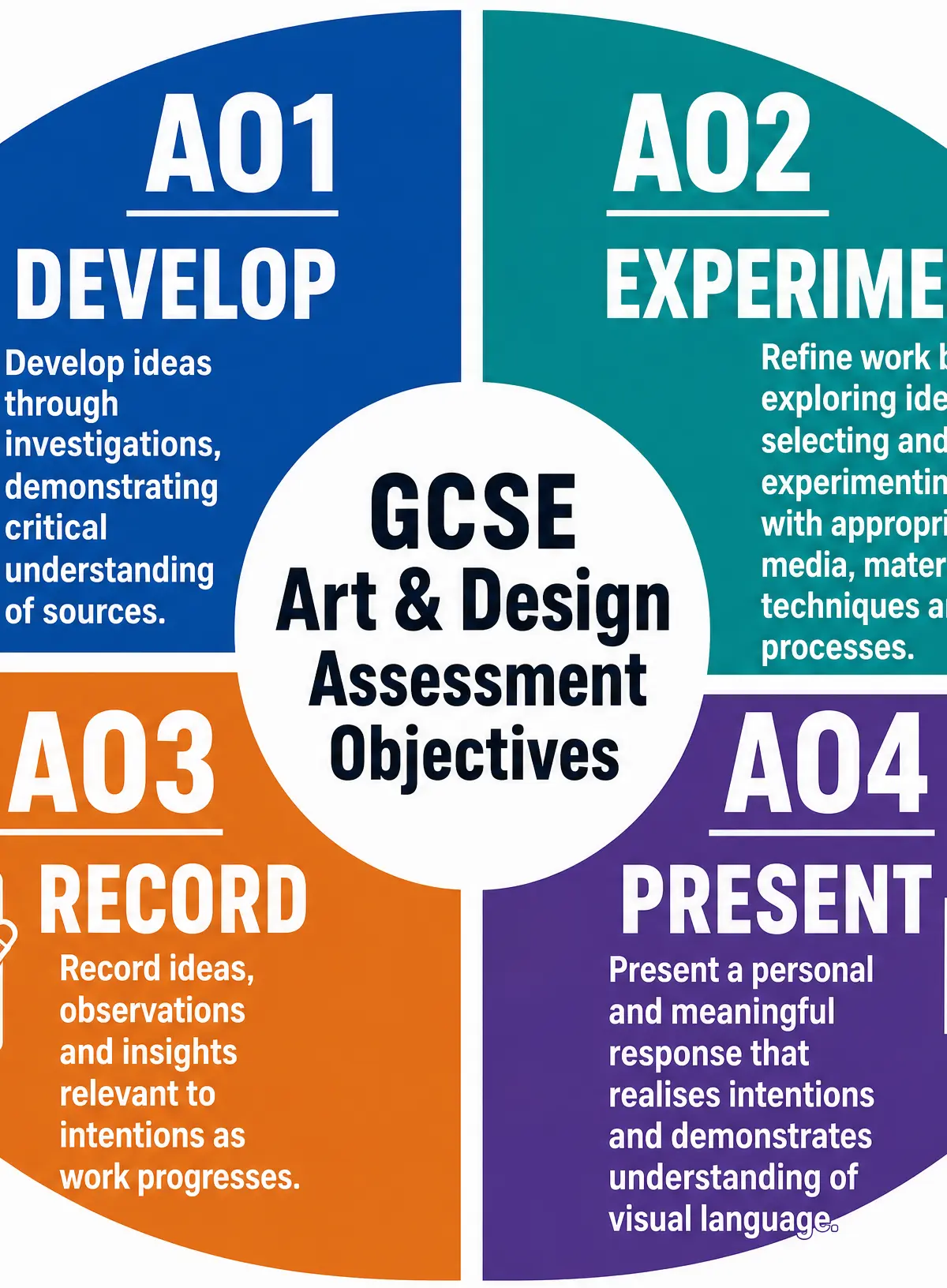
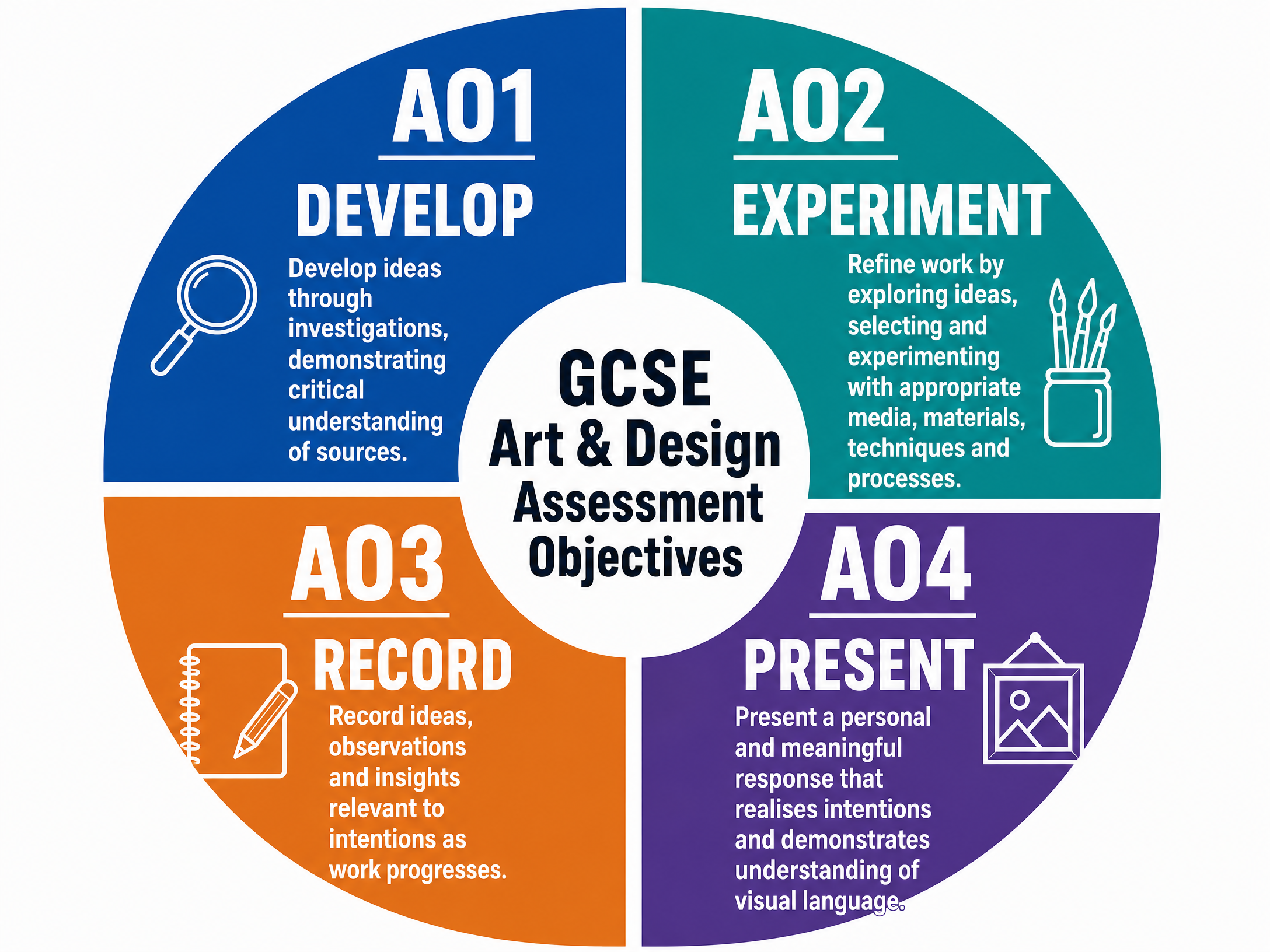
Drawing is assessed across all four Assessment Objectives (AOs):
- AO1 (Develop): Using drawing to analyze artists' work and develop your own ideas inspired by them.
- AO2 (Experiment): Investigating different drawing media and techniques to refine your ideas.
- AO3 (Record): This is the primary AO for drawing. You must record ideas, observations, and insights relevant to your intentions.
- AO4 (Present): Using drawing in your final personal response to realize your intentions.
Building a Strong Portfolio
A high-grade portfolio shows a clear journey. Your sketchbook should read like a visual diary. Show your mistakes and how you fixed them. Annotate your drawings: explain why you chose charcoal instead of pencil, or what you learned from a continuous line study. Ensure you have a balance of primary observational drawings (from life) and developmental sketches.
Exam Component
Practical Exam Preparation (Externally Set Task)
During your preparation period for the timed exam, drawing is your most crucial tool.
- Mind Mapping & Initial Ideas: Use quick sketches alongside text to brainstorm responses to the exam theme.
- Observational Studies: Create high-quality, sustained drawings from primary sources related to your chosen theme. This secures vital AO3 marks early on.
- Media Experiments: Test out the media you plan to use in your final piece. Document these tests with annotated drawings.
- Composition Planning: Create several thumbnail sketches exploring different layouts and viewpoints for your final outcome.

Visual Resources
2 diagrams and illustrations
Interactive Diagrams
1 interactive diagram to visualise key concepts
Conceptual Flow Outline
The role of drawing in the creative development process.
Worked Examples
3 worked examples — open one to explore the question and available guidance.
Practice Questions
Test your understanding — click to reveal model answers
Select a small, everyday object (e.g., a set of keys, a crumpled piece of paper, a piece of fruit). Create three separate 10-minute drawings of this object, using a completely different drawing medium for each.
Hint: Think about contrast. If you use a very controlled medium like fine liner for the first, try a very loose medium like charcoal for the second.
Review a page in your sketchbook where you have tested a new drawing technique. Write a 100-word annotation evaluating its success and how you might use it in your final piece.
Hint: Use the 'What, How, Why' structure. Be honest—if it went wrong, explain why and what you learned.
Create a 'Continuous Line' portrait of a classmate or family member. You must not lift your pen from the paper until the drawing is complete.
Hint: Don't worry about making it look 'perfect' or realistic. Focus on the journey of your eye around the subject's features.
Analyse how a specific artist (of your choice) uses drawing in their practice. How might their approach influence your own work?
Hint: Don't just write a biography. Focus on their *techniques*, *materials*, and *intentions*.