OCR · GCSE · Art and Design
Experimental
This study guide delves into the 'Experimental' component (3.4) of the OCR GCSE Art and Design course, focusing on Assessment Objective 2. It provides a detailed framework for developing, refining, and annotating practical work to meet examiner expectations and achieve top marks."
- 8 min read
- 3 worked examples
- 4 practice questions
Study Notes
Overview
The 'Experimental' component of your OCR GCSE Art and Design course is where your artistic voice truly begins to emerge. It is the engine room of your portfolio, governed by Assessment Objective 2 (AO2), which requires you to 'refine work by exploring ideas, selecting and experimenting with appropriate media, materials, techniques, and processes.' This is not about random play; it is a rigorous and purposeful investigation. Examiners are looking for a clear, iterative journey where you take calculated risks, manipulate materials with intent, and critically evaluate your outcomes to inform the development of your final personal response. Success in this area demonstrates that you are not just a maker, but a thinking artist who can connect research, practice, and reflection into a cohesive whole.

Key Knowledge & Theory
Core Concepts
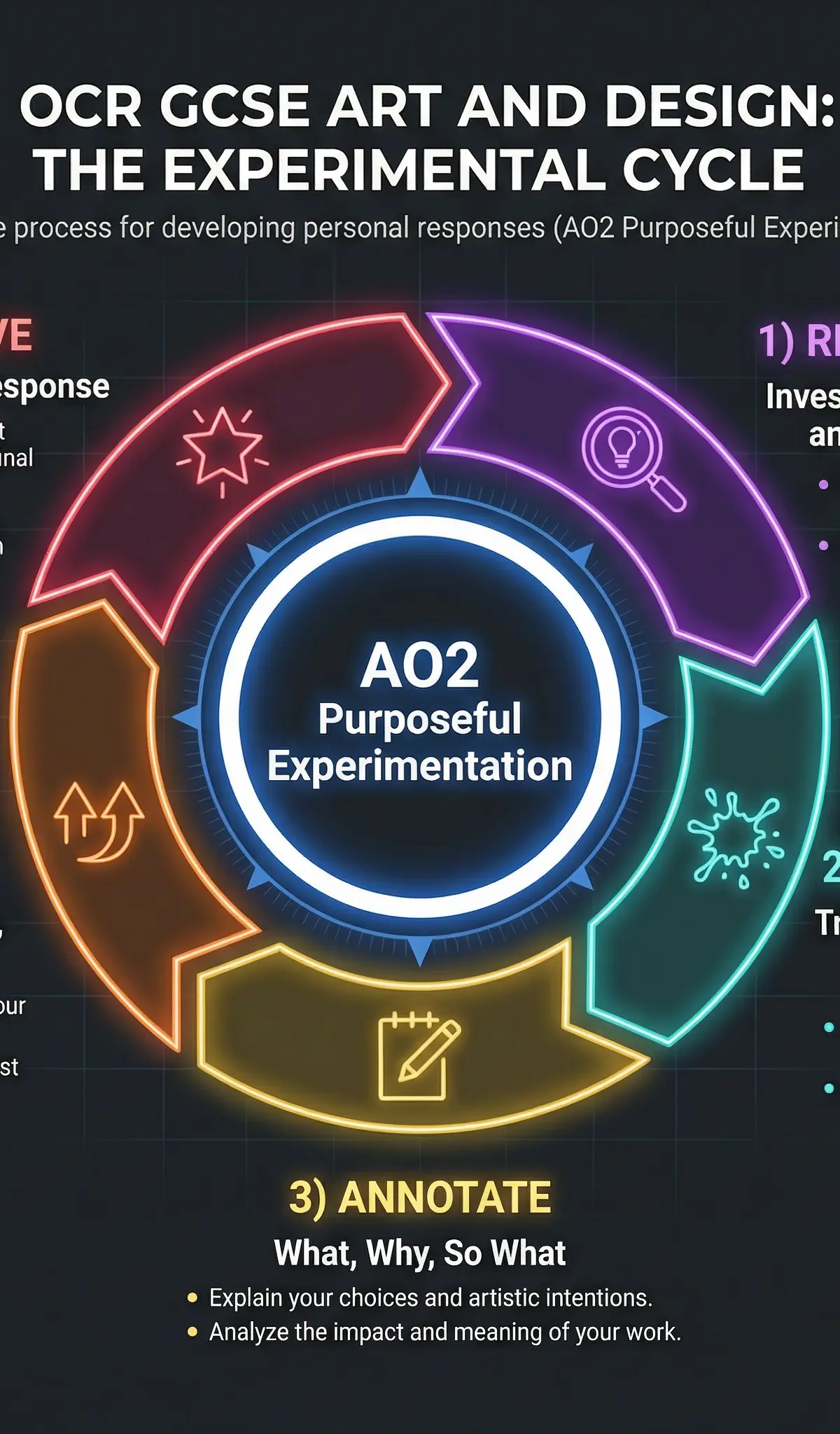
Understanding the theory behind experimentation is crucial for earning marks. The central concept is purposeful iteration. This means every experiment must have a clear 'why' – a connection to your initial research (AO1) and a goal for what you want to discover. It is a cycle: you research an artist, identify a technique or quality you admire, experiment with it, evaluate your success, and then refine your approach in the next attempt. This contrasts with 'media sampling,' a common pitfall where candidates present a disconnected series of technical samples without a unifying conceptual thread. Examiners must see a clear trajectory of thought and development.
Key Practitioners/Artists/Composers
| Name | Period/Style | Key Works | Relevance |
|---|---|---|---|
| Anselm Kiefer | Neo-Expressionism | Margarethe (1981), The Orders of the Night (1996) | Kiefer is a master of material experimentation, using unconventional materials like straw, ash, and lead. His work is a prime example of how texture and surface can carry meaning, providing rich ground for AO2 exploration into impasto, collage, and surface manipulation. |
| Julie Mehretu | Contemporary Abstract | Stadia II (2004), Mogamma (A Painting in Four Parts) (2012) | Mehretu's complex, layered drawings and paintings explore architectural and social networks. Her process of layering gestural marks, technical drawing, and ink washes is a superb precedent for experimenting with composition, scale, and the relationship between different types of mark-making. |
| Cornelia Parker | Conceptual Art | Cold Dark Matter: An Exploded View (1991) | Parker's work often involves transforming objects through violent processes like blowing them up or steamrolling them. She provides a powerful example of how the process itself can be the core concept, encouraging candidates to think beyond traditional media and consider performance or process-based experimentation. |
| Frank Auerbach | School of London | Head of J.Y.M. II (1980) | Auerbach is renowned for his use of extreme impasto, applying paint so thickly that it becomes sculptural. He is an essential reference for any candidate exploring texture, gestural application of paint, and the physical presence of the medium itself. |
Technical Vocabulary
Using precise terminology in your annotations (AO3) is a direct way to signal your understanding to the examiner. Credit is given for candidates who can articulate their process with the correct language.
- Impasto: The technique of laying on paint or pigment thickly so that it stands out from a surface.
- Gestural: A style of painting or drawing in which the artist's physical movements and brushstrokes are evident.
- Scumbling: A painting technique where a thin layer of opaque or semi-opaque colour is applied over another colour to create a softened or broken effect.
- Sgraffito: A form of decoration made by scratching through a surface to reveal a lower layer of a contrasting colour.
- Iterative Process: A cyclical process of prototyping, testing, analysing, and refining a method or idea.
- Resolved: The state of a final piece being complete, coherent, and successfully communicating the artist's intentions.
- Annotation: The written notes, comments, and critical reflections that accompany practical work in a portfolio.
Practical Skills
Techniques & Processes
Your portfolio must evidence a wide range of experimental techniques. Below are some examples and how to approach them with an examiner's mindset.
- Surface Manipulation: Go beyond the flat page. Experiment with folding, tearing, burning, scratching, or stitching into your surfaces. Examiner Tip: Annotate why you chose that specific manipulation. Does tearing the paper link to a theme of fragmentation in your project?
- Layering Media: Combine wet and dry media. For example, use oil pastel as a wax resist for watercolour washes, or draw with ink over dried acrylic paint. Examiner Tip: Evaluate the interaction. Did the media resist, blend, or obscure each other? How does this effect contribute to your intended meaning?
- Monoprinting & Transfer: Explore monoprinting with different inks and surfaces (glass, gel plates). Try transfer techniques, such as using solvents to lift images from magazines. Examiner Tip: Don't just make a print. Refine it. Work back into the print with drawing or collage. How can you make the second version better than the first?
Materials & Equipment
Your choice of materials is a key part of the experimental process. Show that you have considered the properties of your materials and selected them for a specific purpose.
- Paper/Surfaces: Don't just use standard cartridge paper. Test watercolour paper (hot vs. cold press), heavyweight papers for mixed media, tracing paper for layering, and unconventional surfaces like cardboard, wood, or fabric.
- Adhesives: In collage, the adhesive matters. Does PVA glue dry clear and flat? Does a glue stick cause buckling? Does gel medium allow for transparent layering? Document these technical findings.
- Safety: When using materials like spray paint, fixatives, or solvents, always work in a well-ventilated area and follow safety guidelines. Documenting your awareness of safe studio practice can also be credited.
Portfolio/Coursework Guidance
Assessment Criteria
Your portfolio is assessed against four equally weighted Assessment Objectives. For the 'Experimental' component, the focus is on AO2, but it is supported by the others.
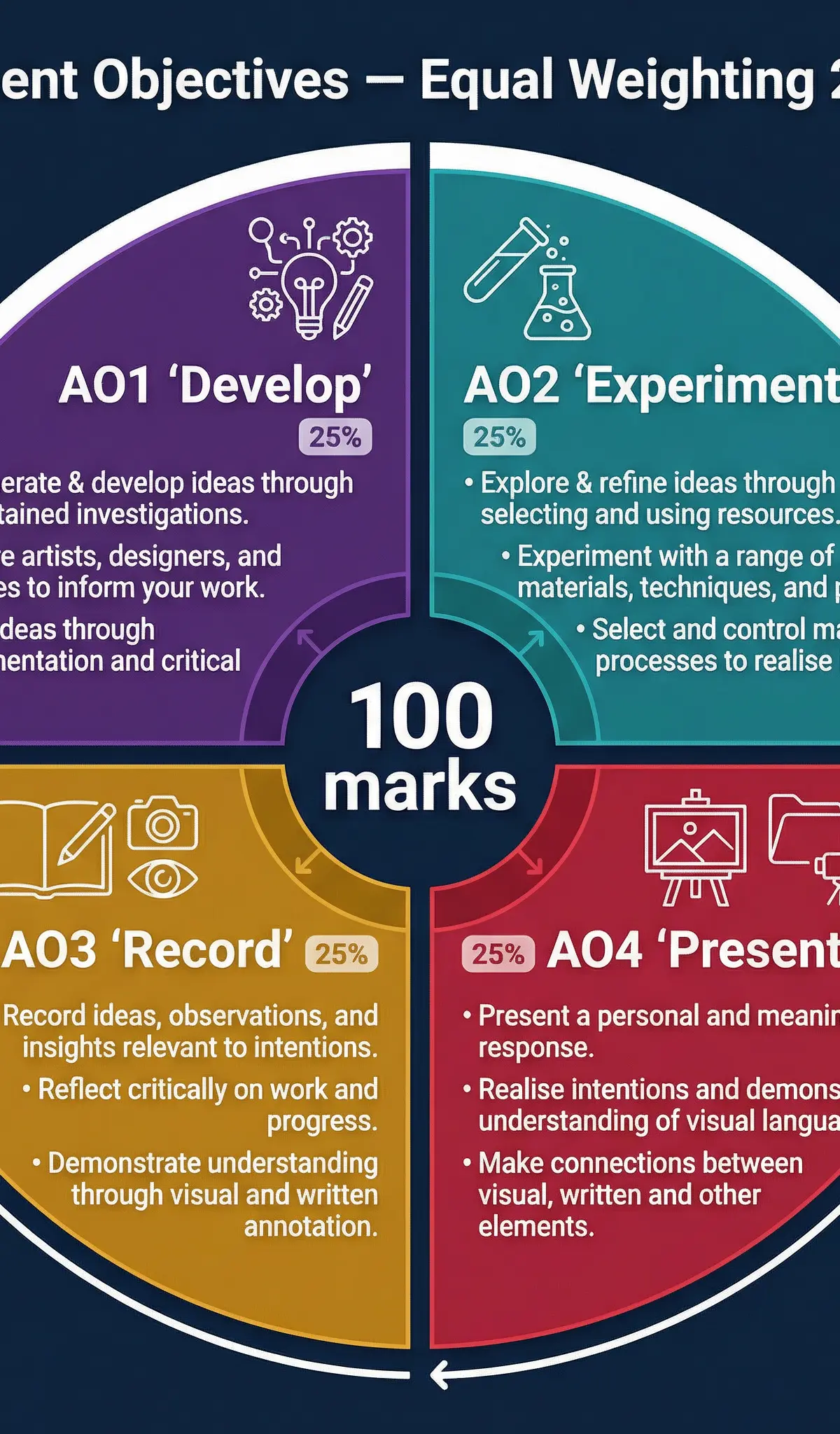
- AO1 (Develop): Your experiments must be a direct response to the artists and sources you have investigated.
- AO2 (Experiment): This is the core. You must show evidence of exploring media, refining techniques, and making purposeful selections.
- AO3 (Record): Your annotations must explain your thinking, evaluate your success, and outline your next steps.
- AO4 (Present): Your final piece should be a culmination of your most successful experiments.
Building a Strong Portfolio
To build a portfolio that scores highly in AO2, you must make your thinking visible.
- Show the Journey: Don't just present perfect outcomes. Include the 'failed' experiments. A page showing a smudged print with an annotation explaining why it smudged and how you fixed it on the next attempt is excellent evidence of refinement.
- Use the 'What, Why, So What' Framework: For every experiment, annotate: What did I do? Why did I do it (linking to an artist)? So What did I learn, and what will I do next?
- Create a 'Review, Refine, Select' Page: Towards the end of your experimental section, dedicate a page to this. Show small snippets of your key experiments and write a summary statement explaining which techniques, colours, and compositions you are selecting to take forward into your final piece (AO4) and justify why.
Exam Component
Written Exam Knowledge
While Art and Design is primarily practical, the externally set assignment often includes a written component or requires you to make connections to other artists. The vocabulary and analytical skills you develop in your experimental annotations are directly transferable. You might be asked to 'analyse' or 'compare' the work of two artists, including how they use materials. Your own hands-on experience with those materials will give your answer depth and authenticity.
Practical Exam Preparation
For the externally set task (the 'exam'), you will have a preparatory period to develop ideas. This is where you apply your experimental skills under timed conditions. You should create a 'mini-portfolio' of research and experiments in response to your chosen starting point. Examiners will expect to see the same rigorous, annotated experimentation as in your main portfolio, just on a smaller scale. Practice brainstorming and developing ideas quickly from a set theme."
Worked Examples
3 worked examples — open one to explore the question and available guidance.
Practice Questions
Test your understanding — click to reveal model answers
Identify two different techniques for creating texture in a mixed-media piece.
Hint: Think about adding things to the surface or changing the surface itself.
Explain how an artist's experimental use of materials can contribute to the meaning of their work. Refer to one artist you have studied.
Hint: Link the 'what' (material) to the 'why' (idea/theme). Think about Anselm Kiefer.
You are starting a project on the theme 'Conflict'. Propose a series of three linked experiments to explore this theme, explaining your choice of media and what you hope to discover.
Hint: Think about a sequence. How can one experiment lead to the next? Link your media choices to the theme.
Evaluate the effectiveness of using digital software versus traditional collage for exploring ideas of fragmentation.
Hint: Think about the pros and cons of each method. Use 'Compare' and 'Evaluate' command words.