AQA · GCSE · Biology
Course version: 8461 · Version from Sept 2018
Students should be able to explain how organisms are adapted to live in…
Full specification wording
Adaptations: Students should be able to explain how organisms are adapted to live in their natural environment, given appropriate information.
An adaptation is a feature or behaviour that helps an organism survive and reproduce in its environment.
Checked against the AQA 8461 specification (opens in a new tab) on .
- Point 1 of 6
- 2 key terms
Study notes
From the checked teaching notes for this specification point.
The idea
An adaptation is a feature or behaviour that helps an organism survive and reproduce in its environment. Adaptations may be structural, such as a camel's hump storing fat or a polar bear's thick fur and small ears reducing heat loss; behavioural, such as migration or nocturnal activity; or functional, such as producing venom or conserving water. To explain an adaptation, name the feature, state the advantage it gives, and link that advantage to survival and reproduction in the named environment. For example, a deep root system lets a desert plant reach water, so it survives drought and can reproduce. Given information about an organism and its habitat, you should select relevant features and explain how each one improves the organism's chance of survival.
What earns the marks
- Identify a named adaptation of the organism, such as a structural, behavioural or functional feature.
- State the advantage the adaptation provides in the organism's natural environment.
- Explain how the advantage helps the organism survive, for example by obtaining food, avoiding predators or coping with physical conditions.
- Link survival to successful reproduction, so the adaptation becomes more common in the population over time.
- Use information provided in the question about the habitat or organism to justify why the adaptation is beneficial there.
Common mistakes and how to put them right
Describing an adaptation without explaining its advantage.
Put it right by adding a sentence that states how the feature helps the organism survive.
Confusing adaptation with acclimatisation, such as a person getting a tan.
Put it right by explaining that adaptations are inherited features that develop over generations.
Giving a general advantage that could apply anywhere.
Put it right by linking the adaptation specifically to the named environment and its conditions.
Exam tips
- Use the structure 'feature, so advantage, therefore survival and reproduction' to make your explanation clear.
- Name the type of adaptation, for example structural, behavioural or functional, when the question asks you to classify it.
- Refer to the specific habitat given in the question, such as 'the desert' or 'the Arctic', rather than writing about environments in general.
- If the question supplies information, use it directly in your answer instead of relying only on remembered examples.
Try the lesson
The start of the Adaptations: Students should be able to explain how organisms are adapted to live in their natural environment, given appropriate information. lesson, made from checked teaching notes for this specification point.
Have a go first
A camel lives in a hot desert and stores fat in its hump. How does this adaptation help the camel to survive in its environment?
Listen
An adaptation is a feature or behaviour that helps an organism survive and reproduce in its environment. Adaptations may be structural, such as a camel's hump storing fat or a polar bear's thick fur and small ears reducing heat loss; behavioural, such as migration or nocturnal activity; or functional, such as producing venom or conserving water. To explain an adaptation, name the feature, state the advantage it gives, and link that advantage to survival and reproduction in the named environment. For example, a deep root system lets a desert plant reach water, so it survives drought and can reproduce. Given information about an organism and its habitat, you should select relevant features and explain how each one improves the organism's chance of survival. A strong answer earns marks for these points. Identify a named adaptation of the organism, such as a structural, behavioural or functional feature. State the advantage the adaptation provides in the organism's natural environment. Explain how the advantage helps the organism survive, for example by obtaining food, avoiding predators or coping with physical conditions. Link survival to successful reproduction, so the adaptation becomes more common in the population over time. A common slip: Describing an adaptation without explaining its advantage. Instead, adding a sentence that states how the feature helps the organism survive. Exam tip: Use the structure 'feature, so advantage, therefore survival and reproduction' to make your explanation clear.
See it
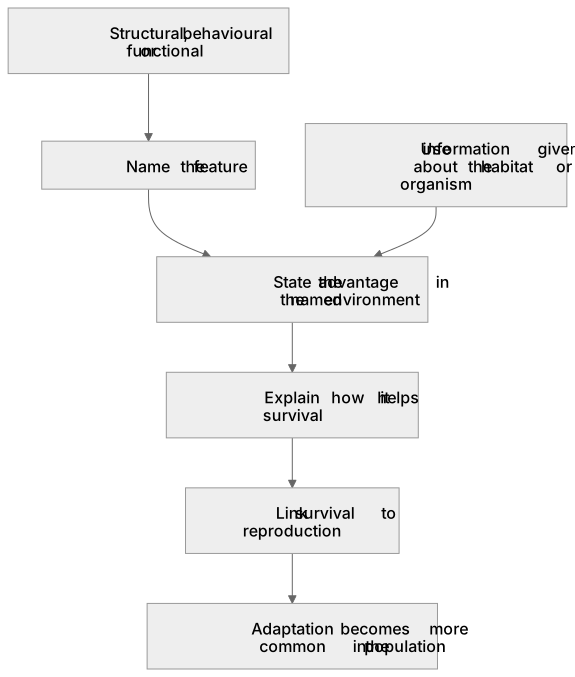
Key words
Say what each word means before you turn the card.
Adaptation
Try answering aloud or in your head before turning the card.
Structural, behavioural and functional adaptations
Try answering aloud or in your head before turning the card.
See every definition
- Adaptation
- A feature or behaviour that helps an organism survive and reproduce in its environment.
- Structural, behavioural and functional adaptations
- Adaptations may be structural, such as a camel's hump storing fat, behavioural, such as migration, or functional, such as producing venom.
Label the diagram
Some boxes have lost their names. Pick the right name for each number.
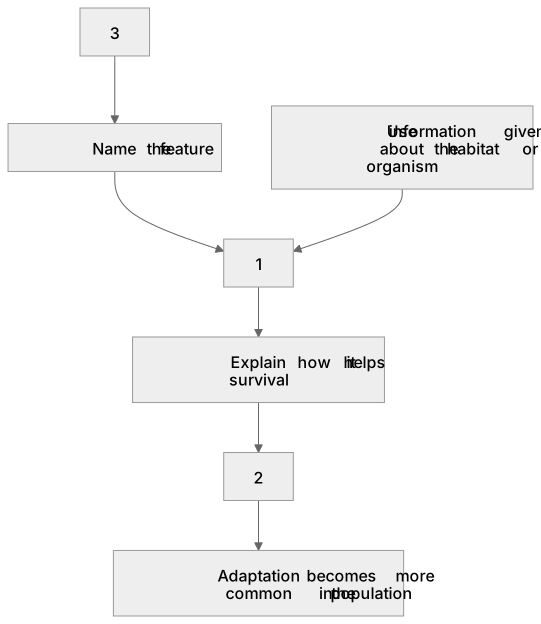
1Box 1
2Box 2
3Box 3
There is more to this lesson
The full lesson goes on to check your understanding and help you earn the marks. Create a free account to carry on, with your progress saved.
A week of Premium from your first lesson · Then the free plan continues · No card, no charge
Test your understanding of Adaptations: Students should be able to explain how organisms are adapted to live in their natural environment, given appropriate information.
Active recall beats re-reading. Take an instant quiz now to test what you’ve learned and lock it into long-term memory.
A week of Premium from your first lesson · Then the free plan continues · No card, no charge