AQA · GCSE · Biology
Course version: 8461 · Version from Sept 2018
Organisms have features (adaptations) that enable them to survive in the…
Full specification wording
Adaptations: Organisms have features (adaptations) that enable them to survive in the conditions in which they normally live.
An adaptation is any inherited feature that improves an organism's chance of surviving and reproducing in its normal habitat.
Checked against the AQA 8461 specification (opens in a new tab) on .
- Point 2 of 6
- 4 key terms
Study notes
From the checked teaching notes for this specification point.
The idea
An adaptation is any inherited feature that improves an organism's chance of surviving and reproducing in its normal habitat. Survival matters because organisms that live long enough can pass on their alleles, so adaptations become common in a population through natural selection. Adaptations match specific conditions: a cactus has a thick waxy cuticle and spines that reduce water loss and grazing in a hot, dry desert, while a fish has gills that extract dissolved oxygen from water. When answering, name the feature, state the condition it suits, then explain the benefit to survival or reproduction. Avoid saying an organism 'adapts' during its life; inherited adaptations arise over many generations.
What earns the marks
- Defines an adaptation as an inherited feature that increases an organism's chance of survival and reproduction in its normal environment.
- Links each named feature to a specific condition in the habitat, such as limited water, low light, cold or predation.
- Explains the survival or reproductive advantage, for example obtaining more food, avoiding being eaten or producing more offspring.
- Uses examples from different groups, such as structural features of plants and animals, to show the idea is general.
- Recognises that adaptations are inherited and become more common over generations through natural selection.
Common mistakes and how to put them right
Treating adaptation as a change an individual makes during its lifetime.
Put it right by stating that adaptations are inherited features already present in some individuals.
Describing a feature without linking it to a condition or benefit.
Put it right by naming the habitat condition and the survival advantage.
Assuming every feature is an adaptation.
Put it right by checking that the feature improves survival or reproduction in that specific environment.
Exam tips
- Use a three-part chain: feature, condition, benefit to survival or reproduction.
- Choose examples you can explain confidently, such as desert plants, Arctic mammals or deep-sea fish.
- If asked to suggest an adaptation, name it and justify it rather than only describing its appearance.
Try the lesson
The start of the Adaptations: Organisms have features (adaptations) that enable them to survive in the conditions in which they normally live. lesson, made from checked teaching notes for this specification point.
Have a go first
A camel lives in a hot desert. Which feature is an adaptation that helps it survive there?
Listen
An adaptation is any inherited feature that improves an organism's chance of surviving and reproducing in its normal habitat. Survival matters because organisms that live long enough can pass on their alleles, so adaptations become common in a population through natural selection. Adaptations match specific conditions: a cactus has a thick waxy cuticle and spines that reduce water loss and grazing in a hot, dry desert, while a fish has gills that extract dissolved oxygen from water. When answering, name the feature, state the condition it suits, then explain the benefit to survival or reproduction. Avoid saying an organism 'adapts' during its life; inherited adaptations arise over many generations. A strong answer earns marks for these points. Defines an adaptation as an inherited feature that increases an organism's chance of survival and reproduction in its normal environment. Links each named feature to a specific condition in the habitat, such as limited water, low light, cold or predation. Explains the survival or reproductive advantage, for example obtaining more food, avoiding being eaten or producing more offspring. Uses examples from different groups, such as structural features of plants and animals, to show the idea is general. A common slip: Treating adaptation as a change an individual makes during its lifetime. Instead, stating that adaptations are inherited features already present in some individuals. Exam tip: Use a three-part chain: feature, condition, benefit to survival or reproduction.
See it
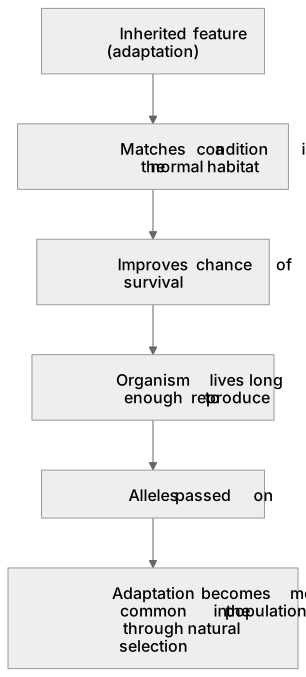
Put it in order
Put these steps in the order they happen.
- 1. Improves chance of survival
- 2. Matches a condition in the normal habitat
- 3. Inherited feature (adaptation)
- 4. Adaptation becomes more common in the population through natural selection
- 5. Alleles passed on
- 6. Organism lives long enough to reproduce
Key words
Say what each word means before you turn the card.
Adaptation
Try answering aloud or in your head before turning the card.
Natural selection
Try answering aloud or in your head before turning the card.
Survival and reproduction
Try answering aloud or in your head before turning the card.
Inherited characteristics
Try answering aloud or in your head before turning the card.
See every definition
- Adaptation
- An inherited feature that improves an organism's chance of surviving and reproducing in its normal habitat.
- Natural selection
- The process by which adaptations become common in a population over many generations.
- Survival and reproduction
- Living long enough to pass on alleles, which is why survival matters.
- Inherited characteristics
- Features already present in some individuals that are passed on and are not changes made during an organism's lifetime.
Label the diagram
Some boxes have lost their names. Pick the right name for each number.
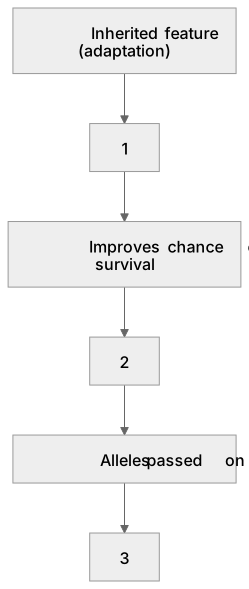
1Box 1
2Box 2
3Box 3
There is more to this lesson
The full lesson goes on to check your understanding and help you earn the marks. Create a free account to carry on, with your progress saved.
A week of Premium from your first lesson · Then the free plan continues · No card, no charge
Test your understanding of Adaptations: Organisms have features (adaptations) that enable them to survive in the conditions in which they normally live.
Active recall beats re-reading. Take an instant quiz now to test what you’ve learned and lock it into long-term memory.
A week of Premium from your first lesson · Then the free plan continues · No card, no charge