AQA · GCSE · Biology
Course version: 8461 · Version from Sept 2018
Adaptations: These organisms are called extremophiles.
Organisms adapted to survive in extreme environments are called extremophiles.
Checked against the AQA 8461 specification (opens in a new tab) on .
- Point 5 of 6
- 4 key terms
Study notes
From the checked teaching notes for this specification point.
The idea
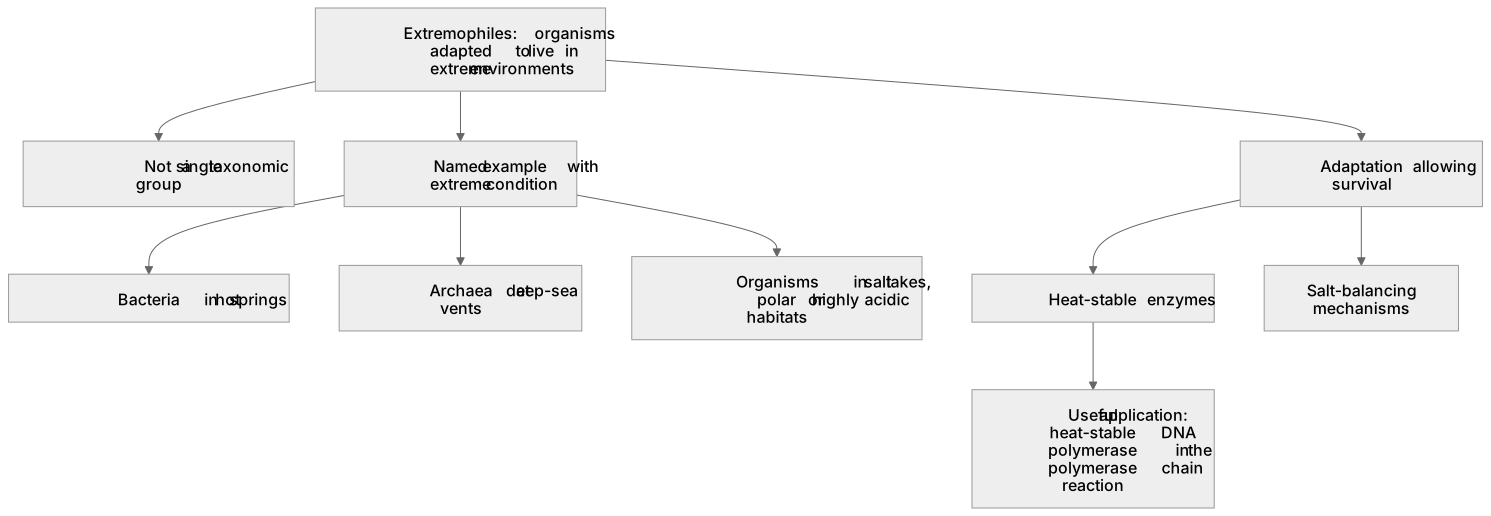
Organisms adapted to survive in extreme environments are called extremophiles. The term covers many groups, including bacteria and archaea in hot springs, deep-sea vents and salt lakes, and multicellular organisms in polar or highly acidic habitats. Extremophiles are not a single taxonomic group; the name describes where they live and the adaptations they possess. Their enzymes can be useful to humans, for example heat-stable DNA polymerase used in the polymerase chain reaction. In an answer, define extremophile, give a named example with its extreme condition, and state one adaptation that allows it to survive there. Distinguish extremophiles from organisms that merely tolerate mild variation, and avoid implying that all extremophiles are bacteria.
What earns the marks
- Defines extremophiles as organisms adapted to live in extreme environments.
- Gives a named example with the extreme condition, such as bacteria in hot springs or archaea at deep-sea vents.
- States an adaptation that allows the named organism to survive, such as heat-stable enzymes or salt-balancing mechanisms.
- Recognises that extremophiles belong to different groups and are not defined by a single type of organism.
- Links extremophile adaptations to a useful application, such as heat-stable enzymes in laboratory techniques.
Common mistakes and how to put them right
Defining extremophiles as a type of bacteria only.
Put it right by stating that the term covers organisms from different groups living in extreme conditions.
Using the word for any organism in a difficult habitat without naming the extreme condition.
Put it right by specifying the condition, such as high temperature or high salt concentration.
Confusing extremophiles with organisms that are simply well adapted to ordinary habitats.
Put it right by checking that the environment is extreme.
Exam tips
- Define the term, then give one named example and its extreme condition.
- Add one adaptation and one benefit or application to show deeper understanding.
- Use the word extremophile accurately rather than as a general term for any hardy organism.
Try the lesson
The start of the Adaptations: These organisms are called extremophiles. lesson, made from checked teaching notes for this specification point.
Have a go first
What name is given to organisms that live in very extreme environments?
Listen
Organisms adapted to survive in extreme environments are called extremophiles. The term covers many groups, including bacteria and archaea in hot springs, deep-sea vents and salt lakes, and multicellular organisms in polar or highly acidic habitats. Extremophiles are not a single taxonomic group; the name describes where they live and the adaptations they possess. Their enzymes can be useful to humans, for example heat-stable DNA polymerase used in the polymerase chain reaction. In an answer, define extremophile, give a named example with its extreme condition, and state one adaptation that allows it to survive there. Distinguish extremophiles from organisms that merely tolerate mild variation, and avoid implying that all extremophiles are bacteria. A strong answer earns marks for these points. Defines extremophiles as organisms adapted to live in extreme environments. Gives a named example with the extreme condition, such as bacteria in hot springs or archaea at deep-sea vents. States an adaptation that allows the named organism to survive, such as heat-stable enzymes or salt-balancing mechanisms. Recognises that extremophiles belong to different groups and are not defined by a single type of organism. A common slip: Defining extremophiles as a type of bacteria only. Instead, stating that the term covers organisms from different groups living in extreme conditions. Exam tip: Define the term, then give one named example and its extreme condition.
See it
Key words
Say what each word means before you turn the card.
Extremophiles
Try answering aloud or in your head before turning the card.
Extreme environments
Try answering aloud or in your head before turning the card.
Adaptation
Try answering aloud or in your head before turning the card.
Biotechnology applications
Try answering aloud or in your head before turning the card.
See every definition
- Extremophiles
- Organisms adapted to survive in extreme environments.
- Extreme environments
- Habitats such as hot springs, deep-sea vents, salt lakes, polar or highly acidic habitats.
- Adaptation
- A feature that allows an organism to survive, such as heat-stable enzymes or salt-balancing mechanisms.
- Biotechnology applications
- Useful uses of extremophile enzymes, such as heat-stable DNA polymerase used in the polymerase chain reaction.
Label the diagram
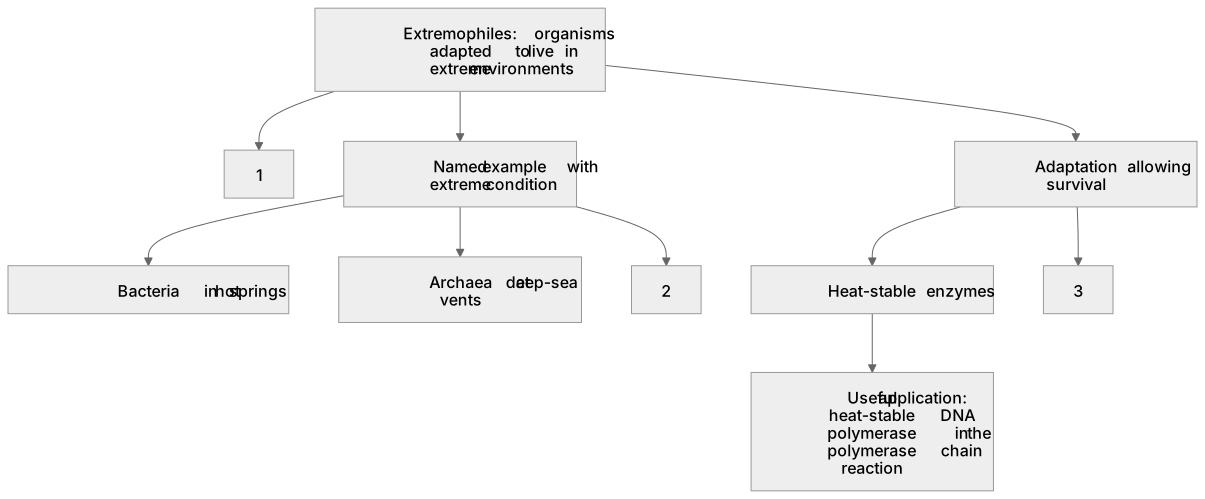
Some boxes have lost their names. Pick the right name for each number.
1Box 1
2Box 2
3Box 3
There is more to this lesson
The full lesson goes on to check your understanding and help you earn the marks. Create a free account to carry on, with your progress saved.
A week of Premium from your first lesson · Then the free plan continues · No card, no charge
Test your understanding of Adaptations: These organisms are called extremophiles.
Active recall beats re-reading. Take an instant quiz now to test what you’ve learned and lock it into long-term memory.
A week of Premium from your first lesson · Then the free plan continues · No card, no charge