AQA · GCSE · Biology
Course version: 8461 · Version from Sept 2018
Some organisms live in environments that are very extreme, such as at high…
Full specification wording
Adaptations: Some organisms live in environments that are very extreme, such as at high temperature, pressure, or salt concentration.
Extreme environments have conditions that would kill most organisms.
Checked against the AQA 8461 specification (opens in a new tab) on .
- Point 4 of 6
- 4 key terms
Study notes
From the checked teaching notes for this specification point.
The idea
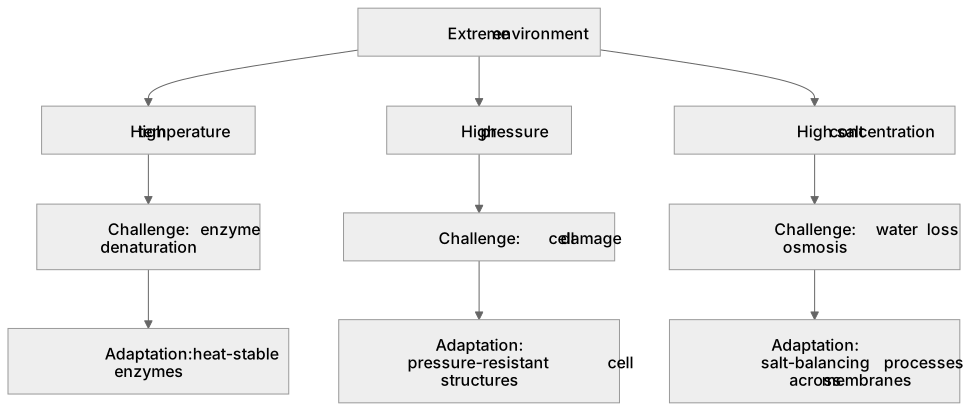
Extreme environments have conditions that would kill most organisms. Examples include deep-sea hydrothermal vents at high pressure and temperature, hot springs and volcanic pools at high temperature, salt lakes and salt pans at very high salt concentration, and polar regions at very low temperature. Organisms survive there because they possess adaptations matched to those conditions, such as heat-stable enzymes, pressure-resistant cell structures or mechanisms that balance water and salt across membranes. When answering, name the extreme condition, identify the challenge it creates for cells or enzymes, and explain how the organism's adaptation meets that challenge. Do not simply say the organism 'likes' the condition; focus on the biological problem and its solution.
What earns the marks
- Identifies extreme conditions such as high temperature, high pressure or high salt concentration.
- Describes the challenge each condition creates, for example enzyme denaturation, cell damage or water loss by osmosis.
- Links a named adaptation to survival in that extreme condition, such as heat-stable enzymes or salt-balancing processes.
- Uses a specific example, such as organisms at deep-sea vents or in salt lakes, to illustrate the link.
- Recognises that extreme environments support life only where suitable adaptations are present.
Common mistakes and how to put them right
Confusing high salt concentration with high temperature.
Put it right by naming the specific condition and its separate challenge.
Saying organisms survive because they are 'used to' the conditions.
Put it right by naming the adaptation and its biological effect.
Ignoring the challenge to cells.
Put it right by explaining what would happen without the adaptation, such as enzyme denaturation or water loss.
Exam tips
- Name the extreme condition first, then the challenge, then the adaptation.
- Use precise terms such as denaturation, osmosis and enzyme activity where relevant.
- Refer to a real example, such as hydrothermal vent communities or salt-tolerant plants, to support your explanation.
Try the lesson
The start of the Adaptations: Some organisms live in environments that are very extreme, such as at high temperature, pressure, or salt concentration. lesson, made from checked teaching notes for this specification point.
Have a go first
Which of these describes an environment that is very extreme for living organisms?
Listen
Extreme environments have conditions that would kill most organisms. Examples include deep-sea hydrothermal vents at high pressure and temperature, hot springs and volcanic pools at high temperature, salt lakes and salt pans at very high salt concentration, and polar regions at very low temperature. Organisms survive there because they possess adaptations matched to those conditions, such as heat-stable enzymes, pressure-resistant cell structures or mechanisms that balance water and salt across membranes. When answering, name the extreme condition, identify the challenge it creates for cells or enzymes, and explain how the organism's adaptation meets that challenge. Do not simply say the organism 'likes' the condition; focus on the biological problem and its solution. A strong answer earns marks for these points. Identifies extreme conditions such as high temperature, high pressure or high salt concentration. Describes the challenge each condition creates, for example enzyme denaturation, cell damage or water loss by osmosis. Links a named adaptation to survival in that extreme condition, such as heat-stable enzymes or salt-balancing processes. Uses a specific example, such as organisms at deep-sea vents or in salt lakes, to illustrate the link. A common slip: Confusing high salt concentration with high temperature. Instead, naming the specific condition and its separate challenge. Exam tip: Name the extreme condition first, then the challenge, then the adaptation.
See it
Key words
Say what each word means before you turn the card.
Extreme environments
Try answering aloud or in your head before turning the card.
Enzyme stability
Try answering aloud or in your head before turning the card.
Water and salt balance
Try answering aloud or in your head before turning the card.
Adaptation and survival
Try answering aloud or in your head before turning the card.
See every definition
- Extreme environments
- Environments that are very extreme, such as at high temperature, pressure, or salt concentration, with conditions that would kill most organisms.
- Enzyme stability
- Heat-stable enzymes are an adaptation matched to extreme conditions, meeting the challenge of enzyme denaturation.
- Water and salt balance
- Mechanisms that balance water and salt across membranes, an adaptation to very high salt concentration.
- Adaptation and survival
- Organisms survive in extreme environments because they possess adaptations matched to those conditions, and such environments support life only where suitable adaptations are present.
Label the diagram
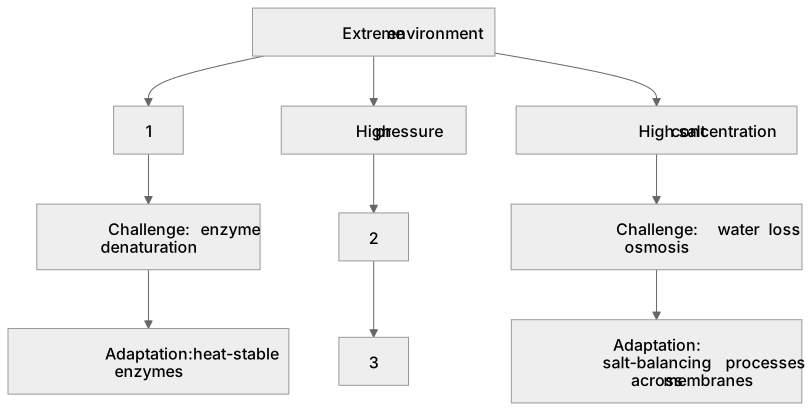
Some boxes have lost their names. Pick the right name for each number.
1Box 1
2Box 2
3Box 3
There is more to this lesson
The full lesson goes on to check your understanding and help you earn the marks. Create a free account to carry on, with your progress saved.
A week of Premium from your first lesson · Then the free plan continues · No card, no charge
Test your understanding of Adaptations: Some organisms live in environments that are very extreme, such as at high temperature, pressure, or salt concentration.
Active recall beats re-reading. Take an instant quiz now to test what you’ve learned and lock it into long-term memory.
A week of Premium from your first lesson · Then the free plan continues · No card, no charge