AQA · GCSE · Biology
Course version: 8461 · Version from Sept 2018
Advantages of asexual reproduction: • only one parent needed • more time…
Full specification wording
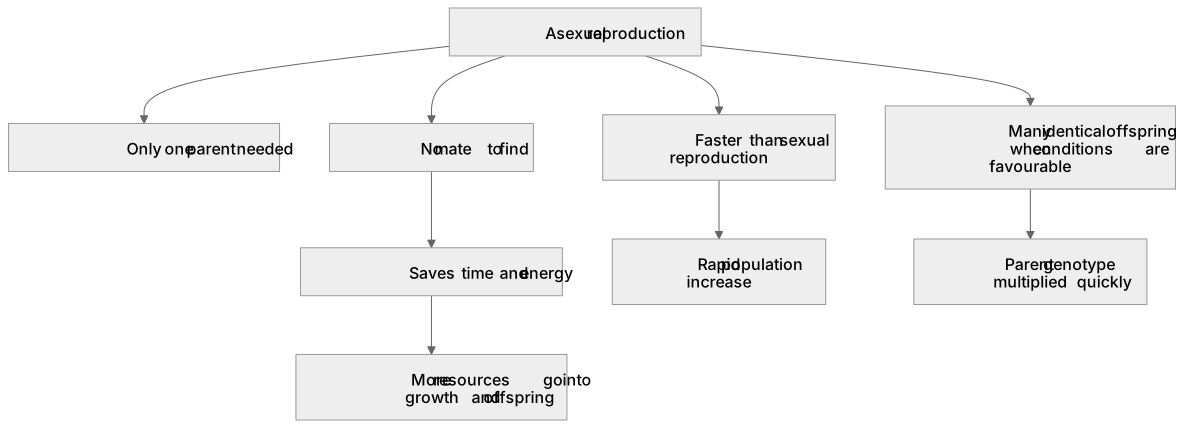
Advantages and disadvantages of sexual and asexual reproduction (biology only): Advantages of asexual reproduction: • only one parent needed • more time and energy efficient as do not need to find a mate • faster than sexual reproduction • many identical offspring can be produced when conditions are favourable.
Asexual reproduction produces genetically identical offspring from one parent, without gametes or fertilisation.
Checked against the AQA 8461 specification (opens in a new tab) on .
- Point 2 of 8
- 4 key terms
Study notes
From the checked teaching notes for this specification point.
The idea
Asexual reproduction produces genetically identical offspring from one parent, without gametes or fertilisation. Because no mate must be found, the organism saves the time and energy that sexual reproduction would spend on courtship, gamete production and pollination. Reproduction can therefore be rapid, and in favourable conditions a single parent can generate many identical offspring, quickly colonising a garden, field or pond. For example, a strawberry plant sends out runners and a bacterium divides by binary fission, each producing clones suited to the current environment. The trade-off is lack of genetic variation, so if conditions change, all identical offspring may be equally vulnerable. The skill is to explain each advantage in terms of time, energy, speed or offspring number, and to link it to favourable conditions.
What earns the marks
- Only one parent is needed, so a mate does not have to be found and fertilisation is not required.
- No time or energy is spent finding a mate, producing gametes or attracting pollinators, so more resources go into growth and offspring.
- Asexual reproduction is faster than sexual reproduction, allowing rapid population increase.
- Many identical offspring can be produced when conditions are favourable, so the parent genotype is multiplied quickly.
- Named examples such as runners in strawberry plants, tubers in potatoes or binary fission in bacteria illustrate the advantages.
Common mistakes and how to put them right
Writing that asexual reproduction produces genetically different offspring.
Put it right: It produces genetically identical offspring, which is why it is described as cloning.
Saying asexual reproduction is always better than sexual reproduction.
Put it right: It is advantageous in favourable, stable conditions but risky if the environment changes.
Confusing energy efficiency with producing no energy.
Put it right: The organism saves energy because it does not need to find a mate or make gametes.
Exam tips
- Use the phrase genetically identical rather than similar when describing asexual offspring.
- For each advantage, add a consequence, such as rapid colonisation or preservation of a successful genotype.
- When comparing with sexual reproduction, refer explicitly to finding a mate, gamete production and speed.
Try the lesson
The start of the Advantages and disadvantages of sexual and asexual reproduction (biology only): Advantages of asexual reproduction: • only one parent needed • more time and energy efficient as do not need to find a mate • faster than sexual reproduction • many identical offspring can be produced when conditions are favourable. lesson, made from checked teaching notes for this specification point.
Have a go first
Why might a plant species benefit from reproducing asexually rather than sexually when growing in a stable, favourable environment?
Listen
Asexual reproduction produces genetically identical offspring from one parent, without gametes or fertilisation. Because no mate must be found, the organism saves the time and energy that sexual reproduction would spend on courtship, gamete production and pollination. Reproduction can therefore be rapid, and in favourable conditions a single parent can generate many identical offspring, quickly colonising a garden, field or pond. For example, a strawberry plant sends out runners and a bacterium divides by binary fission, each producing clones suited to the current environment. The trade-off is lack of genetic variation, so if conditions change, all identical offspring may be equally vulnerable. The skill is to explain each advantage in terms of time, energy, speed or offspring number, and to link it to favourable conditions. A strong answer earns marks for these points. Only one parent is needed, so a mate does not have to be found and fertilisation is not required. No time or energy is spent finding a mate, producing gametes or attracting pollinators, so more resources go into growth and offspring. Asexual reproduction is faster than sexual reproduction, allowing rapid population increase. Many identical offspring can be produced when conditions are favourable, so the parent genotype is multiplied quickly. A common slip: Writing that asexual reproduction produces genetically different offspring. Instead, it produces genetically identical offspring, which is why it is described as cloning. Exam tip: Use the phrase genetically identical rather than similar when describing asexual offspring.
See it
Key words
Say what each word means before you turn the card.
Asexual reproduction and cloning
Try answering aloud or in your head before turning the card.
Energy and time efficiency
Try answering aloud or in your head before turning the card.
Rapid population growth
Try answering aloud or in your head before turning the card.
Favourable conditions and environmental stability
Try answering aloud or in your head before turning the card.
See every definition
- Asexual reproduction and cloning
- Reproduction producing genetically identical offspring from one parent, without gametes or fertilisation, which is why it is described as cloning.
- Energy and time efficiency
- No time or energy is spent finding a mate, producing gametes or attracting pollinators, so more resources go into growth and offspring.
- Rapid population growth
- Asexual reproduction is faster than sexual reproduction, allowing rapid population increase.
- Favourable conditions and environmental stability
- Many identical offspring can be produced when conditions are favourable, but this is risky if the environment changes.
Label the diagram
Some boxes have lost their names. Pick the right name for each number.
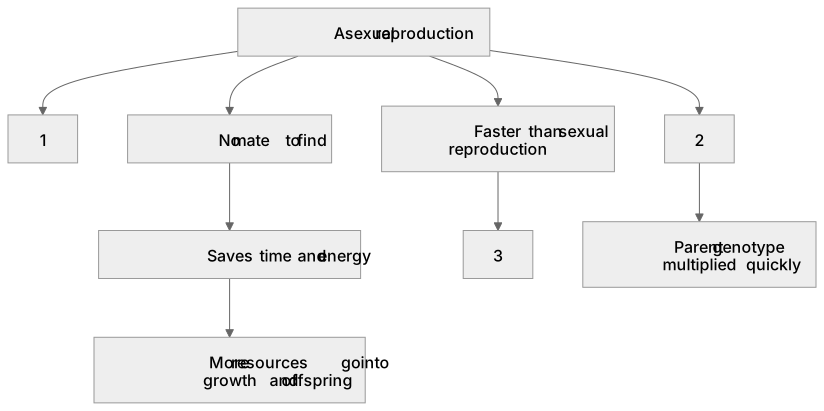
1Box 1
2Box 2
3Box 3
There is more to this lesson
The full lesson goes on to check your understanding and help you earn the marks. Create a free account to carry on, with your progress saved.
A week of Premium from your first lesson · Then the free plan continues · No card, no charge
Test your understanding of Advantages and disadvantages of sexual and asexual reproduction (biology only): Advantages of asexual reproduction: • only one parent needed • more time and energy efficient as do not need to find a mate • faster than sexual reproduction • many identical offspring can be produced when conditions are favourable.
Active recall beats re-reading. Take an instant quiz now to test what you’ve learned and lock it into long-term memory.
A week of Premium from your first lesson · Then the free plan continues · No card, no charge