AQA · GCSE · Biology
Course version: 8461 · Version from Sept 2018
Some organisms reproduce by both methods depending on the circumstances.
Full specification wording
Advantages and disadvantages of sexual and asexual reproduction (biology only): Some organisms reproduce by both methods depending on the circumstances.
Many organisms can switch between asexual and sexual reproduction according to conditions.
Checked against the AQA 8461 specification (opens in a new tab) on .
- Point 3 of 8
Study notes
From the checked teaching notes for this specification point.
The idea
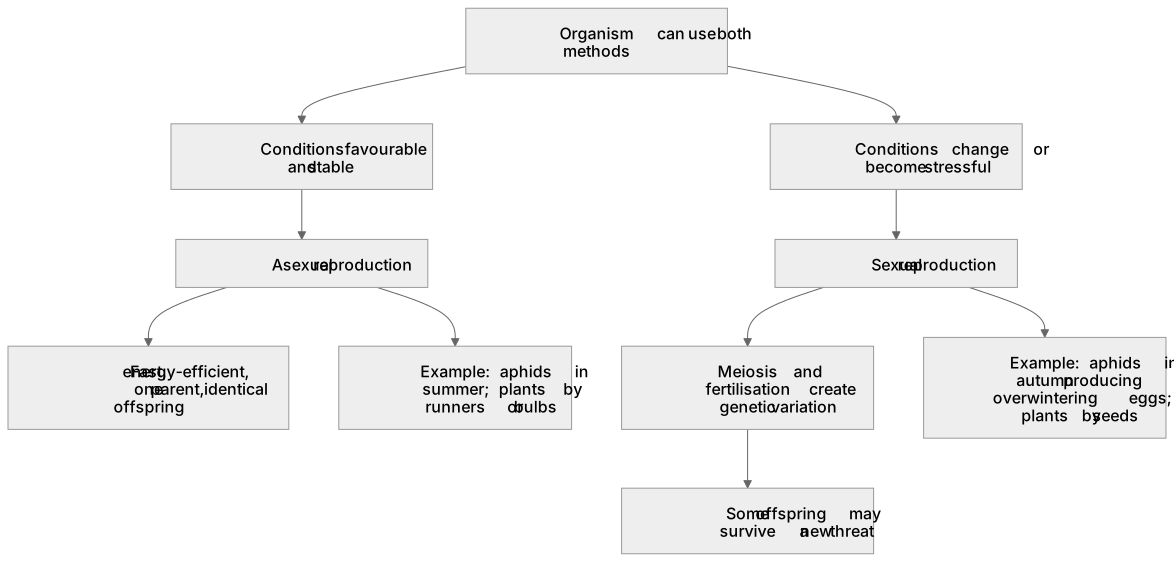
Many organisms can switch between asexual and sexual reproduction according to conditions. Asexual reproduction is favoured when the environment is stable and favourable, because it is fast, needs one parent and produces many identical offspring. Sexual reproduction is favoured when conditions change or become stressful, because meiosis and fertilisation create genetic variation, so some offspring may survive a new threat such as disease, drought or a new predator. For example, aphids reproduce asexually in summer when food is plentiful, but sexually in autumn, producing eggs that survive winter. Some plants spread by runners or bulbs in good conditions but produce flowers and seeds when stressed. The skill is to link each method to the circumstance and explain the benefit in terms of speed, energy or variation.
What earns the marks
- Asexual reproduction is used when conditions are favourable and stable, because it is fast, energy-efficient and needs only one parent.
- Sexual reproduction is used when conditions change or become stressful, because genetic variation may allow some offspring to survive.
- Aphids reproduce asexually in summer and sexually in autumn, producing overwintering eggs.
- Some plants reproduce asexually by runners or bulbs in good conditions and sexually by seeds when conditions change.
- The switch is an adaptation that balances rapid cloning against the survival value of genetic variation.
Common mistakes and how to put them right
Stating that an organism uses only one method for life.
Put it right: Some organisms use both methods at different times or in different circumstances.
Claiming that asexual reproduction creates variation that helps survival.
Put it right: Sexual reproduction creates the variation, while asexual reproduction produces identical offspring.
Giving no circumstance for the switch.
Put it right: State the condition, such as favourable versus stressful or changing environments.
Exam tips
- Name the organism and the two circumstances, then state which method is used in each.
- Explain the benefit of the chosen method using speed, energy or genetic variation.
- Use a named example such as aphids or strawberry plants to make the answer concrete.
Try the lesson
The start of the Advantages and disadvantages of sexual and asexual reproduction (biology only): Some organisms reproduce by both methods depending on the circumstances. lesson, made from checked teaching notes for this specification point.
Have a go first
Which of the following is an example of an organism that reproduces by both sexual and asexual methods depending on the circumstances?
Listen
Many organisms can switch between asexual and sexual reproduction according to conditions. Asexual reproduction is favoured when the environment is stable and favourable, because it is fast, needs one parent and produces many identical offspring. Sexual reproduction is favoured when conditions change or become stressful, because meiosis and fertilisation create genetic variation, so some offspring may survive a new threat such as disease, drought or a new predator. For example, aphids reproduce asexually in summer when food is plentiful, but sexually in autumn, producing eggs that survive winter. Some plants spread by runners or bulbs in good conditions but produce flowers and seeds when stressed. The skill is to link each method to the circumstance and explain the benefit in terms of speed, energy or variation. A strong answer earns marks for these points. Asexual reproduction is used when conditions are favourable and stable, because it is fast, energy-efficient and needs only one parent. Sexual reproduction is used when conditions change or become stressful, because genetic variation may allow some offspring to survive. Aphids reproduce asexually in summer and sexually in autumn, producing overwintering eggs. Some plants reproduce asexually by runners or bulbs in good conditions and sexually by seeds when conditions change. A common slip: Stating that an organism uses only one method for life. Instead, some organisms use both methods at different times or in different circumstances. Exam tip: Name the organism and the two circumstances, then state which method is used in each.
See it
Label the diagram
Some boxes have lost their names. Pick the right name for each number.
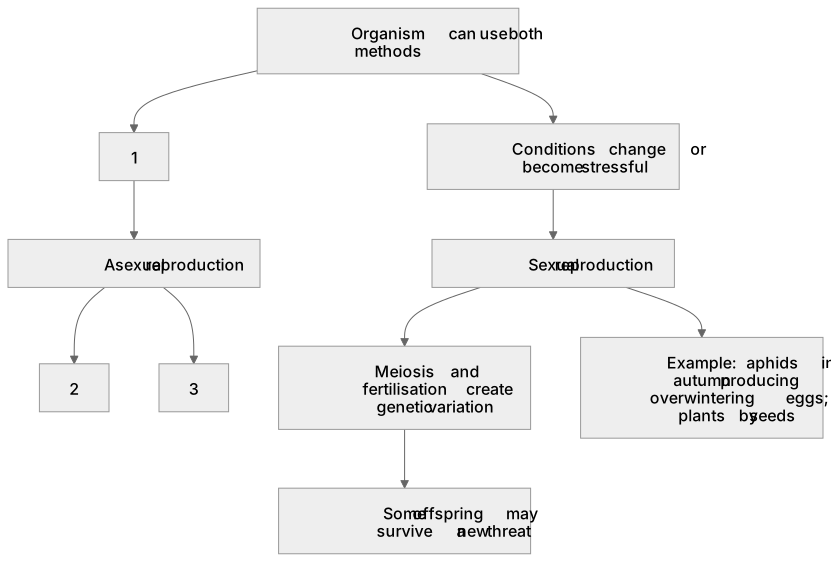
1Box 1
2Box 2
3Box 3
There is more to this lesson
The full lesson goes on to check your understanding and help you earn the marks. Create a free account to carry on, with your progress saved.
A week of Premium from your first lesson · Then the free plan continues · No card, no charge
Test your understanding of Advantages and disadvantages of sexual and asexual reproduction (biology only): Some organisms reproduce by both methods depending on the circumstances.
Active recall beats re-reading. Take an instant quiz now to test what you’ve learned and lock it into long-term memory.
A week of Premium from your first lesson · Then the free plan continues · No card, no charge