AQA · GCSE · Biology
Course version: 8461 · Version from Sept 2018
Malarial parasites reproduce asexually in the human host, but sexually in…
Full specification wording
Advantages and disadvantages of sexual and asexual reproduction (biology only): Malarial parasites reproduce asexually in the human host, but sexually in the mosquito.
Malaria is caused by Plasmodium, a protozoan parasite spread by female Anopheles mosquitoes.
Checked against the AQA 8461 specification (opens in a new tab) on .
- Point 4 of 8
- 3 key terms
Study notes
From the checked teaching notes for this specification point.
The idea
Malaria is caused by Plasmodium, a protozoan parasite spread by female Anopheles mosquitoes. The parasite has two hosts and switches reproductive mode between them. In the human host, Plasmodium reproduces asexually inside red blood cells and liver cells, multiplying rapidly to produce many identical parasites; this causes symptoms. When a mosquito bites an infected person, it takes up gametocytes. Inside the mosquito gut, these develop into gametes which fuse sexually to form a zygote, generating genetic variation. The mosquito carries infective stages to the next person. Asexual reproduction in humans amplifies numbers, while sexual reproduction in the mosquito creates variation and completes the life cycle.
What earns the marks
- Plasmodium is a protozoan parasite transmitted by female Anopheles mosquitoes.
- In the human host, reproduction is asexual, producing genetically identical parasites rapidly inside red blood cells and liver cells.
- Asexual reproduction in humans amplifies parasite numbers and causes the symptoms of malaria.
- Gametocytes are taken up by a mosquito when it feeds on an infected person.
- In the mosquito, gametes fuse sexually to form a zygote, generating genetic variation.
- The sexual stage in the mosquito completes the life cycle and produces infective stages passed on at the next bite.
- The two modes occur in different hosts, so the life cycle depends on both humans and mosquitoes.
Common mistakes and how to put them right
Thinking the mosquito itself is the parasite.
Put it right: The mosquito is the vector, while Plasmodium is the parasite.
Saying reproduction is sexual in humans and asexual in the mosquito.
Put it right: The order is the reverse.
Believing the mosquito becomes ill from malaria.
Put it right: The parasite's sexual stage occurs in the mosquito but the serious disease is in humans.
Confusing gametocytes with gametes.
Put it right: Gametocytes are the cells taken up by the mosquito and develop into gametes there.
Exam tips
- Name both hosts and state clearly which reproductive mode occurs in each.
- Use the terms asexual, sexual, gametocyte, gamete, zygote and vector accurately.
- Link asexual reproduction to rapid increase in parasite numbers and sexual reproduction to variation.
- When asked to explain the life cycle, sequence the stages from human to mosquito to human.
Try the lesson
The start of the Advantages and disadvantages of sexual and asexual reproduction (biology only): Malarial parasites reproduce asexually in the human host, but sexually in the mosquito. lesson, made from checked teaching notes for this specification point.
Have a go first
Where does the malarial parasite reproduce sexually?
Listen
Malaria is caused by Plasmodium, a protozoan parasite spread by female Anopheles mosquitoes. The parasite has two hosts and switches reproductive mode between them. In the human host, Plasmodium reproduces asexually inside red blood cells and liver cells, multiplying rapidly to produce many identical parasites; this causes symptoms. When a mosquito bites an infected person, it takes up gametocytes. Inside the mosquito gut, these develop into gametes which fuse sexually to form a zygote, generating genetic variation. The mosquito carries infective stages to the next person. Asexual reproduction in humans amplifies numbers, while sexual reproduction in the mosquito creates variation and completes the life cycle. A strong answer earns marks for these points. Plasmodium is a protozoan parasite transmitted by female Anopheles mosquitoes. In the human host, reproduction is asexual, producing genetically identical parasites rapidly inside red blood cells and liver cells. Asexual reproduction in humans amplifies parasite numbers and causes the symptoms of malaria. Gametocytes are taken up by a mosquito when it feeds on an infected person. Exam tip: Name both hosts and state clearly which reproductive mode occurs in each.
See it
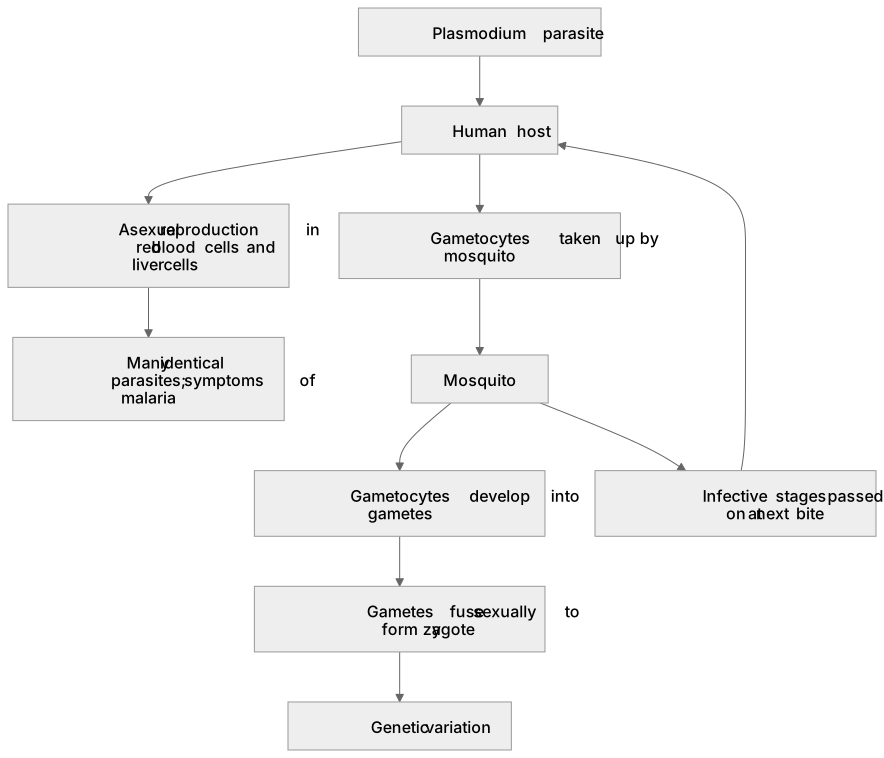
Key words
Say what each word means before you turn the card.
Asexual reproduction
Try answering aloud or in your head before turning the card.
Sexual reproduction
Try answering aloud or in your head before turning the card.
Vector
Try answering aloud or in your head before turning the card.
See every definition
- Asexual reproduction
- In the human host, Plasmodium reproduces asexually inside red blood cells and liver cells, multiplying rapidly to produce many identical parasites.
- Sexual reproduction
- In the mosquito, gametes fuse sexually to form a zygote, generating genetic variation.
- Vector
- The mosquito is the vector, while Plasmodium is the parasite.
Label the diagram
Some boxes have lost their names. Pick the right name for each number.
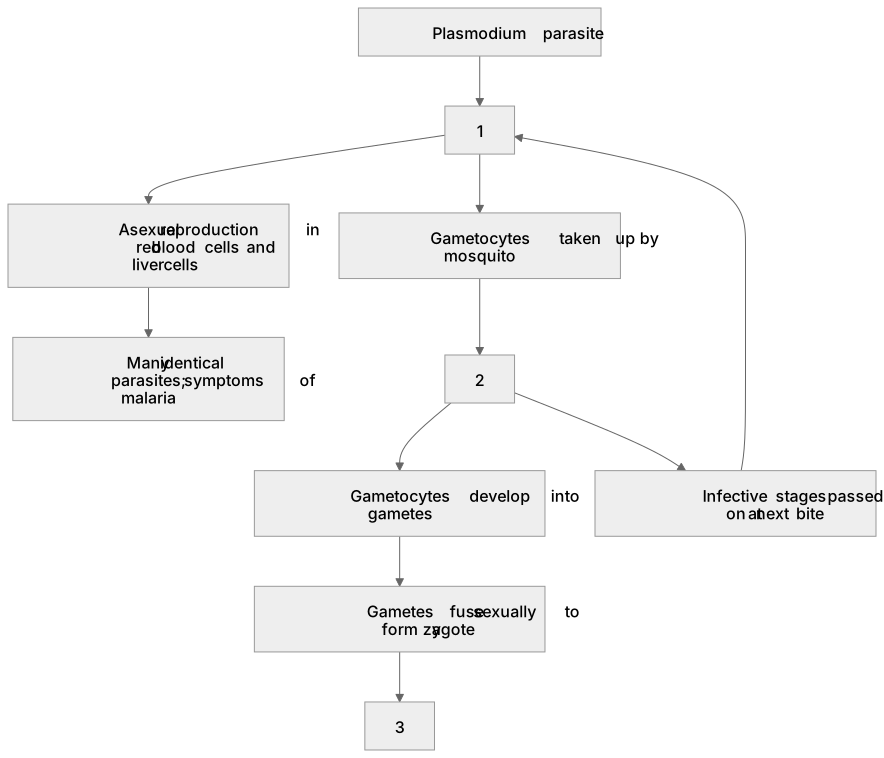
1Box 1
2Box 2
3Box 3
There is more to this lesson
The full lesson goes on to check your understanding and help you earn the marks. Create a free account to carry on, with your progress saved.
A week of Premium from your first lesson · Then the free plan continues · No card, no charge
Test your understanding of Advantages and disadvantages of sexual and asexual reproduction (biology only): Malarial parasites reproduce asexually in the human host, but sexually in the mosquito.
Active recall beats re-reading. Take an instant quiz now to test what you’ve learned and lock it into long-term memory.
A week of Premium from your first lesson · Then the free plan continues · No card, no charge