AQA · GCSE · Biology
Course version: 8461 · Version from Sept 2018
Students should be able to describe cellular respiration as an exothermic…
Full specification wording
Aerobic and anaerobic respiration: Students should be able to describe cellular respiration as an exothermic reaction which is continuously occurring in living cells.
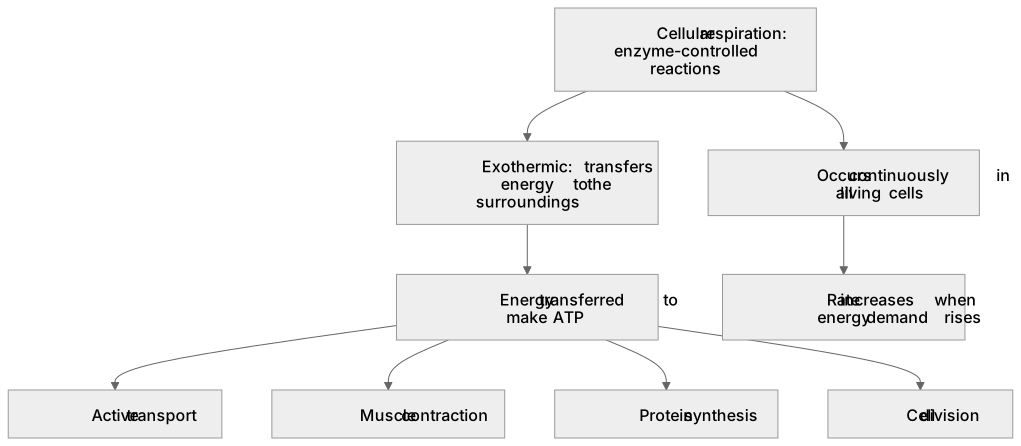
Cellular respiration is the set of enzyme-controlled reactions that transfer energy from glucose and other respiratory substrates to ATP and heat.
Checked against the AQA 8461 specification (opens in a new tab) on .
- Point 1 of 6
- 3 key terms
Study notes
From the checked teaching notes for this specification point.
The idea
Cellular respiration is the set of enzyme-controlled reactions that transfer energy from glucose and other respiratory substrates to ATP and heat. It is exothermic because the energy released when bonds form in the products is greater than the energy needed to break bonds in the reactants, so the overall reaction transfers energy to the surroundings. Respiration occurs continuously in all living cells, including plant cells, because the energy it transfers is needed for processes such as active transport, muscle contraction, protein synthesis and cell division. In aerobic respiration, glucose and oxygen are reactants and carbon dioxide and water are products. Anaerobic respiration occurs without oxygen and releases less energy per glucose molecule. The continuous nature means that even resting cells respire, and the rate increases when energy demand rises, for example during exercise.
What earns the marks
- Respiration is a series of enzyme-controlled reactions that release energy from glucose and other substrates.
- The energy transferred is used to make ATP, which supplies energy for cellular processes.
- Respiration occurs continuously in all living cells, not only in animals or only during exercise.
- Aerobic respiration uses oxygen and releases more energy per glucose molecule than anaerobic respiration.
- The word equation for aerobic respiration is glucose + oxygen → carbon dioxide + water, with energy transferred.
Common mistakes and how to put them right
Describing respiration as breathing.
Put it right: Breathing is ventilation, whereas respiration is the chemical process in cells.
Saying respiration is endothermic because it needs glucose.
Put it right: It is exothermic overall because it transfers energy to the surroundings.
Believing respiration stops when a person is resting.
Put it right: It is continuous in living cells, though the rate can change.
Exam tips
- Use the term 'exothermic' and explain it in terms of energy transferred to the surroundings, not just 'gives out heat'.
- When comparing aerobic and anaerobic respiration, state the oxygen requirement and the relative energy released.
- Link continuous respiration to a specific process such as active transport in root hair cells to show understanding.
Try the lesson
The start of the Aerobic and anaerobic respiration: Students should be able to describe cellular respiration as an exothermic reaction which is continuously occurring in living cells. lesson, made from checked teaching notes for this specification point.
Have a go first
A runner's muscle cells continue to release energy during a race. Which statement best describes cellular respiration in these cells?
Listen
Cellular respiration is the set of enzyme-controlled reactions that transfer energy from glucose and other respiratory substrates to ATP and heat. It is exothermic because the energy released when bonds form in the products is greater than the energy needed to break bonds in the reactants, so the overall reaction transfers energy to the surroundings. Respiration occurs continuously in all living cells, including plant cells, because the energy it transfers is needed for processes such as active transport, muscle contraction, protein synthesis and cell division. In aerobic respiration, glucose and oxygen are reactants and carbon dioxide and water are products. Anaerobic respiration occurs without oxygen and releases less energy per glucose molecule. The continuous nature means that even resting cells respire, and the rate increases when energy demand rises, for example during exercise. A strong answer earns marks for these points. Respiration is a series of enzyme-controlled reactions that release energy from glucose and other substrates. The energy transferred is used to make ATP, which supplies energy for cellular processes. Respiration occurs continuously in all living cells, not only in animals or only during exercise. Aerobic respiration uses oxygen and releases more energy per glucose molecule than anaerobic respiration. A common slip: Describing respiration as breathing. Instead, breathing is ventilation, whereas respiration is the chemical process in cells. Exam tip: Use the term 'exothermic' and explain it in terms of energy transferred to the surroundings, not just 'gives out heat'.
See it
Key words
Say what each word means before you turn the card.
Cellular respiration
Try answering aloud or in your head before turning the card.
Exothermic reactions
Try answering aloud or in your head before turning the card.
Aerobic and anaerobic pathways
Try answering aloud or in your head before turning the card.
See every definition
- Cellular respiration
- A set of enzyme-controlled reactions that transfer energy from glucose and other respiratory substrates to ATP and heat.
- Exothermic reactions
- Reactions in which the energy released when bonds form in the products is greater than the energy needed to break bonds in the reactants, so energy is transferred to the surroundings.
- Aerobic and anaerobic pathways
- Aerobic respiration uses glucose and oxygen as reactants and releases more energy per glucose molecule, while anaerobic respiration occurs without oxygen and releases less energy per glucose molecule.
Label the diagram
Some boxes have lost their names. Pick the right name for each number.
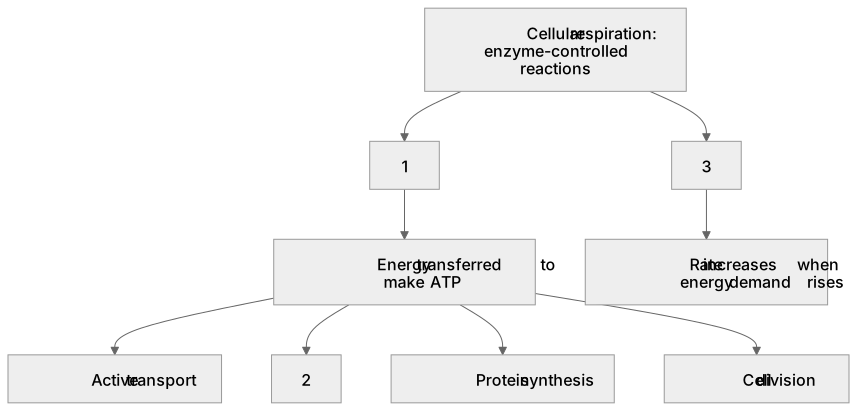
1Box 1
2Box 2
3Box 3
There is more to this lesson
The full lesson goes on to check your understanding and help you earn the marks. Create a free account to carry on, with your progress saved.
A week of Premium from your first lesson · Then the free plan continues · No card, no charge
Test your understanding of Aerobic and anaerobic respiration: Students should be able to describe cellular respiration as an exothermic reaction which is continuously occurring in living cells.
Active recall beats re-reading. Take an instant quiz now to test what you’ve learned and lock it into long-term memory.
A week of Premium from your first lesson · Then the free plan continues · No card, no charge