AQA · GCSE · Biology
Course version: 8461 · Version from Sept 2018
The energy transferred supplies all the energy needed for living processes.
Full specification wording
Aerobic and anaerobic respiration: The energy transferred supplies all the energy needed for living processes.
The energy transferred by respiration is essential for all living processes.
Checked against the AQA 8461 specification (opens in a new tab) on .
- Point 2 of 6
- 4 key terms
Study notes
From the checked teaching notes for this specification point.
The idea
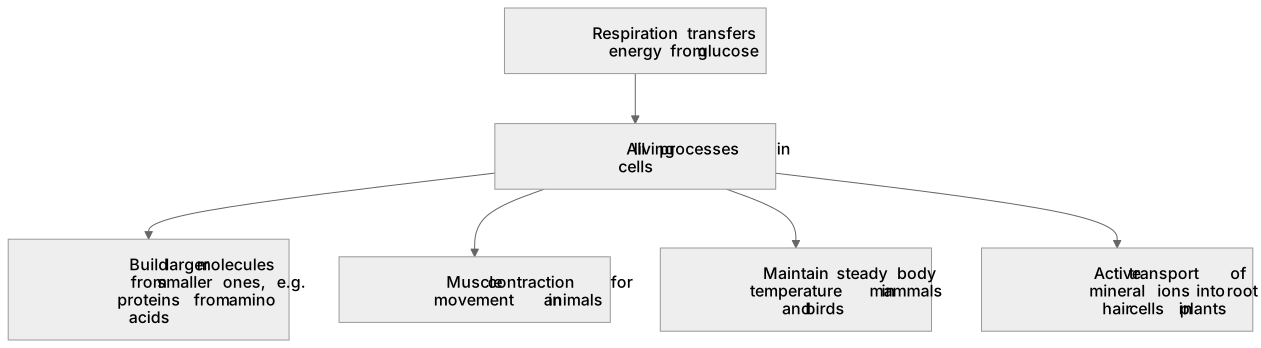
The energy transferred by respiration is essential for all living processes. It is a continuous process occurring in every living cell. In animals, this energy is used for muscle contraction, enabling movement. In mammals and birds, respiratory energy is used to maintain a steady body temperature in colder surroundings. Across all organisms, the energy transferred is used to build larger molecules from smaller ones, such as synthesising proteins from amino acids. In plants, it also powers the active transport of mineral ions, like nitrates, from the soil into root hair cells. Respiration does not 'create' energy; it transfers energy from chemical stores in glucose to power these vital cellular activities.
What earns the marks
- Respiration transfers energy that is essential for all living processes in cells.
- Energy from respiration is used to build larger molecules from smaller ones, such as making proteins from amino acids.
- In animals, the energy transferred by respiration is required for muscle contraction to allow movement.
- In mammals and birds, respiratory energy is used to keep their bodies warm and maintain a constant internal temperature.
- In plants, energy from respiration is needed for the active transport of mineral ions into root hair cells.
Common mistakes and how to put them right
Stating that respiration 'produces' or 'creates' energy.
Put it right: Energy cannot be created; respiration 'transfers' energy from glucose.
Believing that only animals respire.
Put it right: Plants also respire continuously to transfer energy for processes like building molecules and active transport.
Including A-level concepts like ATP or sliding filaments in GCSE answers.
Put it right: Stick to GCSE concepts such as building larger molecules, movement, and keeping warm.
Exam tips
- Always use the phrase 'transfers energy' rather than 'makes energy' or 'produces energy' when defining respiration.
- Be prepared to list three specific uses of energy from respiration: building larger molecules, movement, and keeping warm.
Try the lesson
The start of the Aerobic and anaerobic respiration: The energy transferred supplies all the energy needed for living processes. lesson, made from checked teaching notes for this specification point.
Have a go first
Which process transfers the energy that supplies all the energy needed for living processes in a cell?
Listen
The energy transferred by respiration is essential for all living processes. It is a continuous process occurring in every living cell. In animals, this energy is used for muscle contraction, enabling movement. In mammals and birds, respiratory energy is used to maintain a steady body temperature in colder surroundings. Across all organisms, the energy transferred is used to build larger molecules from smaller ones, such as synthesising proteins from amino acids. In plants, it also powers the active transport of mineral ions, like nitrates, from the soil into root hair cells. Respiration does not 'create' energy; it transfers energy from chemical stores in glucose to power these vital cellular activities. A strong answer earns marks for these points. Respiration transfers energy that is essential for all living processes in cells. Energy from respiration is used to build larger molecules from smaller ones, such as making proteins from amino acids. In animals, the energy transferred by respiration is required for muscle contraction to allow movement. In mammals and birds, respiratory energy is used to keep their bodies warm and maintain a constant internal temperature. A common slip: Stating that respiration 'produces' or 'creates' energy. Instead, energy cannot be created; respiration 'transfers' energy from glucose. Exam tip: Always use the phrase 'transfers energy' rather than 'makes energy' or 'produces energy' when defining respiration.
See it
Key words
Say what each word means before you turn the card.
Cellular respiration
Try answering aloud or in your head before turning the card.
Energy transfer
Try answering aloud or in your head before turning the card.
Metabolism and synthesis
Try answering aloud or in your head before turning the card.
Homeostasis and movement
Try answering aloud or in your head before turning the card.
See every definition
- Cellular respiration
- A continuous process occurring in every living cell that transfers energy from chemical stores in glucose to power vital cellular activities.
- Energy transfer
- The movement of energy from chemical stores in glucose to supply all the energy needed for living processes, without creating energy.
- Metabolism and synthesis
- The use of transferred energy to build larger molecules from smaller ones, such as synthesising proteins from amino acids.
- Homeostasis and movement
- The use of respiratory energy for muscle contraction enabling movement, and in mammals and birds to maintain a steady body temperature in colder surroundings.
Label the diagram
Some boxes have lost their names. Pick the right name for each number.
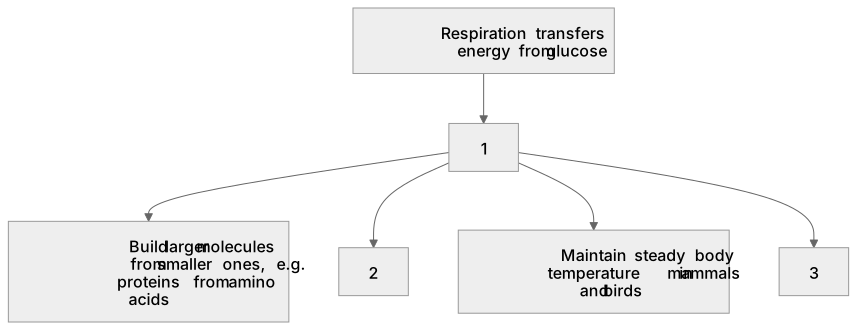
1Box 1
2Box 2
3Box 3
There is more to this lesson
The full lesson goes on to check your understanding and help you earn the marks. Create a free account to carry on, with your progress saved.
A week of Premium from your first lesson · Then the free plan continues · No card, no charge
Test your understanding of Aerobic and anaerobic respiration: The energy transferred supplies all the energy needed for living processes.
Active recall beats re-reading. Take an instant quiz now to test what you’ve learned and lock it into long-term memory.
A week of Premium from your first lesson · Then the free plan continues · No card, no charge