AQA · GCSE · Biology
Course version: 8461 · Version from Sept 2018
In the UK, poultry are vaccinated against Salmonella to control the spread.
Full specification wording
Bacterial diseases: In the UK, poultry are vaccinated against Salmonella to control the spread.
Salmonella is a bacterium that can cause food poisoning in humans, typically after eating contaminated food such as undercooked chicken or eggs.
Checked against the AQA 8461 specification (opens in a new tab) on .
- Point 2 of 7
- 3 key terms
Study notes
From the checked teaching notes for this specification point.
The idea
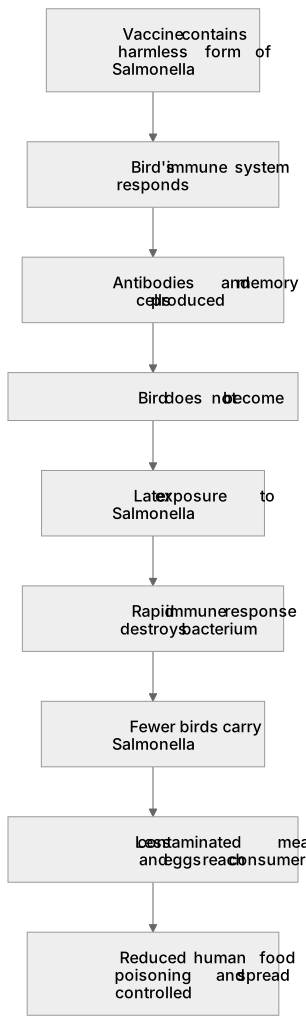
Salmonella is a bacterium that can cause food poisoning in humans, typically after eating contaminated food such as undercooked chicken or eggs. In the UK, poultry such as chickens and turkeys are routinely vaccinated against Salmonella. Vaccination introduces a harmless form of the pathogen, so the bird's immune system produces antibodies and memory cells without becoming ill. If the bird later meets Salmonella, its immune response is rapid and the bacterium is destroyed, so fewer birds carry the pathogen. This reduces the chance that contaminated meat or eggs reach consumers, breaking the chain of transmission and controlling the spread of the disease. The vaccination programme is therefore a preventive control measure rather than a treatment for infected birds.
What earns the marks
- Salmonella is a bacterium that causes food poisoning in humans, often linked to eating contaminated poultry or eggs.
- Vaccination gives poultry immunity without causing the disease, because the vaccine contains a harmless form of the pathogen.
- Immune memory means vaccinated birds destroy Salmonella quickly on later exposure, so they are less likely to carry and shed the bacterium.
- Fewer infected birds means less contaminated meat and eggs reach consumers, reducing human cases and controlling spread.
- Vaccination is a preventive control measure applied to the poultry population, not a cure for birds already infected.
Common mistakes and how to put them right
Thinking the vaccine treats a bird that already has Salmonella.
Put it right: Vaccination prevents disease by preparing the immune system before exposure.
Confusing vaccination with antibiotic treatment.
Put it right: Vaccines stimulate immunity, whereas antibiotics kill bacteria in an infected individual.
Assuming vaccination guarantees zero Salmonella in all poultry products.
Put it right: It greatly reduces the risk but hygiene and cooking remain important.
Exam tips
- Link the vaccination of poultry directly to reduced human food poisoning, not just to healthier birds.
- Use the terms immune system, antibodies and memory cells to show the biological mechanism.
- If asked to evaluate control measures, compare vaccination with hygiene measures such as cooking food thoroughly and refrigerating it correctly.
Try the lesson
The start of the Bacterial diseases: In the UK, poultry are vaccinated against Salmonella to control the spread. lesson, made from checked teaching notes for this specification point.
Have a go first
In the UK, why are poultry vaccinated against Salmonella?
Listen
Salmonella is a bacterium that can cause food poisoning in humans, typically after eating contaminated food such as undercooked chicken or eggs. In the UK, poultry such as chickens and turkeys are routinely vaccinated against Salmonella. Vaccination introduces a harmless form of the pathogen, so the bird's immune system produces antibodies and memory cells without becoming ill. If the bird later meets Salmonella, its immune response is rapid and the bacterium is destroyed, so fewer birds carry the pathogen. This reduces the chance that contaminated meat or eggs reach consumers, breaking the chain of transmission and controlling the spread of the disease. The vaccination programme is therefore a preventive control measure rather than a treatment for infected birds. A strong answer earns marks for these points. Salmonella is a bacterium that causes food poisoning in humans, often linked to eating contaminated poultry or eggs. Vaccination gives poultry immunity without causing the disease, because the vaccine contains a harmless form of the pathogen. Immune memory means vaccinated birds destroy Salmonella quickly on later exposure, so they are less likely to carry and shed the bacterium. Fewer infected birds means less contaminated meat and eggs reach consumers, reducing human cases and controlling spread. A common slip: Thinking the vaccine treats a bird that already has Salmonella. Instead, vaccination prevents disease by preparing the immune system before exposure. Exam tip: Link the vaccination of poultry directly to reduced human food poisoning, not just to healthier birds.
See it
Key words
Say what each word means before you turn the card.
Salmonella
Try answering aloud or in your head before turning the card.
Vaccination
Try answering aloud or in your head before turning the card.
Preventive control measure
Try answering aloud or in your head before turning the card.
See every definition
- Salmonella
- A bacterium that can cause food poisoning in humans, typically after eating contaminated food such as undercooked chicken or eggs.
- Vaccination
- Introduces a harmless form of the pathogen, so the bird's immune system produces antibodies and memory cells without becoming ill.
- Preventive control measure
- A measure applied to the poultry population rather than a treatment for infected birds, breaking the chain of transmission and controlling the spread of the disease.
Label the diagram
Some boxes have lost their names. Pick the right name for each number.
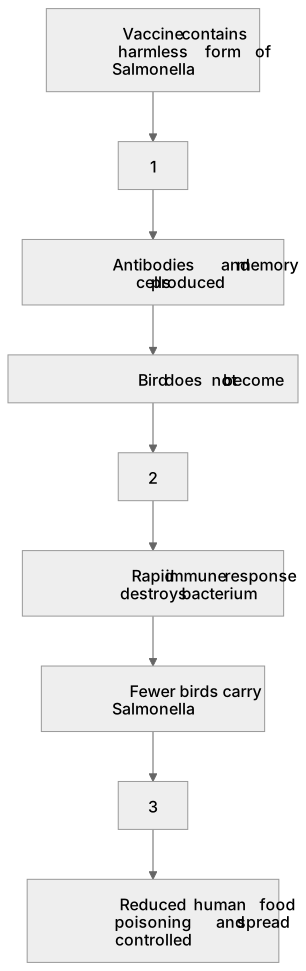
1Box 1
2Box 2
3Box 3
There is more to this lesson
The full lesson goes on to check your understanding and help you earn the marks. Create a free account to carry on, with your progress saved.
A week of Premium from your first lesson · Then the free plan continues · No card, no charge
Test your understanding of Bacterial diseases: In the UK, poultry are vaccinated against Salmonella to control the spread.
Active recall beats re-reading. Take an instant quiz now to test what you’ve learned and lock it into long-term memory.
A week of Premium from your first lesson · Then the free plan continues · No card, no charge