AQA · GCSE · Biology
Course version: 8461 · Version from Sept 2018
A great biodiversity ensures the stability of ecosystems by reducing the…
Full specification wording
Biodiversity: A great biodiversity ensures the stability of ecosystems by reducing the dependence of one species on another for food, shelter and the maintenance of the physical environment.
Stable ecosystems keep functioning when conditions change.
Checked against the AQA 8461 specification (opens in a new tab) on .
- Point 2 of 4
- 4 key terms
Study notes
From the checked teaching notes for this specification point.
The idea
Stable ecosystems keep functioning when conditions change. High biodiversity contributes to this stability because many species perform similar roles, so the loss of one species has less impact. If a woodland has several plant species providing food and shelter, a disease affecting one tree species does not remove all food and nesting sites. Similarly, several decomposers and pollinators may maintain nutrient cycling and reproduction. Where biodiversity is low, species depend heavily on one another: a single crop species, one pollinator or one decomposer may be essential, so its decline can collapse the whole community. Reducing dependence on any one species for food, shelter and maintaining the physical environment therefore buffers the ecosystem against change.
What earns the marks
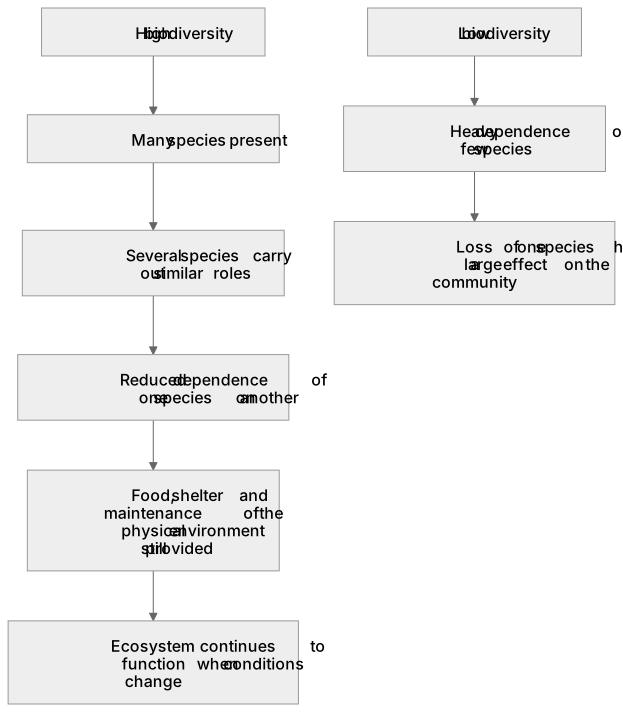
- High biodiversity means many species are present, so several species can carry out similar roles.
- If one species declines, others can still provide food, shelter or nutrient cycling, so the ecosystem continues to function.
- Low biodiversity creates heavy dependence on a few species, so the loss of one species can have a large effect on the community.
- Maintenance of the physical environment includes processes such as nutrient cycling, soil formation and water retention carried out by living organisms.
- Stability means the ecosystem can resist or recover from change, such as disease, drought or the arrival of a new predator.
- Reducing dependence between species is the mechanism linking high biodiversity to ecosystem stability.
Common mistakes and how to put them right
Saying high biodiversity means no species can ever be lost.
Put it right: It means the ecosystem is more likely to keep functioning when a species is lost, not that loss is impossible.
Treating stability as the same as no change.
Put it right: Stable ecosystems still change, but they continue to support a community of organisms.
Forgetting the physical environment.
Put it right: Decomposers and plants maintain soil and nutrient cycles, which is part of the stability described.
Exam tips
- Use the phrase 'reduces dependence on one species' and then give a concrete example such as several pollinators or several decomposers.
- Structure your answer as cause and effect: high biodiversity leads to several species per role, which leads to continued food, shelter and nutrient cycling.
- When asked about a low-biodiversity example such as a wheat field, explain that a single pest or disease could remove the dominant species and disrupt the whole community.
Try the lesson
The start of the Biodiversity: A great biodiversity ensures the stability of ecosystems by reducing the dependence of one species on another for food, shelter and the maintenance of the physical environment. lesson, made from checked teaching notes for this specification point.
Have a go first
Why does a high level of biodiversity help to ensure the stability of an ecosystem?
Listen
Stable ecosystems keep functioning when conditions change. High biodiversity contributes to this stability because many species perform similar roles, so the loss of one species has less impact. If a woodland has several plant species providing food and shelter, a disease affecting one tree species does not remove all food and nesting sites. Similarly, several decomposers and pollinators may maintain nutrient cycling and reproduction. Where biodiversity is low, species depend heavily on one another: a single crop species, one pollinator or one decomposer may be essential, so its decline can collapse the whole community. Reducing dependence on any one species for food, shelter and maintaining the physical environment therefore buffers the ecosystem against change. A strong answer earns marks for these points. High biodiversity means many species are present, so several species can carry out similar roles. If one species declines, others can still provide food, shelter or nutrient cycling, so the ecosystem continues to function. Low biodiversity creates heavy dependence on a few species, so the loss of one species can have a large effect on the community. Maintenance of the physical environment includes processes such as nutrient cycling, soil formation and water retention carried out by living organisms. Exam tip: Use the phrase 'reduces dependence on one species' and then give a concrete example such as several pollinators or several decomposers.
See it
Key words
Say what each word means before you turn the card.
Ecosystem stability
Try answering aloud or in your head before turning the card.
Reduced species dependence
Try answering aloud or in your head before turning the card.
Food and shelter provision
Try answering aloud or in your head before turning the card.
Maintenance of the physical environment
Try answering aloud or in your head before turning the card.
See every definition
- Ecosystem stability
- The ability of an ecosystem to keep functioning when conditions change, resisting or recovering from change such as disease, drought or the arrival of a new predator.
- Reduced species dependence
- The mechanism linking high biodiversity to ecosystem stability, because many species perform similar roles so the loss of one species has less impact.
- Food and shelter provision
- Roles that several species can carry out, so that if one species declines others can still provide food or shelter and the ecosystem continues to function.
- Maintenance of the physical environment
- Processes such as nutrient cycling, soil formation and water retention carried out by living organisms, which several species can still provide if one declines.
Label the diagram
Some boxes have lost their names. Pick the right name for each number.
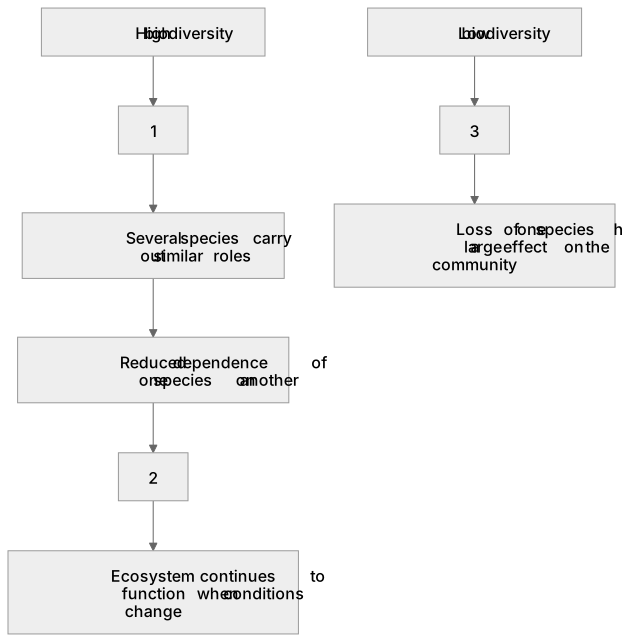
1Box 1
2Box 2
3Box 3
There is more to this lesson
The full lesson goes on to check your understanding and help you earn the marks. Create a free account to carry on, with your progress saved.
A week of Premium from your first lesson · Then the free plan continues · No card, no charge
Test your understanding of Biodiversity: A great biodiversity ensures the stability of ecosystems by reducing the dependence of one species on another for food, shelter and the maintenance of the physical environment.
Active recall beats re-reading. Take an instant quiz now to test what you’ve learned and lock it into long-term memory.
A week of Premium from your first lesson · Then the free plan continues · No card, no charge