AQA · GCSE · Biology
Course version: 8461 · Version from Sept 2018
Biodiversity is the variety of all the different species of organisms on…
Full specification wording
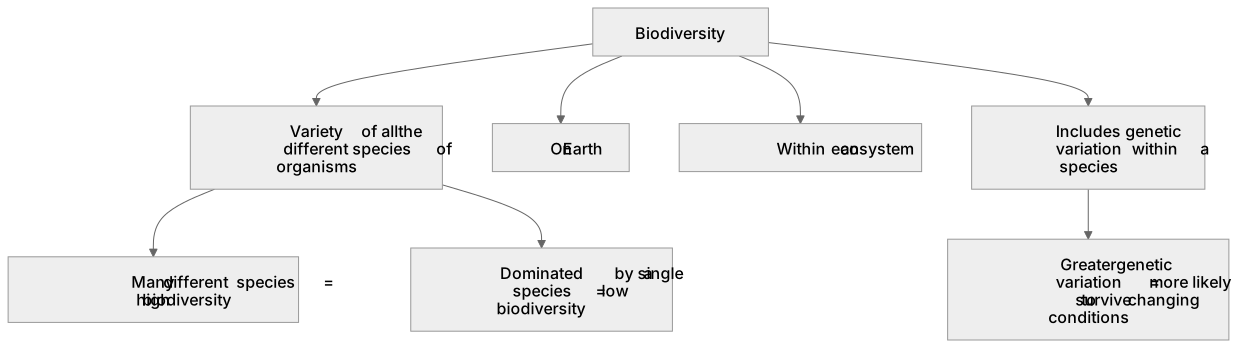
Biodiversity: Biodiversity is the variety of all the different species of organisms on earth, or within an ecosystem.
Biodiversity means the variety of life, measured as the number of different species present.
Checked against the AQA 8461 specification (opens in a new tab) on .
- Point 1 of 4
- 4 key terms
Study notes
From the checked teaching notes for this specification point.
The idea
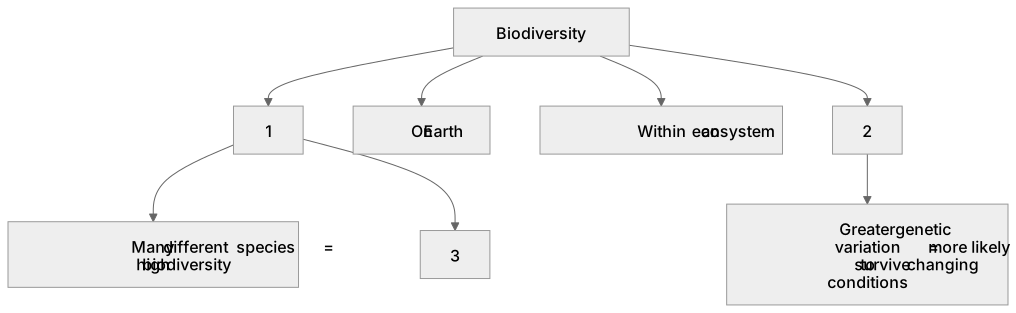
Biodiversity means the variety of life, measured as the number of different species present. It can be considered on a global scale, covering all species on Earth, or on a local scale within one ecosystem such as a pond or woodland. A habitat with many different species has high biodiversity; one dominated by a single species has low biodiversity. Biodiversity also includes the range of genetic variation within a species, because populations with greater genetic variation are more likely to survive changing conditions. When comparing two areas, count or estimate the number of species present rather than simply the total number of organisms, since a large population of one species does not give high biodiversity.
What earns the marks
- Biodiversity is the variety of different species, not simply the total number of individual organisms.
- An ecosystem with many different species has high biodiversity; one with few species has low biodiversity.
- Biodiversity includes genetic variation within a species as well as the number of species.
- Comparing biodiversity between two areas requires identifying and counting the different species present, not just counting individuals.
- High biodiversity makes an ecosystem better able to withstand environmental change because different species respond in different ways.
Common mistakes and how to put them right
Confusing biodiversity with population size.
Put it right: A field containing thousands of one grass species has a large population but low biodiversity.
Thinking biodiversity applies only to the whole planet.
Put it right: It can also describe a single ecosystem, such as a hedgerow or rock pool.
Ignoring genetic variation: two woodlands with the same species list can differ in biodiversity if one population has much less genetic variation.
Exam tips
- Define biodiversity in terms of variety of species, and add 'within an ecosystem or on Earth' to show you understand both scales.
- When comparing two habitats, refer to the number of different species present and give a clear conclusion about which has greater biodiversity.
- If a question mentions genetic variation, link it to biodiversity by explaining that variation within a species is part of the variety of life.
Try the lesson
The start of the Biodiversity: Biodiversity is the variety of all the different species of organisms on earth, or within an ecosystem. lesson, made from checked teaching notes for this specification point.
Have a go first
Which statement best describes biodiversity?
Listen
Biodiversity means the variety of life, measured as the number of different species present. It can be considered on a global scale, covering all species on Earth, or on a local scale within one ecosystem such as a pond or woodland. A habitat with many different species has high biodiversity; one dominated by a single species has low biodiversity. Biodiversity also includes the range of genetic variation within a species, because populations with greater genetic variation are more likely to survive changing conditions. When comparing two areas, count or estimate the number of species present rather than simply the total number of organisms, since a large population of one species does not give high biodiversity. A strong answer earns marks for these points. Biodiversity is the variety of different species, not simply the total number of individual organisms. An ecosystem with many different species has high biodiversity; one with few species has low biodiversity. Biodiversity includes genetic variation within a species as well as the number of species. Comparing biodiversity between two areas requires identifying and counting the different species present, not just counting individuals. Exam tip: Define biodiversity in terms of variety of species, and add 'within an ecosystem or on Earth' to show you understand both scales.
See it
Key words
Say what each word means before you turn the card.
Biodiversity
Try answering aloud or in your head before turning the card.
Global and local scales
Try answering aloud or in your head before turning the card.
Genetic variation within species
Try answering aloud or in your head before turning the card.
Ecosystem comparison
Try answering aloud or in your head before turning the card.
See every definition
- Biodiversity
- The variety of all the different species of organisms on earth, or within an ecosystem.
- Global and local scales
- Biodiversity can be considered on a global scale, covering all species on Earth, or on a local scale within one ecosystem such as a pond or woodland.
- Genetic variation within species
- The range of genetic variation within a species is part of biodiversity, because populations with greater genetic variation are more likely to survive changing conditions.
- Ecosystem comparison
- When comparing two areas, count or estimate the number of species present rather than simply the total number of organisms.
Label the diagram
Some boxes have lost their names. Pick the right name for each number.
1Box 1
2Box 2
3Box 3
There is more to this lesson
The full lesson goes on to check your understanding and help you earn the marks. Create a free account to carry on, with your progress saved.
A week of Premium from your first lesson · Then the free plan continues · No card, no charge
Test your understanding of Biodiversity: Biodiversity is the variety of all the different species of organisms on earth, or within an ecosystem.
Active recall beats re-reading. Take an instant quiz now to test what you’ve learned and lock it into long-term memory.
A week of Premium from your first lesson · Then the free plan continues · No card, no charge