AQA · GCSE · Biology
Course version: 8461 · Version from Sept 2018
Malignant tumour cells are cancers. They invade neighbouring tissues and…
Full specification wording
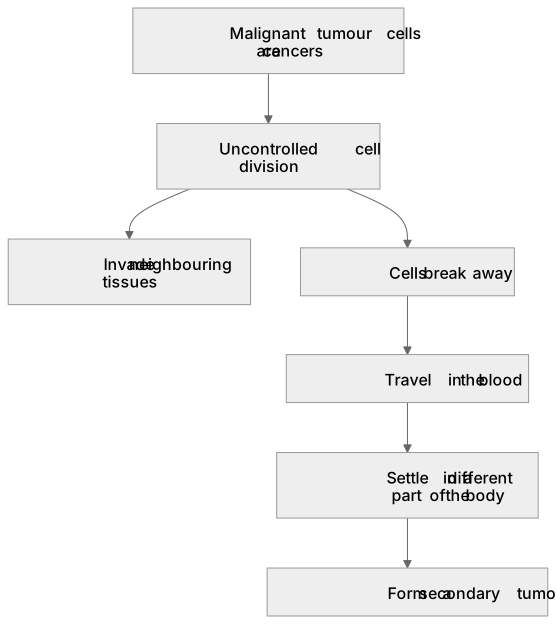
Cancer: Malignant tumour cells are cancers. They invade neighbouring tissues and spread to different parts of the body in the blood where they form secondary tumours.
A malignant tumour is a cancer.
Checked against the AQA 8461 specification (opens in a new tab) on .
- Point 3 of 5
- 3 key terms
Study notes
From the checked teaching notes for this specification point.
The idea
A malignant tumour is a cancer. Its cells divide uncontrollably and are not contained within a membrane, so they can break into neighbouring tissues and destroy them. Cells can also detach from the primary tumour and enter the bloodstream. Blood carries them around the body, and where they settle in another organ they divide to form a secondary tumour. This spreading process is called metastasis. For example, a primary tumour in the lung can release cells that travel in the blood and form secondary growths in the liver or brain. Because malignant cells reach many sites, treatment is more difficult than for a benign growth, and early detection improves the chance of successful treatment.
What earns the marks
- Malignant tumour cells are cancers, formed by uncontrolled cell division.
- Malignant cells invade neighbouring tissues and can damage them.
- Cells can break away and travel to other parts of the body in the blood.
- A tumour that forms at a new site is a secondary tumour.
- The spread of malignant cells makes treatment more difficult than for a benign tumour.
Common mistakes and how to put them right
Saying malignant cells travel in the blood but omitting that they form secondary tumours.
Put it right: State both transport and the new growth.
Using the words benign and malignant as if they were interchangeable.
Put it right: Only malignant tumours are cancers and only they invade and spread.
Claiming that a secondary tumour is a new, unrelated cancer.
Put it right: It formed from cells of the original primary tumour.
Exam tips
- Name the transport system explicitly: cells spread in the blood.
- Use the term secondary tumour when describing growth at a new site.
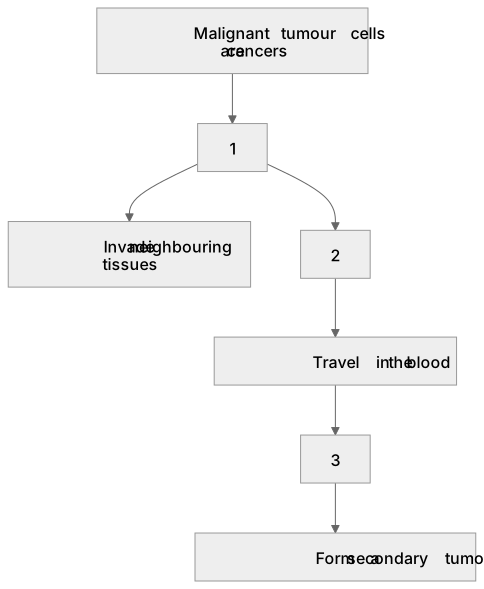
- Sequence the process: uncontrolled division, invasion, entry into blood, settlement, secondary tumour.
Try the lesson
The start of the Cancer: Malignant tumour cells are cancers. They invade neighbouring tissues and spread to different parts of the body in the blood where they form secondary tumours. lesson, made from checked teaching notes for this specification point.
Have a go first
What name is given to a tumour that invades neighbouring tissues and spreads in the blood?
Listen
A malignant tumour is a cancer. Its cells divide uncontrollably and are not contained within a membrane, so they can break into neighbouring tissues and destroy them. Cells can also detach from the primary tumour and enter the bloodstream. Blood carries them around the body, and where they settle in another organ they divide to form a secondary tumour. This spreading process is called metastasis. For example, a primary tumour in the lung can release cells that travel in the blood and form secondary growths in the liver or brain. Because malignant cells reach many sites, treatment is more difficult than for a benign growth, and early detection improves the chance of successful treatment. A strong answer earns marks for these points. Malignant tumour cells are cancers, formed by uncontrolled cell division. Malignant cells invade neighbouring tissues and can damage them. Cells can break away and travel to other parts of the body in the blood. A tumour that forms at a new site is a secondary tumour. A common slip: Saying malignant cells travel in the blood but omitting that they form secondary tumours. Instead, state both transport and the new growth. Exam tip: Name the transport system explicitly: cells spread in the blood.
See it
Key words
Say what each word means before you turn the card.
Invasion of tissues
Try answering aloud or in your head before turning the card.
Spread in the blood
Try answering aloud or in your head before turning the card.
Secondary tumours
Try answering aloud or in your head before turning the card.
See every definition
- Invasion of tissues
- Malignant cells invade neighbouring tissues and can damage them.
- Spread in the blood
- Cells can break away and travel to other parts of the body in the blood.
- Secondary tumours
- A tumour that forms at a new site is a secondary tumour.
Label the diagram
Some boxes have lost their names. Pick the right name for each number.
1Box 1
2Box 2
3Box 3
There is more to this lesson
The full lesson goes on to check your understanding and help you earn the marks. Create a free account to carry on, with your progress saved.
A week of Premium from your first lesson · Then the free plan continues · No card, no charge
Test your understanding of Cancer: Malignant tumour cells are cancers. They invade neighbouring tissues and spread to different parts of the body in the blood where they form secondary tumours.
Active recall beats re-reading. Take an instant quiz now to test what you’ve learned and lock it into long-term memory.
A week of Premium from your first lesson · Then the free plan continues · No card, no charge