AQA · GCSE · Biology
Course version: 8461 · Version from Sept 2018
Benign tumours are growths of abnormal cells which are contained in one…
Full specification wording
Cancer: Benign tumours are growths of abnormal cells which are contained in one area, usually within a membrane. They do not invade other parts of the body.
A benign tumour is a mass of abnormal cells that stays in the place where it first formed.
Checked against the AQA 8461 specification (opens in a new tab) on .
- Point 2 of 5
- 4 key terms
Study notes
From the checked teaching notes for this specification point.
The idea
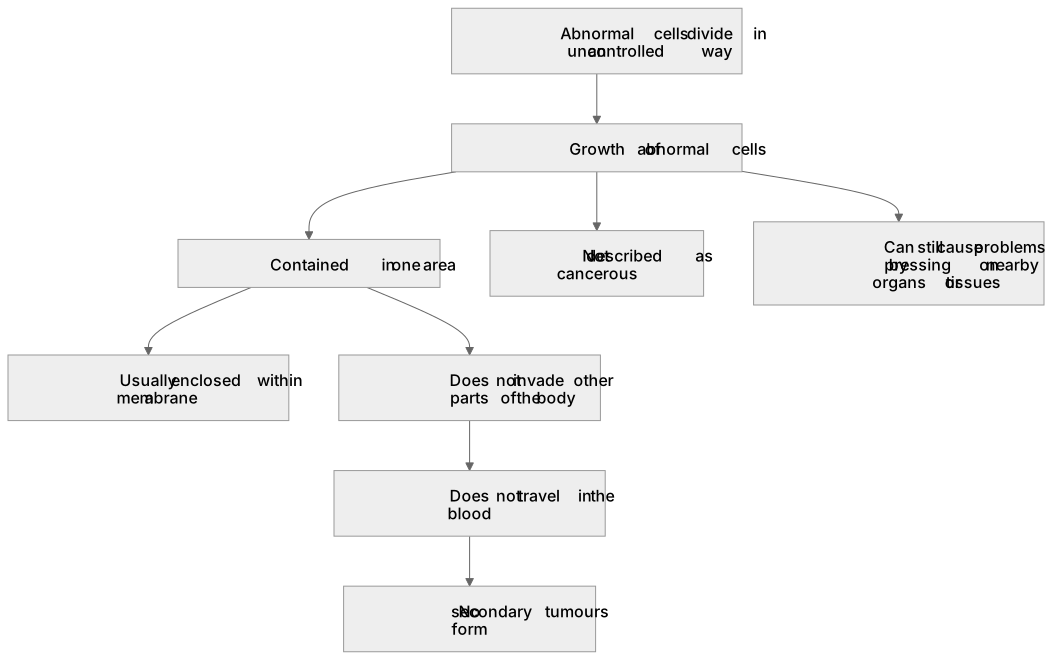
A benign tumour is a mass of abnormal cells that stays in the place where it first formed. The cells divide in an uncontrolled way, but the resulting growth is contained in one area, usually enclosed within a membrane. Because it remains localised, it does not invade neighbouring tissues and does not travel in the blood to form tumours elsewhere. A common example is a mole or wart on the skin: it may enlarge slowly and can be removed, but it does not spread through the body. Benign tumours are not described as cancerous, although a large one can still cause problems by pressing on nearby organs or tissues. Contrast this with a malignant tumour, which invades and spreads.
What earns the marks
- Benign tumours are growths of abnormal cells, meaning cell division has gone wrong but the cells remain grouped together.
- The growth is contained in one area and is usually enclosed within a membrane.
- Benign tumour cells do not invade neighbouring tissues.
- Benign tumour cells do not travel in the blood to other parts of the body, so no secondary tumours form.
- Benign tumours are not cancers, although they can still damage health by pressing on surrounding structures.
Common mistakes and how to put them right
Saying a benign tumour is harmless in every case.
Put it right: It does not spread, but it can still press on organs and cause problems.
Confusing benign with malignant and claiming benign tumours spread in the blood.
Put it right: Only malignant tumours invade and spread.
Describing a benign tumour as a group of normal cells.
Put it right: The cells are abnormal, but the growth stays localised.
Exam tips
- Use the phrase contained in one area when explaining why a benign tumour is not cancer.
- Link each feature to the outcome: no invasion and no spreading means no secondary tumours.
- If asked to compare, set out benign and malignant features side by side rather than describing only one type.
Try the lesson
The start of the Cancer: Benign tumours are growths of abnormal cells which are contained in one area, usually within a membrane. They do not invade other parts of the body. lesson, made from checked teaching notes for this specification point.
Have a go first
Which statement describes a benign tumour?
Listen
A benign tumour is a mass of abnormal cells that stays in the place where it first formed. The cells divide in an uncontrolled way, but the resulting growth is contained in one area, usually enclosed within a membrane. Because it remains localised, it does not invade neighbouring tissues and does not travel in the blood to form tumours elsewhere. A common example is a mole or wart on the skin: it may enlarge slowly and can be removed, but it does not spread through the body. Benign tumours are not described as cancerous, although a large one can still cause problems by pressing on nearby organs or tissues. Contrast this with a malignant tumour, which invades and spreads. A strong answer earns marks for these points. Benign tumours are growths of abnormal cells, meaning cell division has gone wrong but the cells remain grouped together. The growth is contained in one area and is usually enclosed within a membrane. Benign tumour cells do not invade neighbouring tissues. Benign tumour cells do not travel in the blood to other parts of the body, so no secondary tumours form. A common slip: Saying a benign tumour is harmless in every case. Instead, it does not spread, but it can still press on organs and cause problems. Exam tip: Use the phrase contained in one area when explaining why a benign tumour is not cancer.
See it
Key words
Say what each word means before you turn the card.
Benign tumour
Try answering aloud or in your head before turning the card.
Uncontrolled cell division
Try answering aloud or in your head before turning the card.
Membrane containment
Try answering aloud or in your head before turning the card.
Absence of invasion and spread
Try answering aloud or in your head before turning the card.
See every definition
- Benign tumour
- A growth of abnormal cells which is contained in one area, usually within a membrane.
- Uncontrolled cell division
- The way the abnormal cells divide, although the resulting growth remains grouped together in one area.
- Membrane containment
- The growth is contained in one area and is usually enclosed within a membrane.
- Absence of invasion and spread
- The cells do not invade other parts of the body and do not travel in the blood to form tumours elsewhere.
Label the diagram
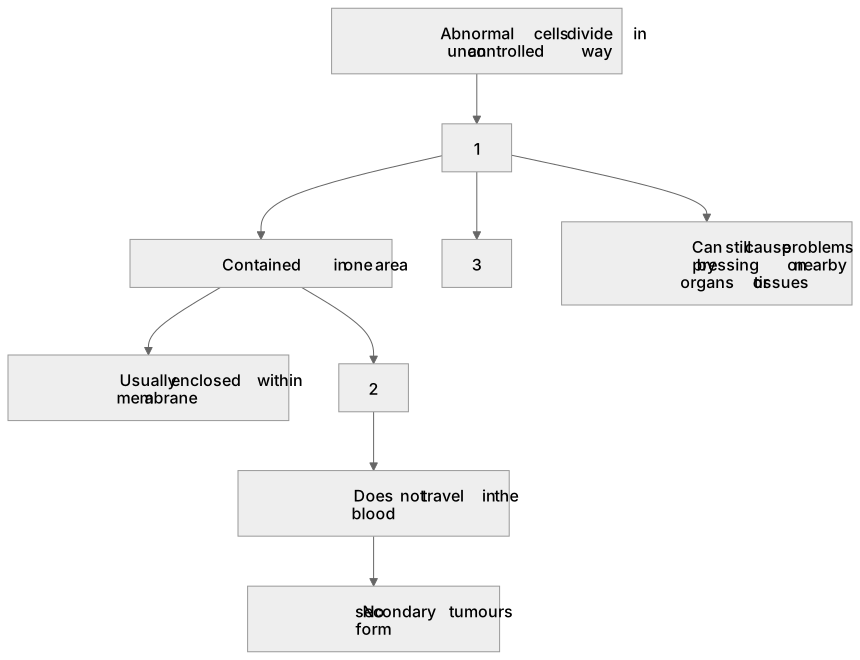
Some boxes have lost their names. Pick the right name for each number.
1Box 1
2Box 2
3Box 3
There is more to this lesson
The full lesson goes on to check your understanding and help you earn the marks. Create a free account to carry on, with your progress saved.
A week of Premium from your first lesson · Then the free plan continues · No card, no charge
Test your understanding of Cancer: Benign tumours are growths of abnormal cells which are contained in one area, usually within a membrane. They do not invade other parts of the body.
Active recall beats re-reading. Take an instant quiz now to test what you’ve learned and lock it into long-term memory.
A week of Premium from your first lesson · Then the free plan continues · No card, no charge