AQA · GCSE · Biology
Course version: 8461 · Version from Sept 2018
Students should be able to describe cancer as the result of changes in…
Full specification wording
Cancer: Students should be able to describe cancer as the result of changes in cells that lead to uncontrolled growth and division.
Cancer develops when changes occur in the DNA of a cell, altering the way the cell divides.
Checked against the AQA 8461 specification (opens in a new tab) on .
- Point 1 of 5
- 4 key terms
Study notes
From the checked teaching notes for this specification point.
The idea
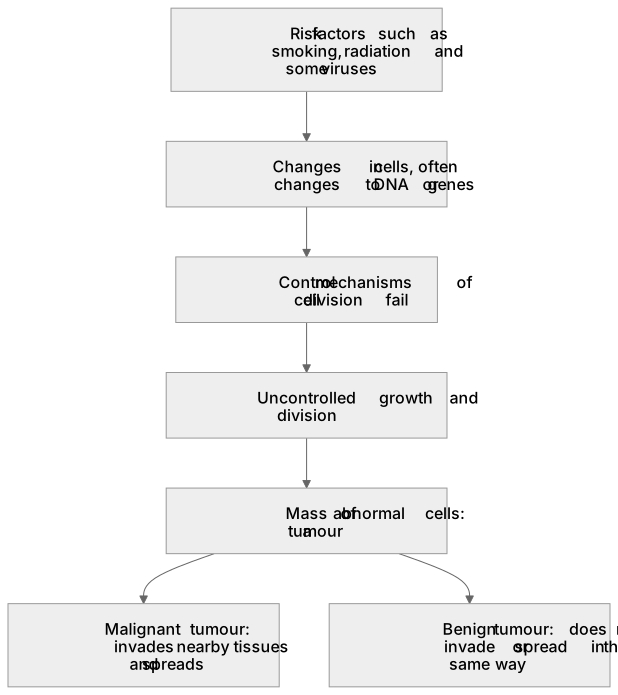
Cancer develops when changes occur in the DNA of a cell, altering the way the cell divides. Normally, cell division is controlled so that new cells are produced only when needed. In cancer, these control mechanisms fail, so the cell divides repeatedly and uncontrollably. The resulting mass of abnormal cells is a tumour. If the tumour invades nearby tissues and spreads to other parts of the body, it is malignant; benign tumours do not invade or spread in the same way. Risk factors such as smoking, radiation and some viruses increase the chance of the DNA changes that can start cancer.
What earns the marks
- States that cancer results from changes in cells, often described as changes to DNA or genes.
- Explains that these changes cause uncontrolled growth and division of cells.
- Describes the formation of a tumour as a mass of abnormal cells.
- Distinguishes malignant tumours, which invade and spread, from benign tumours, which do not.
- Links risk factors such as smoking or radiation to an increased chance of the cell changes that cause cancer.
- Uses correct terminology such as cell division, uncontrolled growth and tumour.
Common mistakes and how to put them right
Saying cancer is a single disease caused by one pathogen.
Put it right by explaining that cancer arises from changes in cells and has many forms.
Confusing benign and malignant tumours.
Put it right by stating that malignant tumours invade and spread, while benign tumours do not.
Stating that all tumours are cancerous.
Put it right by explaining that a tumour is a mass of abnormal cells and may be benign or malignant.
Exam tips
- Use the phrase uncontrolled growth and division when describing cancer.
- Link the description to cell changes, such as changes in DNA, rather than saying cells simply grow.
- If asked about risk factors, name a specific factor and explain how it increases the chance of cell changes.
Try the lesson
The start of the Cancer: Students should be able to describe cancer as the result of changes in cells that lead to uncontrolled growth and division. lesson, made from checked teaching notes for this specification point.
Have a go first
Which of the following best describes the biological cause of cancer?
Listen
Cancer develops when changes occur in the DNA of a cell, altering the way the cell divides. Normally, cell division is controlled so that new cells are produced only when needed. In cancer, these control mechanisms fail, so the cell divides repeatedly and uncontrollably. The resulting mass of abnormal cells is a tumour. If the tumour invades nearby tissues and spreads to other parts of the body, it is malignant; benign tumours do not invade or spread in the same way. Risk factors such as smoking, radiation and some viruses increase the chance of the DNA changes that can start cancer. A strong answer earns marks for these points. States that cancer results from changes in cells, often described as changes to DNA or genes. Explains that these changes cause uncontrolled growth and division of cells. Describes the formation of a tumour as a mass of abnormal cells. Distinguishes malignant tumours, which invade and spread, from benign tumours, which do not. A common slip: Saying cancer is a single disease caused by one pathogen. Instead, explaining that cancer arises from changes in cells and has many forms. Exam tip: Use the phrase uncontrolled growth and division when describing cancer.
See it
Key words
Say what each word means before you turn the card.
Cancer
Try answering aloud or in your head before turning the card.
Tumour
Try answering aloud or in your head before turning the card.
Malignant tumour
Try answering aloud or in your head before turning the card.
Benign tumour
Try answering aloud or in your head before turning the card.
See every definition
- Cancer
- The result of changes in cells that lead to uncontrolled growth and division.
- Tumour
- A mass of abnormal cells formed when control mechanisms fail and a cell divides repeatedly and uncontrollably.
- Malignant tumour
- A tumour that invades nearby tissues and spreads to other parts of the body.
- Benign tumour
- A tumour that does not invade or spread in the same way as a malignant tumour.
Label the diagram
Some boxes have lost their names. Pick the right name for each number.
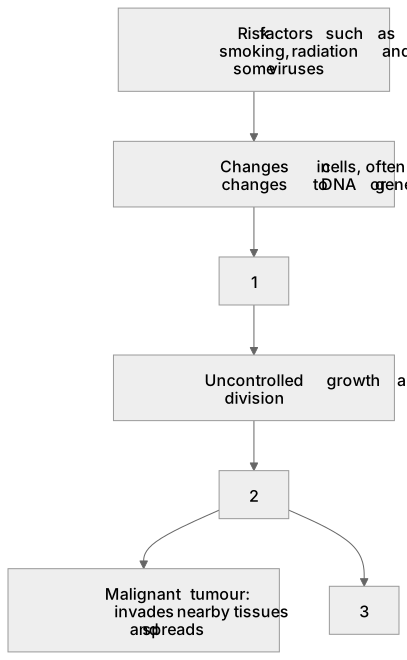
1Box 1
2Box 2
3Box 3
There is more to this lesson
The full lesson goes on to check your understanding and help you earn the marks. Create a free account to carry on, with your progress saved.
A week of Premium from your first lesson · Then the free plan continues · No card, no charge
Test your understanding of Cancer: Students should be able to describe cancer as the result of changes in cells that lead to uncontrolled growth and division.
Active recall beats re-reading. Take an instant quiz now to test what you’ve learned and lock it into long-term memory.
A week of Premium from your first lesson · Then the free plan continues · No card, no charge