AQA · GCSE · Biology
Course version: 8461 · Version from Sept 2018
As a cell differentiates it acquires different sub-cellular structures to…
Full specification wording
Cell differentiation: As a cell differentiates it acquires different sub-cellular structures to enable it to carry out a certain function.
Differentiation is the process by which a cell becomes specialised.
Checked against the AQA 8461 specification (opens in a new tab) on .
- Point 5 of 6
Study notes
From the checked teaching notes for this specification point.
The idea
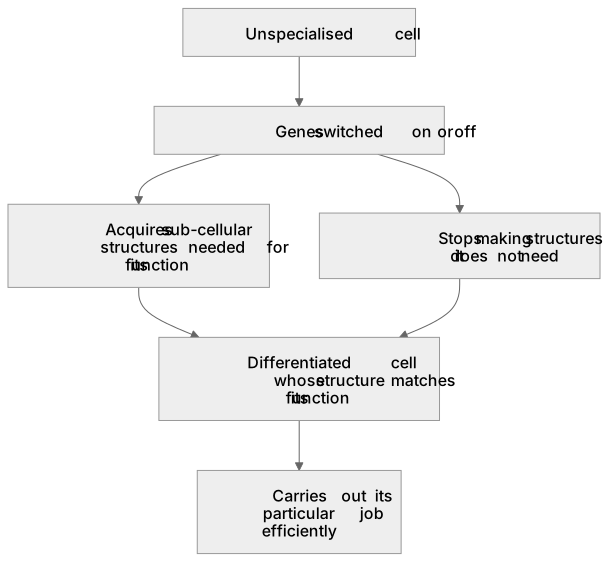
Differentiation is the process by which a cell becomes specialised. As an unspecialised cell matures, it switches on particular genes so that it builds the sub-cellular structures it needs for one job and stops making structures it does not need. For example, a developing red blood cell loses its nucleus and fills with haemoglobin so it can carry oxygen, while a sperm cell grows many mitochondria and a tail for swimming. The result is a cell whose internal structure matches its function, making the whole organism more efficient. In multicellular organisms most cells differentiate early in development, although some, such as stem cells, remain unspecialised and can divide to replace damaged tissue.
What earns the marks
- Differentiation is the process by which a cell becomes specialised for a particular function.
- During differentiation the cell acquires different sub-cellular structures, such as extra mitochondria, more ribosomes or a tail.
- The structures acquired are those needed to carry out the cell's specific function efficiently.
- An example is a sperm cell, which gains many mitochondria and a tail to release energy and swim to the egg.
- Another example is a red blood cell, which loses its nucleus and becomes packed with haemoglobin to carry oxygen.
- Differentiation involves switching genes on or off so that only the required proteins and structures are made.
Common mistakes and how to put them right
Thinking that differentiation means a cell changes its function randomly.
Put it right: The change is controlled by genes and suits a specific job.
Believing that all cells differentiate at the same time.
Put it right: Most differentiation happens during development, while some stem cells stay unspecialised.
Assuming that a differentiated cell gains structures only.
Put it right: It may also lose structures, as when a red blood cell loses its nucleus.
Exam tips
- Link each sub-cellular structure you name to the function it performs, for example many mitochondria supply energy for muscle contraction.
- Use the phrase 'sub-cellular structures' rather than vague words such as 'parts' when describing what the cell acquires.
- Give one named specialised cell and state two structures it has gained or lost, then explain how each helps its job.
Try the lesson
The start of the Cell differentiation: As a cell differentiates it acquires different sub-cellular structures to enable it to carry out a certain function. lesson, made from checked teaching notes for this specification point.
Have a go first
What happens to a cell as it differentiates?
Listen
Differentiation is the process by which a cell becomes specialised. As an unspecialised cell matures, it switches on particular genes so that it builds the sub-cellular structures it needs for one job and stops making structures it does not need. For example, a developing red blood cell loses its nucleus and fills with haemoglobin so it can carry oxygen, while a sperm cell grows many mitochondria and a tail for swimming. The result is a cell whose internal structure matches its function, making the whole organism more efficient. In multicellular organisms most cells differentiate early in development, although some, such as stem cells, remain unspecialised and can divide to replace damaged tissue. A strong answer earns marks for these points. Differentiation is the process by which a cell becomes specialised for a particular function. During differentiation the cell acquires different sub-cellular structures, such as extra mitochondria, more ribosomes or a tail. The structures acquired are those needed to carry out the cell's specific function efficiently. An example is a sperm cell, which gains many mitochondria and a tail to release energy and swim to the egg. A common slip: Thinking that differentiation means a cell changes its function randomly. Instead, the change is controlled by genes and suits a specific job. Exam tip: Link each sub-cellular structure you name to the function it performs, for example many mitochondria supply energy for muscle contraction.
See it
Label the diagram
Some boxes have lost their names. Pick the right name for each number.
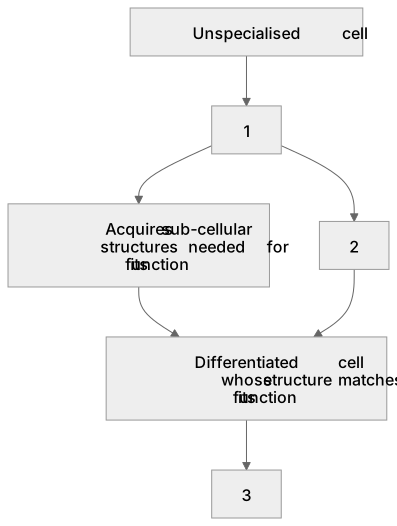
1Box 1
2Box 2
3Box 3
There is more to this lesson
The full lesson goes on to check your understanding and help you earn the marks. Create a free account to carry on, with your progress saved.
A week of Premium from your first lesson · Then the free plan continues · No card, no charge
Test your understanding of Cell differentiation: As a cell differentiates it acquires different sub-cellular structures to enable it to carry out a certain function.
Active recall beats re-reading. Take an instant quiz now to test what you’ve learned and lock it into long-term memory.
A week of Premium from your first lesson · Then the free plan continues · No card, no charge