AQA · GCSE · Biology
Course version: 8461 · Version from Sept 2018
Cell differentiation: It has become a specialised cell.
Once a cell has differentiated, it is described as a specialised cell.
Checked against the AQA 8461 specification (opens in a new tab) on .
- Point 6 of 6
- 3 key terms
Study notes
From the checked teaching notes for this specification point.
The idea
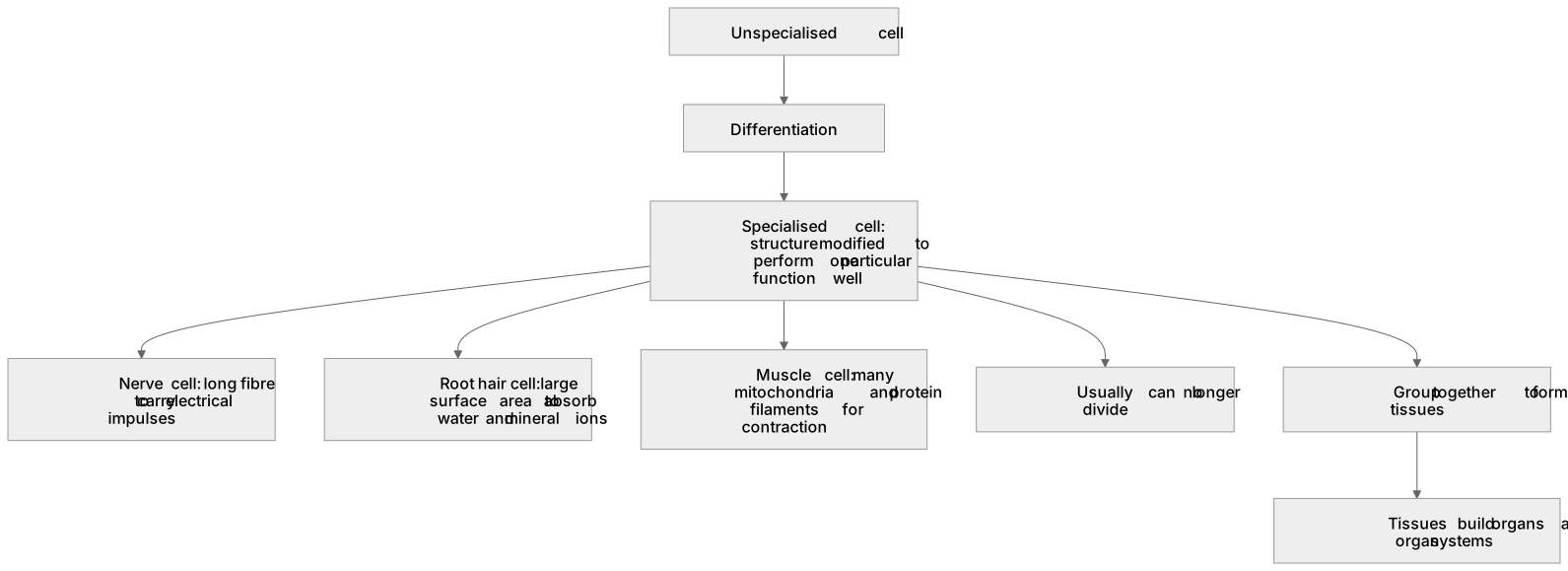
Once a cell has differentiated, it is described as a specialised cell. This means its structure has been modified so that it performs one particular function well. Specialised cells are the building blocks of tissues and organs in multicellular organisms. Examples include a nerve cell with a long fibre to carry electrical impulses, a root hair cell with a large surface area to absorb water and mineral ions, and a muscle cell containing many mitochondria and protein filaments for contraction. Specialisation usually means the cell can no longer divide, because it has committed to its role. Recognising a specialised cell therefore means identifying the feature that matches its job, not simply naming the cell.
What earns the marks
- A specialised cell is one whose structure has been modified to carry out a particular function.
- Specialised cells arise from unspecialised cells through the process of differentiation.
- The specialised feature of a cell can be identified and linked to its function, such as a long nerve fibre carrying impulses.
- Specialised cells group together to form tissues, which build organs and organ systems.
- Most specialised cells have lost the ability to divide, unlike unspecialised stem cells.
Common mistakes and how to put them right
Calling any cell 'specialised' without naming the feature that suits its function.
Put it right: State the structural adaptation and its benefit.
Confusing specialised cells with stem cells.
Put it right: Stem cells are unspecialised and can still divide and differentiate.
Describing a specialised cell's function without linking it to structure.
Put it right: Explain how the shape or contents enable the job.
Exam tips
- When asked to identify a specialised cell, name it and immediately give one structural feature and its function.
- Use comparative language such as 'more mitochondria than a typical cell' to show the adaptation clearly.
- Practise matching a list of cells to their functions so you can recall examples quickly under time pressure.
Try the lesson
The start of the Cell differentiation: It has become a specialised cell. lesson, made from checked teaching notes for this specification point.
Have a go first
A cell has become specialised. What does this mean?
Listen
Once a cell has differentiated, it is described as a specialised cell. This means its structure has been modified so that it performs one particular function well. Specialised cells are the building blocks of tissues and organs in multicellular organisms. Examples include a nerve cell with a long fibre to carry electrical impulses, a root hair cell with a large surface area to absorb water and mineral ions, and a muscle cell containing many mitochondria and protein filaments for contraction. Specialisation usually means the cell can no longer divide, because it has committed to its role. Recognising a specialised cell therefore means identifying the feature that matches its job, not simply naming the cell. A strong answer earns marks for these points. A specialised cell is one whose structure has been modified to carry out a particular function. Specialised cells arise from unspecialised cells through the process of differentiation. The specialised feature of a cell can be identified and linked to its function, such as a long nerve fibre carrying impulses. Specialised cells group together to form tissues, which build organs and organ systems. A common slip: Calling any cell 'specialised' without naming the feature that suits its function. Instead, state the structural adaptation and its benefit. Exam tip: When asked to identify a specialised cell, name it and immediately give one structural feature and its function.
See it
Key words
Say what each word means before you turn the card.
Structure and function
Try answering aloud or in your head before turning the card.
Cells to tissues
Try answering aloud or in your head before turning the card.
Stem cells
Try answering aloud or in your head before turning the card.
See every definition
- Structure and function
- The feature of a cell that matches its job, which must be identified rather than simply naming the cell.
- Cells to tissues
- Specialised cells group together to form tissues, which build organs and organ systems.
- Stem cells
- Unspecialised cells that can still divide and differentiate, unlike most specialised cells.
Label the diagram
Some boxes have lost their names. Pick the right name for each number.
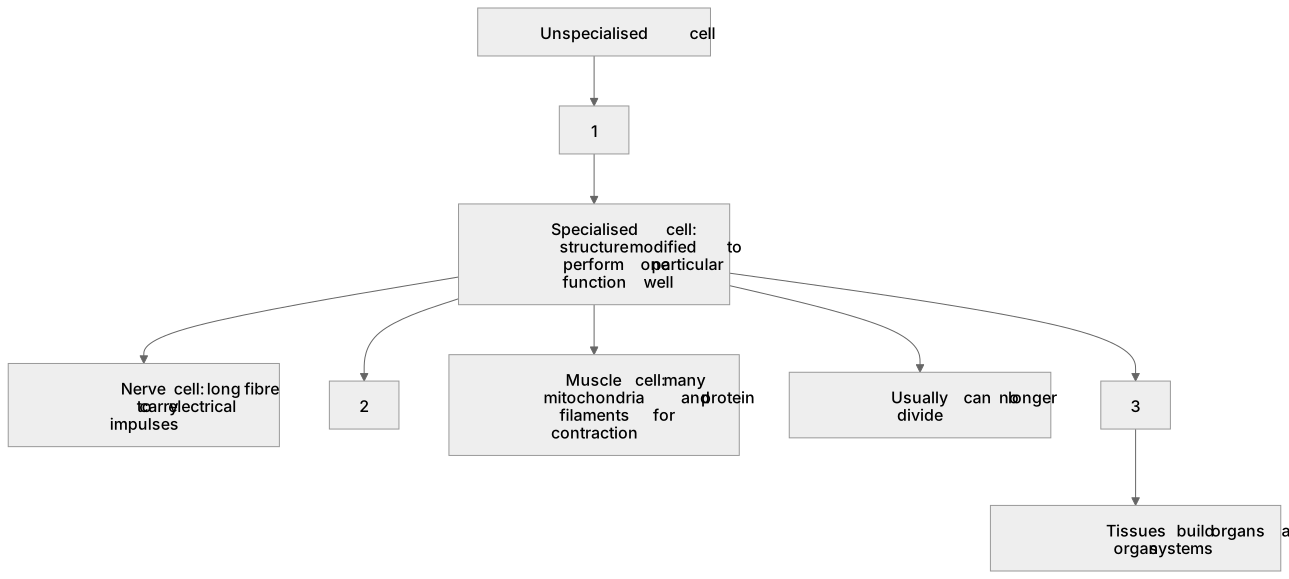
1Box 1
2Box 2
3Box 3
There is more to this lesson
The full lesson goes on to check your understanding and help you earn the marks. Create a free account to carry on, with your progress saved.
A week of Premium from your first lesson · Then the free plan continues · No card, no charge
Test your understanding of Cell differentiation: It has become a specialised cell.
Active recall beats re-reading. Take an instant quiz now to test what you’ve learned and lock it into long-term memory.
A week of Premium from your first lesson · Then the free plan continues · No card, no charge