AQA · GCSE · Biology
Course version: 8461 · Version from Sept 2018
Students should be able to explain the importance of cell differentiation.
Full specification wording
Cell differentiation: Students should be able to explain the importance of cell differentiation.
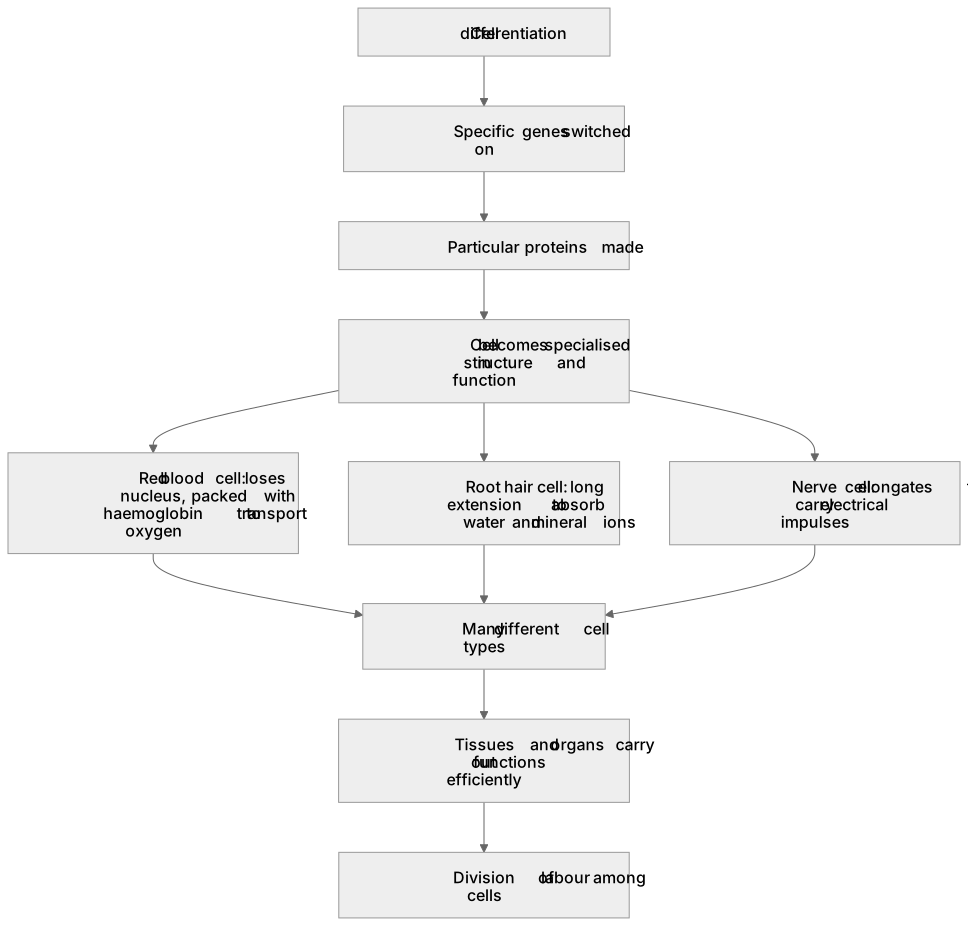
Cell differentiation is the process by which a cell becomes specialised for a particular function by switching on specific genes and producing particular proteins.
Checked against the AQA 8461 specification (opens in a new tab) on .
- Point 1 of 6
- 4 key terms
Study notes
From the checked teaching notes for this specification point.
The idea
Cell differentiation is the process by which a cell becomes specialised for a particular function by switching on specific genes and producing particular proteins. Its importance is that it allows multicellular organisms to have cells with distinct structures and functions, so tissues and organs can carry out jobs efficiently. For example, a red blood cell loses its nucleus and becomes packed with haemoglobin to transport oxygen; a root hair cell grows a long extension to absorb water and mineral ions; a nerve cell elongates to carry electrical impulses. Without differentiation, all cells would be identical and could not form the range of tissues needed for life processes such as gas exchange, transport, coordination and reproduction. Differentiation therefore increases efficiency and enables division of labour among cells.
What earns the marks
- Differentiation is the process by which a cell becomes specialised in structure and function.
- Differentiation allows multicellular organisms to have many different cell types, each adapted to a specific job.
- Examples include red blood cells adapted to carry oxygen, root hair cells adapted to absorb water and mineral ions, and nerve cells adapted to carry electrical impulses.
- Because cells are specialised, tissues and organs can carry out functions more efficiently than if all cells were identical.
- Differentiation enables division of labour, so different cells contribute to different life processes such as transport, gas exchange and coordination.
Common mistakes and how to put them right
Thinking that differentiation changes the genes a cell contains.
Put it right: The error is that all body cells generally have the same genes, and the correction is that differentiation involves switching genes on or off, not losing or gaining genes.
Confusing differentiation with cell division.
Put it right: The error is treating them as the same process, and the correction is that division produces more cells while differentiation makes those cells specialised.
Assuming that a differentiated cell can easily change into any other cell type.
Put it right: The error is overestimating the flexibility of most animal cells, and the correction is that most animal cells become specialised at an early stage and remain specialised.
Exam tips
- When asked to explain importance, link each specialised feature to the job it performs, for example a root hair cell's large surface area increases water uptake.
- Use the phrase 'switching genes on or off' rather than saying genes are lost, because this shows precise understanding.
- Give at least one named cell type and state how its structure helps its function to make the explanation concrete.
Try the lesson
The start of the Cell differentiation: Students should be able to explain the importance of cell differentiation. lesson, made from checked teaching notes for this specification point.
Have a go first
Why is cell differentiation important in a multicellular organism?
Listen
Cell differentiation is the process by which a cell becomes specialised for a particular function by switching on specific genes and producing particular proteins. Its importance is that it allows multicellular organisms to have cells with distinct structures and functions, so tissues and organs can carry out jobs efficiently. For example, a red blood cell loses its nucleus and becomes packed with haemoglobin to transport oxygen; a root hair cell grows a long extension to absorb water and mineral ions; a nerve cell elongates to carry electrical impulses. Without differentiation, all cells would be identical and could not form the range of tissues needed for life processes such as gas exchange, transport, coordination and reproduction. Differentiation therefore increases efficiency and enables division of labour among cells. A strong answer earns marks for these points. Differentiation is the process by which a cell becomes specialised in structure and function. Differentiation allows multicellular organisms to have many different cell types, each adapted to a specific job. Examples include red blood cells adapted to carry oxygen, root hair cells adapted to absorb water and mineral ions, and nerve cells adapted to carry electrical impulses. Because cells are specialised, tissues and organs can carry out functions more efficiently than if all cells were identical. Exam tip: When asked to explain importance, link each specialised feature to the job it performs, for example a root hair cell's large surface area increases water uptake.
See it
Key words
Say what each word means before you turn the card.
Cell differentiation
Try answering aloud or in your head before turning the card.
Gene switching
Try answering aloud or in your head before turning the card.
Division of labour
Try answering aloud or in your head before turning the card.
Specialised cell
Try answering aloud or in your head before turning the card.
See every definition
- Cell differentiation
- The process by which a cell becomes specialised for a particular function by switching on specific genes and producing particular proteins.
- Gene switching
- Switching on specific genes so that particular proteins are made, giving the cell its specialised features.
- Division of labour
- Different cells contribute to different life processes, which differentiation enables among cells.
- Specialised cell
- A cell with distinct structures and functions, so that tissues and organs can carry out jobs efficiently.
Label the diagram
Some boxes have lost their names. Pick the right name for each number.
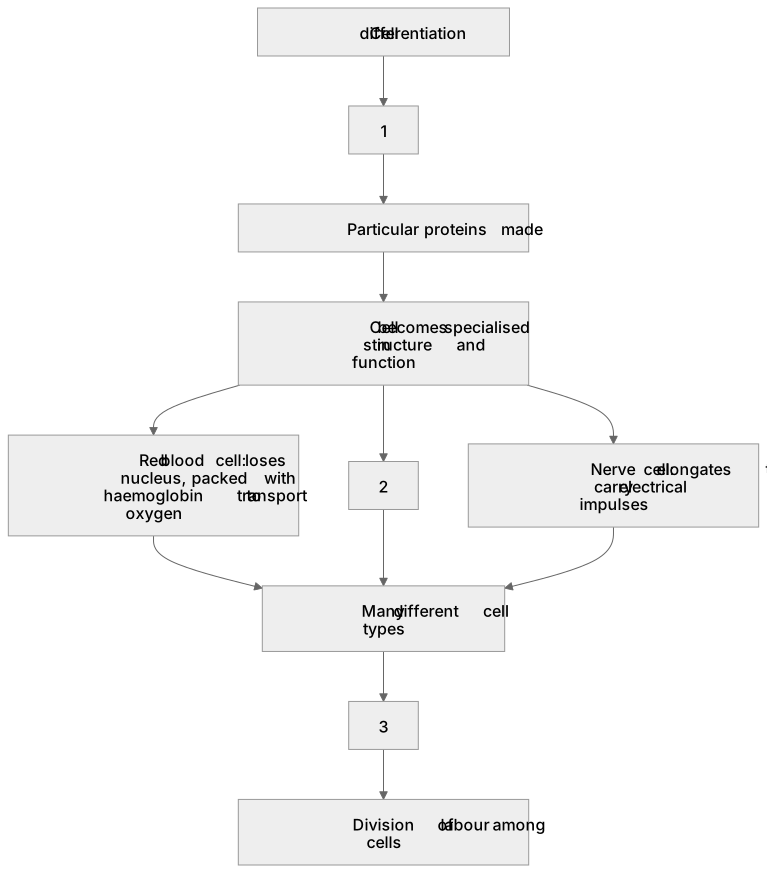
1Box 1
2Box 2
3Box 3
There is more to this lesson
The full lesson goes on to check your understanding and help you earn the marks. Create a free account to carry on, with your progress saved.
A week of Premium from your first lesson · Then the free plan continues · No card, no charge
Test your understanding of Cell differentiation: Students should be able to explain the importance of cell differentiation.
Active recall beats re-reading. Take an instant quiz now to test what you’ve learned and lock it into long-term memory.
A week of Premium from your first lesson · Then the free plan continues · No card, no charge