AQA · GCSE · Biology
Course version: 8461 · Version from Sept 2018
As an organism develops, cells differentiate to form different types of…
Full specification wording
Cell differentiation: As an organism develops, cells differentiate to form different types of cells.
During development, a fertilised egg divides by mitosis to produce many genetically identical cells.
Checked against the AQA 8461 specification (opens in a new tab) on .
- Point 2 of 6
- 4 key terms
Study notes
From the checked teaching notes for this specification point.
The idea
During development, a fertilised egg divides by mitosis to produce many genetically identical cells. As the organism grows, these cells undergo differentiation, meaning they switch on particular genes and become specialised for different roles. This produces the many cell types found in a multicellular organism, such as muscle cells, nerve cells, red blood cells, xylem vessels and palisade mesophyll cells. The process is controlled so that each cell develops the structure needed for its function. In animals, most differentiation happens early in development, while many plants retain the ability to differentiate throughout life. Understanding this sequence helps explain how a single starting cell can give rise to a complex organism with many tissues and organs.
What earns the marks
- A fertilised egg divides by mitosis to produce a ball of genetically identical cells.
- As development proceeds, cells differentiate, meaning they become specialised in structure and function.
- Differentiation involves switching on specific genes so that particular proteins are made.
- Differentiation produces different cell types, such as muscle cells, nerve cells, red blood cells, xylem vessels and palisade mesophyll cells.
- The timing and extent of differentiation differ between animals and plants; most animal cells differentiate early, while many plant cells can differentiate throughout life.
- The result of differentiation is a range of specialised cells that form tissues and organs in a multicellular organism.
Common mistakes and how to put them right
Thinking that differentiation happens before any cell division.
Put it right: The error is reversing the sequence, and the correction is that mitosis produces the cells that then differentiate.
Believing that differentiated cells all contain different genes.
Put it right: The error is misunderstanding gene content, and the correction is that cells generally keep the same genes but use different ones.
Assuming that all cells in an organism differentiate at the same time.
Put it right: The error is ignoring differences between animals and plants, and the correction is that most animal cells differentiate early whereas many plant cells can differentiate throughout life.
Exam tips
- Sequence your answer clearly: mitosis first, then differentiation, then specialised cells forming tissues.
- Name specific cell types to show that you can apply the idea of differentiation to examples.
- If asked about plants, mention that many plant cells retain the ability to differentiate throughout life, unlike most animal cells.
Try the lesson
The start of the Cell differentiation: As an organism develops, cells differentiate to form different types of cells. lesson, made from checked teaching notes for this specification point.
Have a go first
What happens to cells as an organism develops?
Listen
During development, a fertilised egg divides by mitosis to produce many genetically identical cells. As the organism grows, these cells undergo differentiation, meaning they switch on particular genes and become specialised for different roles. This produces the many cell types found in a multicellular organism, such as muscle cells, nerve cells, red blood cells, xylem vessels and palisade mesophyll cells. The process is controlled so that each cell develops the structure needed for its function. In animals, most differentiation happens early in development, while many plants retain the ability to differentiate throughout life. Understanding this sequence helps explain how a single starting cell can give rise to a complex organism with many tissues and organs. A strong answer earns marks for these points. A fertilised egg divides by mitosis to produce a ball of genetically identical cells. As development proceeds, cells differentiate, meaning they become specialised in structure and function. Differentiation involves switching on specific genes so that particular proteins are made. Differentiation produces different cell types, such as muscle cells, nerve cells, red blood cells, xylem vessels and palisade mesophyll cells. Exam tip: Sequence your answer clearly: mitosis first, then differentiation, then specialised cells forming tissues.
See it
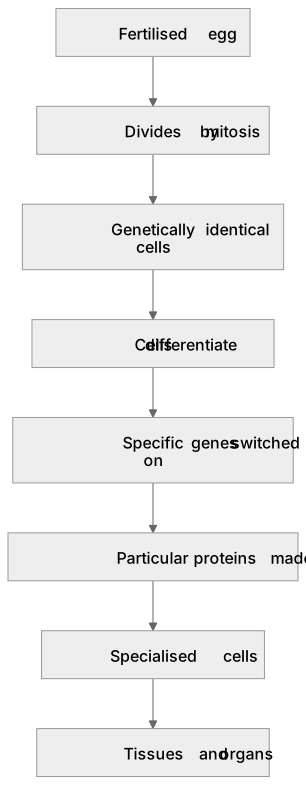
Put it in order
Put these steps in the order they happen.
- 1. Specific genes switched on
- 2. Tissues and organs
- 3. Particular proteins made
- 4. Fertilised egg
- 5. Divides by mitosis
- 6. Specialised cells
- 7. Genetically identical cells
- 8. Cells differentiate
Key words
Say what each word means before you turn the card.
Mitosis
Try answering aloud or in your head before turning the card.
Differentiation
Try answering aloud or in your head before turning the card.
Specialised cells
Try answering aloud or in your head before turning the card.
Tissues and organs
Try answering aloud or in your head before turning the card.
See every definition
- Mitosis
- The process by which a fertilised egg divides to produce many genetically identical cells.
- Differentiation
- The process in which cells switch on particular genes and become specialised for different roles.
- Specialised cells
- Cells that develop the structure needed for their function, such as muscle cells, nerve cells, red blood cells, xylem vessels and palisade mesophyll cells.
- Tissues and organs
- What the range of specialised cells produced by differentiation form in a multicellular organism.
Label the diagram
Some boxes have lost their names. Pick the right name for each number.
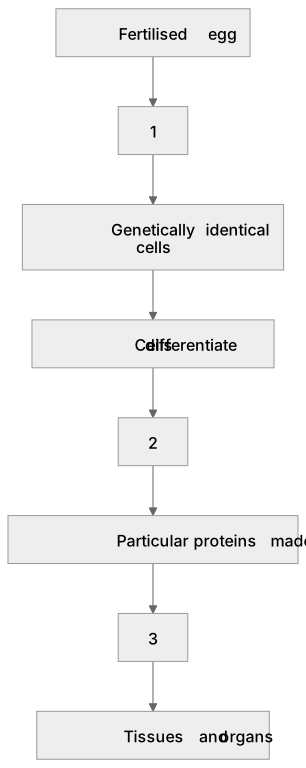
1Box 1
2Box 2
3Box 3
There is more to this lesson
The full lesson goes on to check your understanding and help you earn the marks. Create a free account to carry on, with your progress saved.
A week of Premium from your first lesson · Then the free plan continues · No card, no charge
Test your understanding of Cell differentiation: As an organism develops, cells differentiate to form different types of cells.
Active recall beats re-reading. Take an instant quiz now to test what you’ve learned and lock it into long-term memory.
A week of Premium from your first lesson · Then the free plan continues · No card, no charge