AQA · GCSE · Biology
Course version: 8461 · Version from Sept 2018
The nucleus of a cell contains chromosomes made of DNA molecules.
Full specification wording
Chromosomes: The nucleus of a cell contains chromosomes made of DNA molecules.
Think of the nucleus as the cell's control room, and inside it the genetic material is packaged into chromosomes.
Checked against the AQA 8461 specification (opens in a new tab) on .
- Point 1 of 3
- 4 key terms
Study notes
From the checked teaching notes for this specification point.
The idea
Think of the nucleus as the cell's control room, and inside it the genetic material is packaged into chromosomes. Each chromosome is one very long DNA molecule wound tightly around proteins, so a molecule far too thin to see becomes a compact, visible structure during cell division. DNA itself is a polymer built from four bases whose order forms a code. That code is read in sections, and each section is a gene. In a human body cell there are 46 chromosomes, arranged as 23 pairs, and every one of them is DNA. A useful method is to zoom in mentally: cell, then nucleus, then chromosome, then DNA molecule, then gene. This hierarchy matters because it explains why the nucleus controls cell activities and why DNA can be copied and passed on.
What earns the marks
- States that the nucleus contains the cell's genetic material in the form of chromosomes.
- Describes a chromosome as a structure made of a DNA molecule, typically coiled and associated with protein.
- Links DNA to a code or sequence of bases that carries genetic information.
- Places the structures in order of size: nucleus larger than chromosome, chromosome larger than DNA molecule.
- Uses the human example of 46 chromosomes in a body cell to make the idea concrete.
Common mistakes and how to put them right
Saying the nucleus contains genes but omitting chromosomes.
Put it right: State that genes are carried on chromosomes, which are made of DNA.
Treating DNA and a chromosome as identical.
Put it right: A chromosome is a DNA molecule packaged with protein, so DNA is the molecule and the chromosome is the packaged structure.
Writing that chromosomes float freely in the cytoplasm.
Put it right: In a eukaryotic cell the chromosomes are found inside the nucleus.
Exam tips
- Use the sequence nucleus, chromosome, DNA, gene when explaining where genetic material is found, so each level is clearly placed.
- If asked to describe the relationship, give a size order as well as a location, because both are commonly needed for full credit.
- Check that any diagram is labelled with straight lines and that the label chromosome points to a structure inside the nucleus, not to the nuclear membrane.
Try the lesson
The start of the Chromosomes: The nucleus of a cell contains chromosomes made of DNA molecules. lesson, made from checked teaching notes for this specification point.
Have a go first
Chromosomes are found in the nucleus of a cell. Which molecule within the chromosome carries the genetic information?
Listen
Think of the nucleus as the cell's control room, and inside it the genetic material is packaged into chromosomes. Each chromosome is one very long DNA molecule wound tightly around proteins, so a molecule far too thin to see becomes a compact, visible structure during cell division. DNA itself is a polymer built from four bases whose order forms a code. That code is read in sections, and each section is a gene. In a human body cell there are 46 chromosomes, arranged as 23 pairs, and every one of them is DNA. A useful method is to zoom in mentally: cell, then nucleus, then chromosome, then DNA molecule, then gene. This hierarchy matters because it explains why the nucleus controls cell activities and why DNA can be copied and passed on. A strong answer earns marks for these points. States that the nucleus contains the cell's genetic material in the form of chromosomes. Describes a chromosome as a structure made of a DNA molecule, typically coiled and associated with protein. Links DNA to a code or sequence of bases that carries genetic information. Places the structures in order of size: nucleus larger than chromosome, chromosome larger than DNA molecule. A common slip: Saying the nucleus contains genes but omitting chromosomes. Instead, state that genes are carried on chromosomes, which are made of DNA. Exam tip: Use the sequence nucleus, chromosome, DNA, gene when explaining where genetic material is found, so each level is clearly placed.
See it
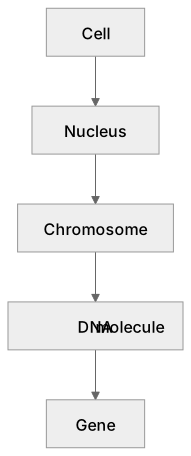
Put it in order
Put these steps in the order they happen.
- 1. Nucleus
- 2. Chromosome
- 3. Cell
- 4. Gene
- 5. DNA molecule
Key words
Say what each word means before you turn the card.
Chromosome
Try answering aloud or in your head before turning the card.
DNA
Try answering aloud or in your head before turning the card.
Gene
Try answering aloud or in your head before turning the card.
Nucleus
Try answering aloud or in your head before turning the card.
See every definition
- Chromosome
- A structure inside the nucleus made of one very long DNA molecule wound tightly around proteins.
- DNA
- A polymer built from four bases whose order forms a code, and every chromosome is made of it.
- Gene
- A section of the code that is read.
- Nucleus
- The cell's control room, which contains chromosomes made of DNA molecules.
Label the diagram
Some boxes have lost their names. Pick the right name for each number.
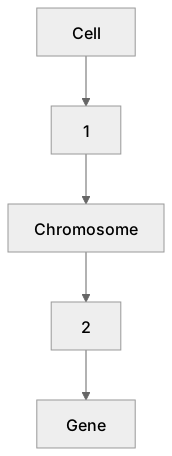
1Box 1
2Box 2
There is more to this lesson
The full lesson goes on to check your understanding and help you earn the marks. Create a free account to carry on, with your progress saved.
A week of Premium from your first lesson · Then the free plan continues · No card, no charge
Test your understanding of Chromosomes: The nucleus of a cell contains chromosomes made of DNA molecules.
Active recall beats re-reading. Take an instant quiz now to test what you’ve learned and lock it into long-term memory.
A week of Premium from your first lesson · Then the free plan continues · No card, no charge