AQA · GCSE · Biology
Course version: 8461 · Version from Sept 2018
Due to evidence available from chemical analysis there is now a ‘three-…
Full specification wording
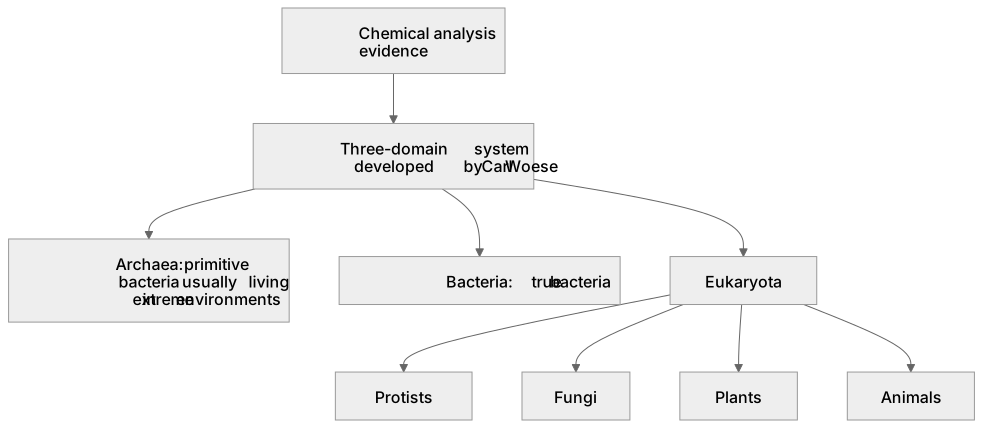
Classification of living organisms: Due to evidence available from chemical analysis there is now a ‘three- domain system’ developed by Carl Woese. In this system organisms are divided into: • archaea (primitive bacteria usually living in extreme environments) • bacteria (true bacteria) • eukaryota (which includes protists, fungi, plants and animals).
Chemical analysis, especially comparing ribosomal RNA and DNA sequences, showed that some organisms placed together in older systems are only distantly related.
Checked against the AQA 8461 specification (opens in a new tab) on .
- Point 7 of 9
- 4 key terms
Study notes
From the checked teaching notes for this specification point.
The idea
Chemical analysis, especially comparing ribosomal RNA and DNA sequences, showed that some organisms placed together in older systems are only distantly related. Carl Woese used this evidence to propose the three-domain system. Archaea are primitive bacteria-like organisms, often found in extreme environments such as hot springs, salt lakes and deep-sea vents; their cell walls and biochemistry differ from true bacteria. Bacteria are the true bacteria, including familiar species such as Escherichia coli. Eukaryota have cells with a nucleus and membrane-bound organelles, and include protists, fungi, plants and animals. The three domains sit above the older kingdom groupings, so the model reflects evolutionary relationships better than grouping by appearance alone.
What earns the marks
- The three-domain system was developed by Carl Woese using evidence from chemical analysis, particularly RNA and DNA sequence comparisons.
- Archaea are primitive bacteria-like organisms usually living in extreme environments.
- Bacteria are the true bacteria, distinct from archaea in their biochemistry and cell structures.
- Eukaryota contain organisms whose cells have a nucleus and include protists, fungi, plants and animals.
- The three domains are a classification level above kingdoms and reflect evolutionary relationships revealed by molecular evidence.
Common mistakes and how to put them right
Treating archaea as a type of eukaryote.
Put it right by stating that archaea are primitive bacteria-like organisms placed in their own domain.
Listing only plants and animals in eukaryota.
Put it right by including protists and fungi as well.
Saying Woese used visible appearance alone.
Put it right by referring to chemical analysis such as RNA and DNA comparisons.
Exam tips
- Name all three domains and give one defining feature of each.
- Use the phrase chemical analysis when explaining why the three-domain system was proposed.
- Keep the eukaryota list complete: protists, fungi, plants and animals.
Try the lesson
The start of the Classification of living organisms: Due to evidence available from chemical analysis there is now a ‘three- domain system’ developed by Carl Woese. In this system organisms are divided into: • archaea (primitive bacteria usually living in extreme environments) • bacteria (true bacteria) • eukaryota (which includes protists, fungi, plants and animals). lesson, made from checked teaching notes for this specification point.
Have a go first
Which scientist developed the three-domain system of classification?
Listen
Chemical analysis, especially comparing ribosomal RNA and DNA sequences, showed that some organisms placed together in older systems are only distantly related. Carl Woese used this evidence to propose the three-domain system. Archaea are primitive bacteria-like organisms, often found in extreme environments such as hot springs, salt lakes and deep-sea vents; their cell walls and biochemistry differ from true bacteria. Bacteria are the true bacteria, including familiar species such as Escherichia coli. Eukaryota have cells with a nucleus and membrane-bound organelles, and include protists, fungi, plants and animals. The three domains sit above the older kingdom groupings, so the model reflects evolutionary relationships better than grouping by appearance alone. A strong answer earns marks for these points. The three-domain system was developed by Carl Woese using evidence from chemical analysis, particularly RNA and DNA sequence comparisons. Archaea are primitive bacteria-like organisms usually living in extreme environments. Bacteria are the true bacteria, distinct from archaea in their biochemistry and cell structures. Eukaryota contain organisms whose cells have a nucleus and include protists, fungi, plants and animals. A common slip: Treating archaea as a type of eukaryote. Instead, stating that archaea are primitive bacteria-like organisms placed in their own domain. Exam tip: Name all three domains and give one defining feature of each.
See it
Key words
Say what each word means before you turn the card.
Three-domain classification
Try answering aloud or in your head before turning the card.
Molecular evidence from RNA and DNA
Try answering aloud or in your head before turning the card.
Extreme-environment archaea
Try answering aloud or in your head before turning the card.
Evolutionary relationships
Try answering aloud or in your head before turning the card.
See every definition
- Three-domain classification
- A system developed by Carl Woese, using evidence from chemical analysis, that divides organisms into archaea, bacteria and eukaryota.
- Molecular evidence from RNA and DNA
- Chemical analysis, particularly comparing RNA and DNA sequences, which showed that some organisms placed together in older systems are only distantly related.
- Extreme-environment archaea
- Primitive bacteria-like organisms usually living in extreme environments, whose cell walls and biochemistry differ from true bacteria.
- Evolutionary relationships
- Relationships between organisms that the three-domain model reflects better than grouping by appearance alone, as revealed by molecular evidence.
Label the diagram
Some boxes have lost their names. Pick the right name for each number.
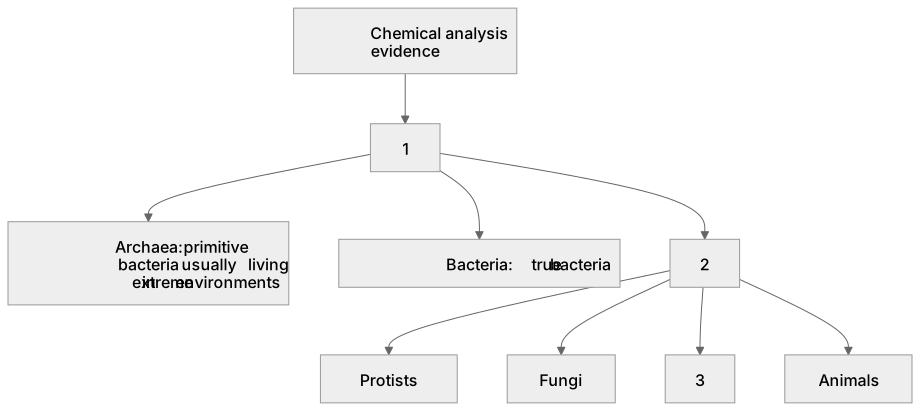
1Box 1
2Box 2
3Box 3
There is more to this lesson
The full lesson goes on to check your understanding and help you earn the marks. Create a free account to carry on, with your progress saved.
A week of Premium from your first lesson · Then the free plan continues · No card, no charge
Test your understanding of Classification of living organisms: Due to evidence available from chemical analysis there is now a ‘three- domain system’ developed by Carl Woese. In this system organisms are divided into: • archaea (primitive bacteria usually living in extreme environments) • bacteria (true bacteria) • eukaryota (which includes protists, fungi, plants and animals).
Active recall beats re-reading. Take an instant quiz now to test what you’ve learned and lock it into long-term memory.
A week of Premium from your first lesson · Then the free plan continues · No card, no charge