AQA · GCSE · Biology
Course version: 8461 · Version from Sept 2018
Evolutionary trees are a method used by scientists to show how they…
Full specification wording
Classification of living organisms: Evolutionary trees are a method used by scientists to show how they believe organisms are related.
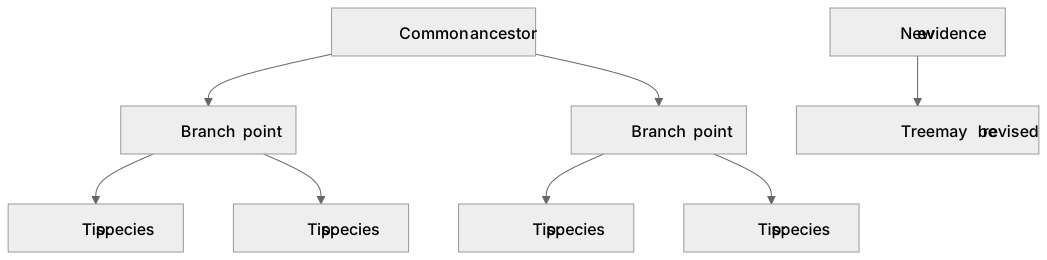
An evolutionary tree, also called a phylogenetic tree, is a branching diagram showing how scientists currently believe organisms are related through common ancestors.
Checked against the AQA 8461 specification (opens in a new tab) on .
- Point 8 of 9
- 2 key terms
Study notes
From the checked teaching notes for this specification point.
The idea
An evolutionary tree, also called a phylogenetic tree, is a branching diagram showing how scientists currently believe organisms are related through common ancestors. The branching points represent common ancestors, and the tips represent present-day or extinct species. Closely related organisms share a more recent common ancestor and sit on branches that split more recently. For example, a tree might show humans and chimpanzees sharing a recent common ancestor, while both are more distantly related to fish. The word believe matters: evolutionary trees are models based on the best available evidence, so they can be redrawn when new data appear. A tree does not show a species turning into another living species today; it shows shared ancestry over evolutionary time.
What earns the marks
- An evolutionary tree is a branching diagram showing proposed relationships between organisms.
- Branching points represent common ancestors from which later groups diverged.
- Organisms sharing a more recent common ancestor are shown as more closely related.
- Evolutionary trees are models based on evidence and may be revised when new data become available.
- The tips of the tree represent species, which may be living or extinct.
Common mistakes and how to put them right
Reading a tree as a sequence of one species turning into another.
Put it right by explaining that branches show shared ancestry, not a chain of transformation.
Assuming the tree is fixed truth.
Put it right by stating that trees are evidence-based models that can be revised.
Ignoring branch points: correct this by identifying branching points as common ancestors.
Exam tips
- Describe what the branch points and tips represent before interpreting relationships.
- Use the phrase common ancestor when explaining why two organisms are closely related.
- State that evolutionary trees are models based on evidence, so they can change.
Try the lesson
The start of the Classification of living organisms: Evolutionary trees are a method used by scientists to show how they believe organisms are related. lesson, made from checked teaching notes for this specification point.
Have a go first
What is an evolutionary tree primarily used by scientists to show?
Listen
An evolutionary tree, also called a phylogenetic tree, is a branching diagram showing how scientists currently believe organisms are related through common ancestors. The branching points represent common ancestors, and the tips represent present-day or extinct species. Closely related organisms share a more recent common ancestor and sit on branches that split more recently. For example, a tree might show humans and chimpanzees sharing a recent common ancestor, while both are more distantly related to fish. The word believe matters: evolutionary trees are models based on the best available evidence, so they can be redrawn when new data appear. A tree does not show a species turning into another living species today; it shows shared ancestry over evolutionary time. A strong answer earns marks for these points. An evolutionary tree is a branching diagram showing proposed relationships between organisms. Branching points represent common ancestors from which later groups diverged. Organisms sharing a more recent common ancestor are shown as more closely related. Evolutionary trees are models based on evidence and may be revised when new data become available. A common slip: Reading a tree as a sequence of one species turning into another. Instead, explaining that branches show shared ancestry, not a chain of transformation. Exam tip: Describe what the branch points and tips represent before interpreting relationships.
See it
Key words
Say what each word means before you turn the card.
Evolutionary tree
Try answering aloud or in your head before turning the card.
Branching diagrams as models
Try answering aloud or in your head before turning the card.
See every definition
- Evolutionary tree
- A branching diagram showing how scientists currently believe organisms are related through common ancestors.
- Branching diagrams as models
- These show proposed relationships between organisms and may be revised when new data become available.
There is more to this lesson
The full lesson goes on to check your understanding and help you earn the marks. Create a free account to carry on, with your progress saved.
A week of Premium from your first lesson · Then the free plan continues · No card, no charge
Test your understanding of Classification of living organisms: Evolutionary trees are a method used by scientists to show how they believe organisms are related.
Active recall beats re-reading. Take an instant quiz now to test what you’ve learned and lock it into long-term memory.
A week of Premium from your first lesson · Then the free plan continues · No card, no charge