AQA · GCSE · Biology
Course version: 8461 · Version from Sept 2018
Linnaeus classified living things into kingdom, phylum, class, order,…
Full specification wording
Classification of living organisms: Linnaeus classified living things into kingdom, phylum, class, order, family, genus and species.
Carl Linnaeus devised a hierarchical system that sorts every organism into seven ranked groups.
Checked against the AQA 8461 specification (opens in a new tab) on .
- Point 2 of 9
Study notes
From the checked teaching notes for this specification point.
The idea
Carl Linnaeus devised a hierarchical system that sorts every organism into seven ranked groups. From broadest to narrowest these are kingdom, phylum, class, order, family, genus and species. Each rank sits inside the one above, so all members of a genus also belong to the same family, and so on up to kingdom. A useful memory aid is the sentence 'King Philip Came Over For Good Soup'. For example, humans are in kingdom Animalia, phylum Chordata, class Mammalia, order Primates, family Hominidae, genus Homo and species Homo sapiens. As you move down the ranks, the number of shared features increases and the number of organisms in the group decreases. Species is the narrowest rank and contains organisms that can breed to produce fertile offspring.
What earns the marks
- States the seven ranks in the correct order from kingdom down to species.
- Explains that the system is hierarchical, with each rank nested inside the rank above.
- Uses a named organism to place it correctly through several ranks.
- Explains that moving down the ranks means more shared characteristics and fewer organisms.
- Defines species as the narrowest group, whose members can breed to produce fertile offspring.
Common mistakes and how to put them right
Writing the ranks in the wrong order, such as putting family before order.
Put it right by learning the sequence kingdom, phylum, class, order, family, genus, species.
Treating the ranks as separate lists rather than nested groups.
Put it right by stating that every genus belongs to a family and every family to an order.
Confusing genus and species when naming an organism.
Put it right by remembering that genus comes first and is capitalised, while species comes second and is lower case.
Exam tips
- Learn a mnemonic for the seven ranks so you can reproduce the sequence quickly and accurately.
- When a question gives an organism, work down the ranks in order rather than jumping to species.
- Use the phrase 'more shared features, fewer organisms' to explain the pattern as you move down the hierarchy.
Try the lesson
The start of the Classification of living organisms: Linnaeus classified living things into kingdom, phylum, class, order, family, genus and species. lesson, made from checked teaching notes for this specification point.
Have a go first
In the Linnaean system, which group is the largest and contains the greatest number of different organisms?
Listen
Carl Linnaeus devised a hierarchical system that sorts every organism into seven ranked groups. From broadest to narrowest these are kingdom, phylum, class, order, family, genus and species. Each rank sits inside the one above, so all members of a genus also belong to the same family, and so on up to kingdom. A useful memory aid is the sentence 'King Philip Came Over For Good Soup'. For example, humans are in kingdom Animalia, phylum Chordata, class Mammalia, order Primates, family Hominidae, genus Homo and species Homo sapiens. As you move down the ranks, the number of shared features increases and the number of organisms in the group decreases. Species is the narrowest rank and contains organisms that can breed to produce fertile offspring. A strong answer earns marks for these points. States the seven ranks in the correct order from kingdom down to species. Explains that the system is hierarchical, with each rank nested inside the rank above. Uses a named organism to place it correctly through several ranks. Explains that moving down the ranks means more shared characteristics and fewer organisms. A common slip: Writing the ranks in the wrong order, such as putting family before order. Instead, learning the sequence kingdom, phylum, class, order, family, genus, species. Exam tip: Learn a mnemonic for the seven ranks so you can reproduce the sequence quickly and accurately.
See it
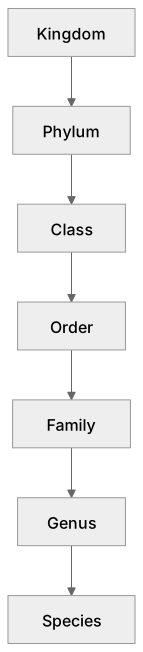
Put it in order
Put these steps in the order they happen.
- 1. Species
- 2. Genus
- 3. Class
- 4. Family
- 5. Kingdom
- 6. Phylum
- 7. Order
Label the diagram
Some boxes have lost their names. Pick the right name for each number.
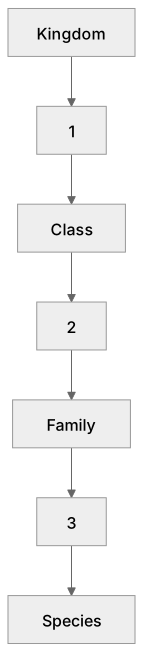
1Box 1
2Box 2
3Box 3
There is more to this lesson
The full lesson goes on to check your understanding and help you earn the marks. Create a free account to carry on, with your progress saved.
A week of Premium from your first lesson · Then the free plan continues · No card, no charge
Test your understanding of Classification of living organisms: Linnaeus classified living things into kingdom, phylum, class, order, family, genus and species.
Active recall beats re-reading. Take an instant quiz now to test what you’ve learned and lock it into long-term memory.
A week of Premium from your first lesson · Then the free plan continues · No card, no charge