AQA · GCSE · Biology
Course version: 8461 · Version from Sept 2018
Organisms are named by the binomial system of genus and species.
Full specification wording
Classification of living organisms: Organisms are named by the binomial system of genus and species.
The binomial system gives every species a two-part scientific name.
Checked against the AQA 8461 specification (opens in a new tab) on .
- Point 3 of 9
- 3 key terms
Study notes
From the checked teaching notes for this specification point.
The idea
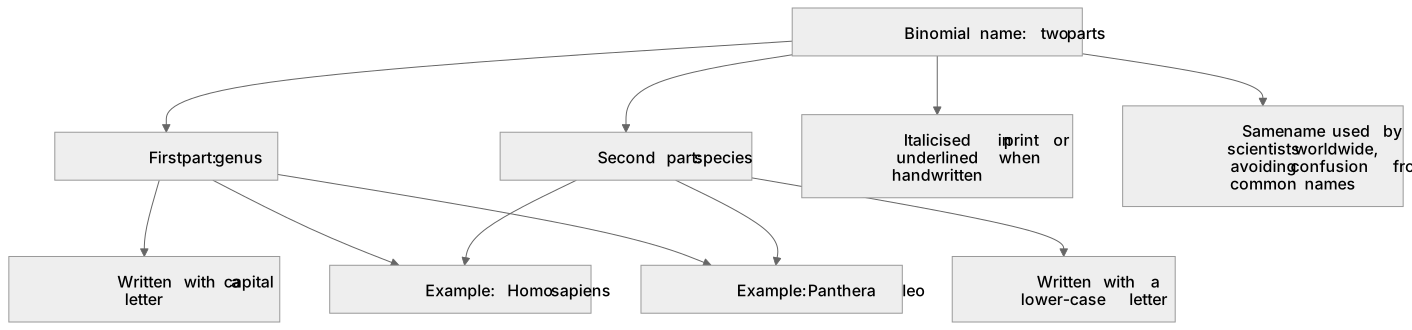
The binomial system gives every species a two-part scientific name. The first part is the genus, written with a capital letter; the second part is the species, written with a lower-case letter. Both parts are italicised in print or underlined when handwritten. For example, humans are Homo sapiens and the lion is Panthera leo. The genus groups closely related species, while the species name identifies one specific kind of organism. Because scientists worldwide use the same binomial name, it avoids confusion caused by different common names in different languages. The name is always written as genus followed by species, never reversed.
What earns the marks
- States that a binomial name has two parts: genus and species.
- Explains that the genus is written first with a capital letter and the species second with a lower-case letter.
- States that binomial names are italicised in print or underlined when handwritten.
- Explains that the system gives a universal name so scientists worldwide can identify the same organism.
- Applies the rules correctly to a named example such as Homo sapiens or Panthera leo.
Common mistakes and how to put them right
Reversing the order and writing the species before the genus.
Put it right by writing genus first, as in Homo sapiens.
Capitalising the species name, for example writing Homo Sapiens.
Put it right by using a lower-case letter for the species part.
Forgetting to italicise or underline the name.
Put it right by italicising in print or underlining when handwritten.
Exam tips
- Check capitalisation and italics every time you write a binomial name in an answer.
- Use one clear example, such as Homo sapiens, to show you can apply the rules.
- Link the binomial system to the need for a universal naming system when explaining its purpose.
Try the lesson
The start of the Classification of living organisms: Organisms are named by the binomial system of genus and species. lesson, made from checked teaching notes for this specification point.
Have a go first
In the binomial system, which two groups are used to give an organism its scientific name?
Listen
The binomial system gives every species a two-part scientific name. The first part is the genus, written with a capital letter; the second part is the species, written with a lower-case letter. Both parts are italicised in print or underlined when handwritten. For example, humans are Homo sapiens and the lion is Panthera leo. The genus groups closely related species, while the species name identifies one specific kind of organism. Because scientists worldwide use the same binomial name, it avoids confusion caused by different common names in different languages. The name is always written as genus followed by species, never reversed. A strong answer earns marks for these points. States that a binomial name has two parts: genus and species. Explains that the genus is written first with a capital letter and the species second with a lower-case letter. States that binomial names are italicised in print or underlined when handwritten. Explains that the system gives a universal name so scientists worldwide can identify the same organism. A common slip: Reversing the order and writing the species before the genus. Instead, writing genus first, as in Homo sapiens. Exam tip: Check capitalisation and italics every time you write a binomial name in an answer.
See it
Key words
Say what each word means before you turn the card.
Binomial system
Try answering aloud or in your head before turning the card.
Genus
Try answering aloud or in your head before turning the card.
Species
Try answering aloud or in your head before turning the card.
See every definition
- Binomial system
- A system in which organisms are named by genus and species, with the name always written as genus followed by species, never reversed.
- Genus
- The first part of a binomial name, written with a capital letter, which groups closely related species.
- Species
- The second part of a binomial name, written with a lower-case letter, which identifies one specific kind of organism.
Label the diagram
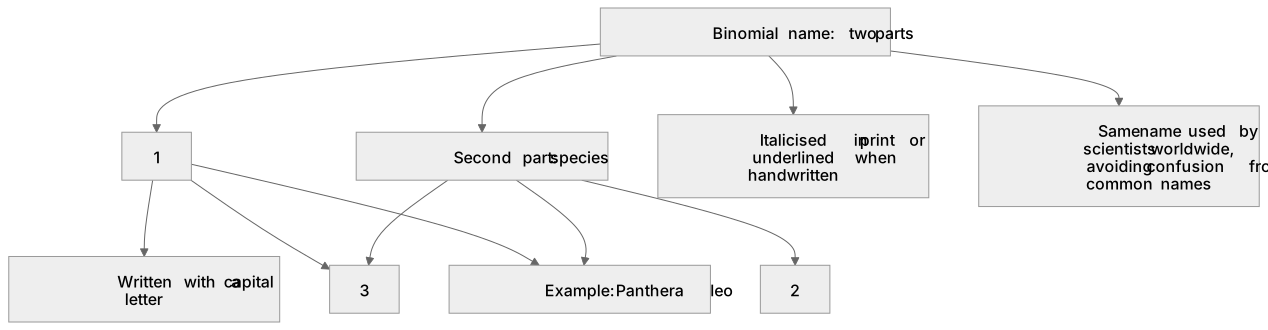
Some boxes have lost their names. Pick the right name for each number.
1Box 1
2Box 2
3Box 3
There is more to this lesson
The full lesson goes on to check your understanding and help you earn the marks. Create a free account to carry on, with your progress saved.
A week of Premium from your first lesson · Then the free plan continues · No card, no charge
Test your understanding of Classification of living organisms: Organisms are named by the binomial system of genus and species.
Active recall beats re-reading. Take an instant quiz now to test what you’ve learned and lock it into long-term memory.
A week of Premium from your first lesson · Then the free plan continues · No card, no charge