AQA · GCSE · Biology
Course version: 8461 · Version from Sept 2018
Students should be able to describe the impact of developments in biology…
Full specification wording
Classification of living organisms: Students should be able to describe the impact of developments in biology on classification systems.
Classification systems change as biological knowledge grows.
Checked against the AQA 8461 specification (opens in a new tab) on .
- Point 5 of 9
- 4 key terms
Study notes
From the checked teaching notes for this specification point.
The idea
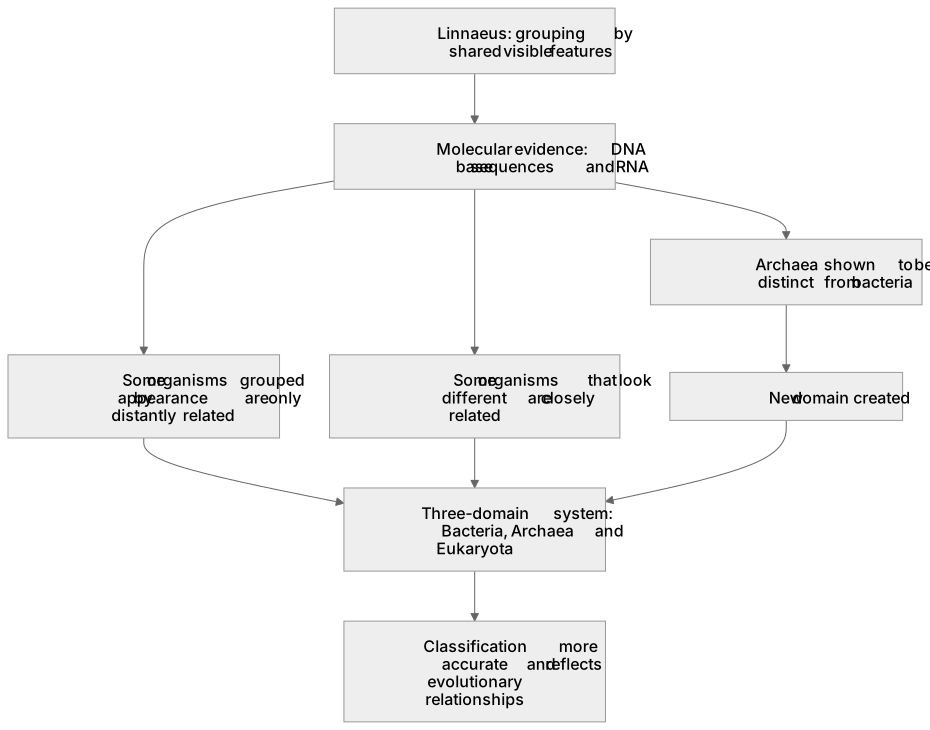
Classification systems change as biological knowledge grows. Linnaeus originally grouped organisms mainly by shared visible features. Later, scientists such as Carl Woese used molecular evidence, including DNA base sequences and RNA, to revise the system. This led to the three-domain system: Bacteria, Archaea and Eukaryota. Advances in microscopy, biochemistry and genetics revealed that some organisms placed together by appearance are only distantly related, while others that look different are closely related. For example, DNA evidence showed that archaea are distinct from bacteria, so a new domain was created. The impact is that classification becomes more accurate and reflects evolutionary relationships rather than just outward appearance.
What earns the marks
- States that early classification used observable features and was devised by Linnaeus.
- Describes how molecular evidence such as DNA base sequences and RNA changed classification.
- Names the three domains: Bacteria, Archaea and Eukaryota.
- Explains that new evidence can move organisms into different groups or create new groups.
- Explains that modern classification aims to reflect evolutionary relationships.
Common mistakes and how to put them right
Claiming that Linnaeus used DNA evidence.
Put it right by stating that he used observable features and that molecular evidence came much later.
Listing the three domains as kingdoms.
Put it right by naming them as domains: Bacteria, Archaea and Eukaryota.
Saying classification never changes.
Put it right by explaining that new evidence leads to revision of groups.
Exam tips
- Name the type of evidence, such as DNA base sequences, rather than saying 'better technology' alone.
- Link each development to a specific change in the classification system.
- Use the three-domain system as a concrete example of classification being revised.
Try the lesson
The start of the Classification of living organisms: Students should be able to describe the impact of developments in biology on classification systems. lesson, made from checked teaching notes for this specification point.
Have a go first
Which development in biology led Carl Woese to propose the three-domain system of classification?
Listen
Classification systems change as biological knowledge grows. Linnaeus originally grouped organisms mainly by shared visible features. Later, scientists such as Carl Woese used molecular evidence, including DNA base sequences and RNA, to revise the system. This led to the three-domain system: Bacteria, Archaea and Eukaryota. Advances in microscopy, biochemistry and genetics revealed that some organisms placed together by appearance are only distantly related, while others that look different are closely related. For example, DNA evidence showed that archaea are distinct from bacteria, so a new domain was created. The impact is that classification becomes more accurate and reflects evolutionary relationships rather than just outward appearance. A strong answer earns marks for these points. States that early classification used observable features and was devised by Linnaeus. Describes how molecular evidence such as DNA base sequences and RNA changed classification. Names the three domains: Bacteria, Archaea and Eukaryota. Explains that new evidence can move organisms into different groups or create new groups. A common slip: Claiming that Linnaeus used DNA evidence. Instead, stating that he used observable features and that molecular evidence came much later. Exam tip: Name the type of evidence, such as DNA base sequences, rather than saying 'better technology' alone.
See it
Key words
Say what each word means before you turn the card.
Changing classification
Try answering aloud or in your head before turning the card.
Molecular evidence
Try answering aloud or in your head before turning the card.
Three-domain system
Try answering aloud or in your head before turning the card.
Evolutionary relationships
Try answering aloud or in your head before turning the card.
See every definition
- Changing classification
- Classification systems change as biological knowledge grows, and new evidence can move organisms into different groups or create new groups.
- Molecular evidence
- Evidence such as DNA base sequences and RNA, used by scientists such as Carl Woese to revise the classification system.
- Three-domain system
- The system of Bacteria, Archaea and Eukaryota, which resulted from molecular evidence showing that archaea are distinct from bacteria.
- Evolutionary relationships
- What modern classification aims to reflect, rather than just outward appearance, so that classification becomes more accurate.
Label the diagram
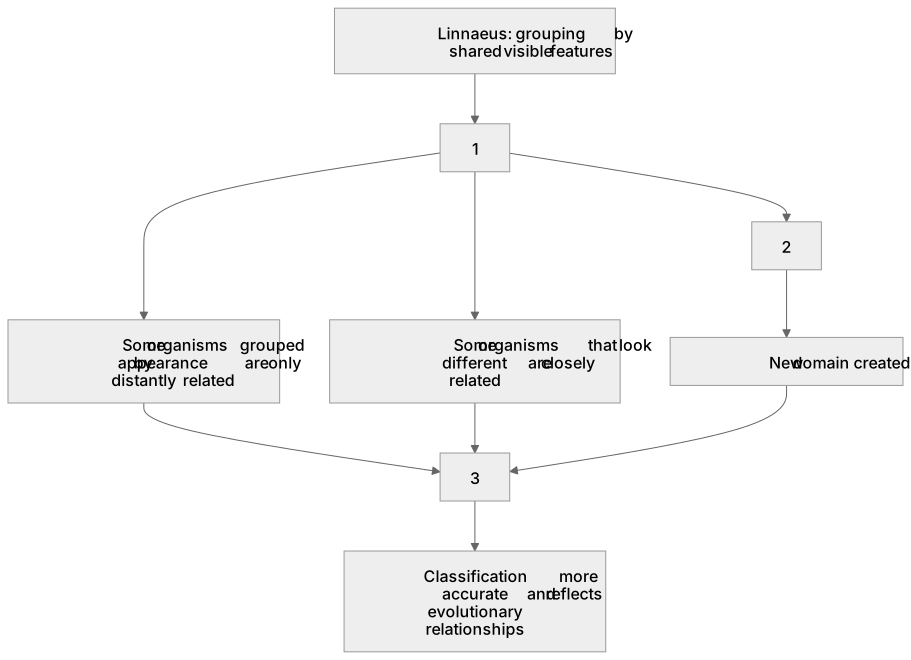
Some boxes have lost their names. Pick the right name for each number.
1Box 1
2Box 2
3Box 3
There is more to this lesson
The full lesson goes on to check your understanding and help you earn the marks. Create a free account to carry on, with your progress saved.
A week of Premium from your first lesson · Then the free plan continues · No card, no charge
Test your understanding of Classification of living organisms: Students should be able to describe the impact of developments in biology on classification systems.
Active recall beats re-reading. Take an instant quiz now to test what you’ve learned and lock it into long-term memory.
A week of Premium from your first lesson · Then the free plan continues · No card, no charge