AQA · GCSE · Biology
Course version: 8461 · Version from Sept 2018
Students should be able to use information given to show understanding of…
Full specification wording
Classification of living organisms: Students should be able to use information given to show understanding of the Linnaean system.
In this skill you are given information, such as a table of features or a list of organisms, and you use it to show that you understand the Linnaean system.
Checked against the AQA 8461 specification (opens in a new tab) on .
- Point 4 of 9
- 4 key terms
Study notes
From the checked teaching notes for this specification point.
The idea
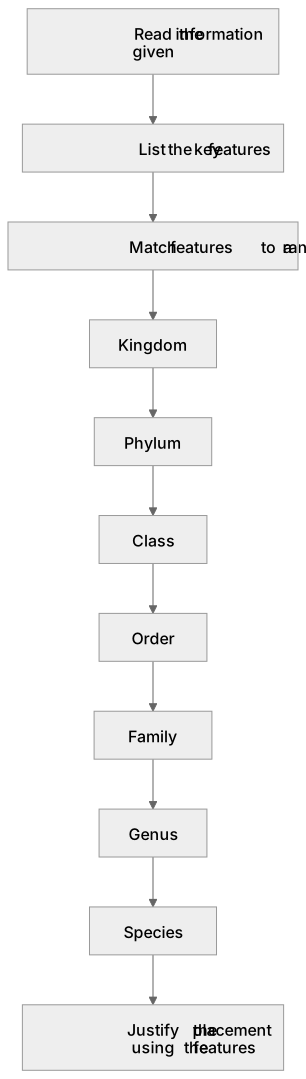
In this skill you are given information, such as a table of features or a list of organisms, and you use it to show that you understand the Linnaean system. You might be asked to place an organism into the correct kingdom, phylum, class, order, family, genus or species using a key or table. You might compare two organisms and identify the rank at which they diverge. The method is to read the information carefully, match the features to the ranks, and work down the hierarchy from kingdom to species. For example, if a table shows an organism with a backbone, hair and mammary glands, you can place it in kingdom Animalia, phylum Chordata and class Mammalia. Always justify your answer using the information provided.
What earns the marks
- Extracts the relevant features or data from the information given.
- Matches the features to the correct Linnaean rank or ranks.
- Works logically down the hierarchy from kingdom towards species.
- Justifies the placement by referring to specific features in the information.
- Compares two organisms and identifies the rank at which they separate.
Common mistakes and how to put them right
Ignoring part of the given information and guessing the rank.
Put it right by listing the features first and matching each one to a rank.
Working upwards from species instead of downwards from kingdom.
Put it right by starting at kingdom and narrowing the group step by step.
Giving a rank without a reason.
Put it right by quoting the feature from the information that supports your answer.
Exam tips
- Underline or list the key features in the information before deciding on a rank.
- Show your reasoning step by step so the examiner can follow how you reached the rank.
- If two organisms are compared, state the rank at which they first differ, not just the final rank.
Try the lesson
The start of the Classification of living organisms: Students should be able to use information given to show understanding of the Linnaean system. lesson, made from checked teaching notes for this specification point.
Have a go first
A scientist discovers three new plant species and names them *Rosa alba*, *Rosa gallica*, and *Hibiscus rosa-sinensis*. Based on the Linnaean system, which conclusion can be drawn from these names?
Listen
In this skill you are given information, such as a table of features or a list of organisms, and you use it to show that you understand the Linnaean system. You might be asked to place an organism into the correct kingdom, phylum, class, order, family, genus or species using a key or table. You might compare two organisms and identify the rank at which they diverge. The method is to read the information carefully, match the features to the ranks, and work down the hierarchy from kingdom to species. For example, if a table shows an organism with a backbone, hair and mammary glands, you can place it in kingdom Animalia, phylum Chordata and class Mammalia. Always justify your answer using the information provided. A strong answer earns marks for these points. Extracts the relevant features or data from the information given. Matches the features to the correct Linnaean rank or ranks. Works logically down the hierarchy from kingdom towards species. Justifies the placement by referring to specific features in the information. A common slip: Ignoring part of the given information and guessing the rank. Instead, listing the features first and matching each one to a rank. Exam tip: Underline or list the key features in the information before deciding on a rank.
See it
Key words
Say what each word means before you turn the card.
Using data
Try answering aloud or in your head before turning the card.
Hierarchical classification
Try answering aloud or in your head before turning the card.
Justification
Try answering aloud or in your head before turning the card.
Comparison
Try answering aloud or in your head before turning the card.
See every definition
- Using data
- Reading the information given, such as a table of features or a list of organisms, and matching the features to the ranks.
- Hierarchical classification
- Working logically down the hierarchy from kingdom to species, narrowing the group step by step.
- Justification
- Giving a reason for a rank by quoting the feature from the information that supports your answer.
- Comparison
- Comparing two organisms and identifying the rank at which they diverge.
Label the diagram
Some boxes have lost their names. Pick the right name for each number.
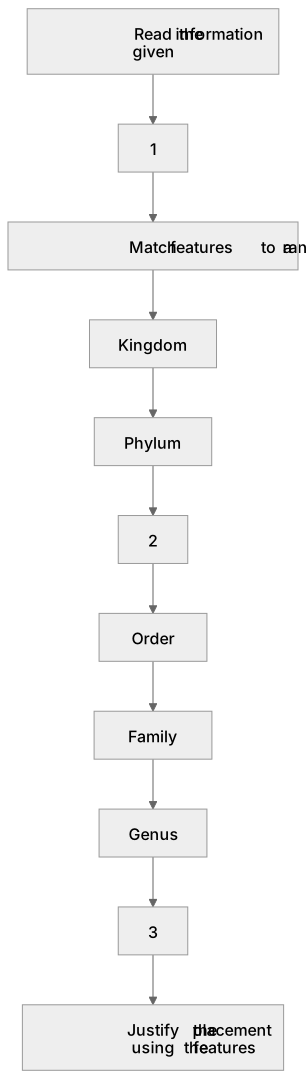
1Box 1
2Box 2
3Box 3
There is more to this lesson
The full lesson goes on to check your understanding and help you earn the marks. Create a free account to carry on, with your progress saved.
A week of Premium from your first lesson · Then the free plan continues · No card, no charge
Test your understanding of Classification of living organisms: Students should be able to use information given to show understanding of the Linnaean system.
Active recall beats re-reading. Take an instant quiz now to test what you’ve learned and lock it into long-term memory.
A week of Premium from your first lesson · Then the free plan continues · No card, no charge