AQA · GCSE · Biology
Course version: 8461 · Version from Sept 2018
Adult cell cloning: • The nucleus is removed from an unfertilised egg…
Full specification wording
Cloning (biology only): Adult cell cloning: • The nucleus is removed from an unfertilised egg cell. • The nucleus from an adult body cell, such as a skin cell, is inserted into the egg cell.
Adult cell cloning produces a genetically identical copy of the adult that donated the body cell.
Checked against the AQA 8461 specification (opens in a new tab) on .
- Point 4 of 6
- 3 key terms
Study notes
From the checked teaching notes for this specification point.
The idea
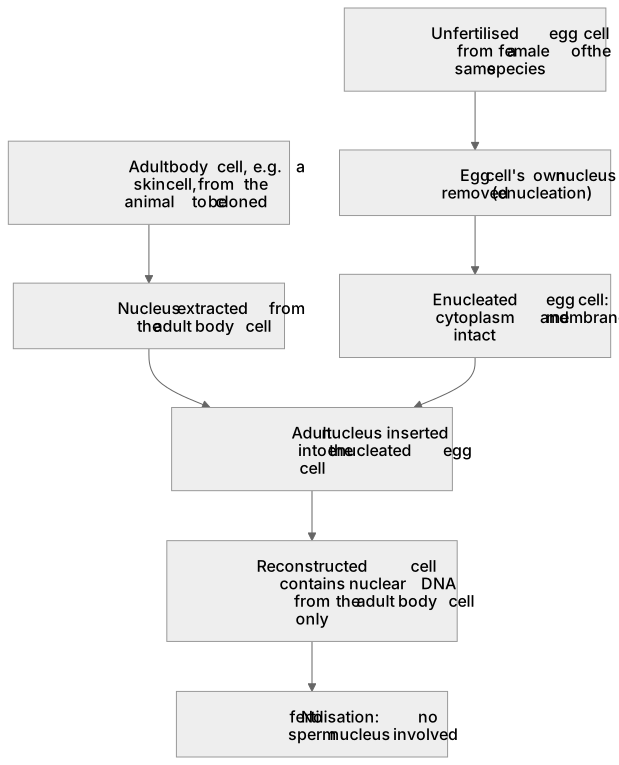
Adult cell cloning produces a genetically identical copy of the adult that donated the body cell. First an unfertilised egg cell is taken from a female of the same species. Its own nucleus is removed, leaving the cytoplasm and cell membrane; this is called enucleation. The nucleus is then taken from an adult body cell, such as a skin cell, of the animal to be cloned. That nucleus is inserted into the empty egg cell, so the egg now contains a full set of chromosomes from the adult donor. Because the egg's original genetic material has gone, all the nuclear DNA in the reconstructed cell comes from the adult body cell. The egg cell is not fertilised, so no sperm nucleus is involved.
For example: Removing the nucleus from a sheep egg cell and inserting a skin-cell nucleus from a second sheep creates a cell whose nuclear genes match that second sheep.
What earns the marks
- An unfertilised egg cell is obtained from a female of the same species as the animal to be cloned.
- The egg cell's own nucleus is removed, a step called enucleation, leaving the cytoplasm and membrane intact.
- A body cell, for example a skin cell, is taken from the adult animal that is to be cloned.
- The nucleus is extracted from that adult body cell and inserted into the enucleated egg cell.
- The resulting cell contains nuclear DNA from the adult body cell only, because the egg's original nucleus was removed.
- No fertilisation occurs, so no sperm cell or second parent contributes genetic material at this stage.
Common mistakes and how to put them right
Thinking the egg cell keeps its own nucleus and simply receives an extra one.
Put it right: The egg nucleus must be removed first so only the adult nucleus remains.
Believing the egg cell is fertilised by a sperm.
Put it right: The egg is unfertilised and the adult nucleus replaces the egg nucleus.
Saying the whole adult body cell is placed inside the egg.
Put it right: The nucleus is removed from the body cell and inserted, not the entire cell.
Exam tips
- Use the precise terms unfertilised egg cell, enucleation and adult body cell rather than vague words like egg and cell.
- Describe the sequence in order: remove egg nucleus, take adult body-cell nucleus, insert it into the empty egg cell.
- State clearly that the clone's nuclear DNA comes from the adult body-cell donor, which explains why the offspring is genetically identical to that donor.
Try the lesson
The start of the Cloning (biology only): Adult cell cloning: • The nucleus is removed from an unfertilised egg cell. • The nucleus from an adult body cell, such as a skin cell, is inserted into the egg cell. lesson, made from checked teaching notes for this specification point.
Have a go first
In adult cell cloning, which part is taken out of an unfertilised egg cell before any other step?
Listen
Adult cell cloning produces a genetically identical copy of the adult that donated the body cell. First an unfertilised egg cell is taken from a female of the same species. Its own nucleus is removed, leaving the cytoplasm and cell membrane; this is called enucleation. The nucleus is then taken from an adult body cell, such as a skin cell, of the animal to be cloned. That nucleus is inserted into the empty egg cell, so the egg now contains a full set of chromosomes from the adult donor. Because the egg's original genetic material has gone, all the nuclear DNA in the reconstructed cell comes from the adult body cell. The egg cell is not fertilised, so no sperm nucleus is involved. For example, removing the nucleus from a sheep egg cell and inserting a skin-cell nucleus from a second sheep creates a cell whose nuclear genes match that second sheep. A strong answer earns marks for these points. An unfertilised egg cell is obtained from a female of the same species as the animal to be cloned. The egg cell's own nucleus is removed, a step called enucleation, leaving the cytoplasm and membrane intact. A body cell, for example a skin cell, is taken from the adult animal that is to be cloned. The nucleus is extracted from that adult body cell and inserted into the enucleated egg cell. A common slip: Thinking the egg cell keeps its own nucleus and simply receives an extra one. Instead, the egg nucleus must be removed first so only the adult nucleus remains. Exam tip: Use the precise terms unfertilised egg cell, enucleation and adult body cell rather than vague words like egg and cell.
See it
Key words
Say what each word means before you turn the card.
Enucleation
Try answering aloud or in your head before turning the card.
Unfertilised egg cell
Try answering aloud or in your head before turning the card.
Adult body cell
Try answering aloud or in your head before turning the card.
See every definition
- Enucleation
- The removal of the egg cell's own nucleus, leaving the cytoplasm and cell membrane intact.
- Unfertilised egg cell
- A cell taken from a female of the same species, whose nucleus is removed before the adult body-cell nucleus is inserted.
- Adult body cell
- A cell such as a skin cell, taken from the animal to be cloned, from which the nucleus is extracted and inserted into the enucleated egg cell.
Label the diagram
Some boxes have lost their names. Pick the right name for each number.
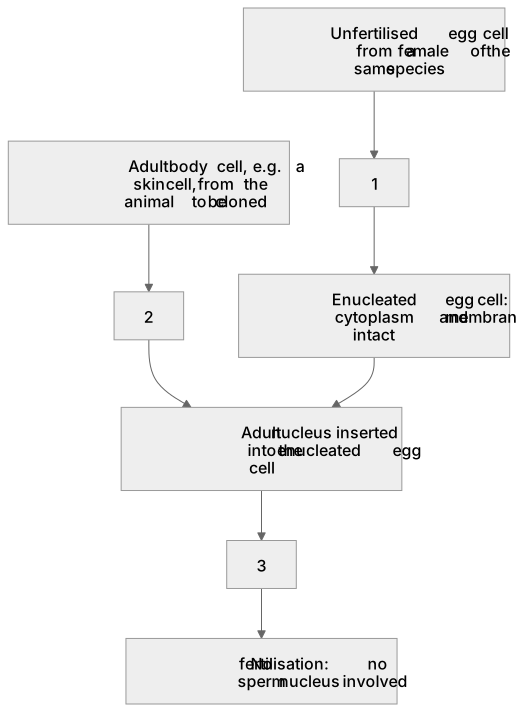
1Box 1
2Box 2
3Box 3
There is more to this lesson
The full lesson goes on to check your understanding and help you earn the marks. Create a free account to carry on, with your progress saved.
A week of Premium from your first lesson · Then the free plan continues · No card, no charge
Test your understanding of Cloning (biology only): Adult cell cloning: • The nucleus is removed from an unfertilised egg cell. • The nucleus from an adult body cell, such as a skin cell, is inserted into the egg cell.
Active recall beats re-reading. Take an instant quiz now to test what you’ve learned and lock it into long-term memory.
A week of Premium from your first lesson · Then the free plan continues · No card, no charge