AQA · GCSE · Biology
Course version: 8461 · Version from Sept 2018
An electric shock stimulates the egg cell to divide to form an embryo. •…
Full specification wording
Cloning (biology only): An electric shock stimulates the egg cell to divide to form an embryo. • These embryo cells contain the same genetic information as the adult skin cell.
After the adult nucleus has been inserted into the enucleated egg cell, the reconstructed cell is given a small electric shock.
Checked against the AQA 8461 specification (opens in a new tab) on .
- Point 5 of 6
- 4 key terms
Study notes
From the checked teaching notes for this specification point.
The idea
After the adult nucleus has been inserted into the enucleated egg cell, the reconstructed cell is given a small electric shock. This stimulus makes the egg cell start to divide by mitosis, as though it had been fertilised. Repeated division produces a ball of cells called an embryo. Because the embryo's cells arise by mitosis from the reconstructed egg, every one of them contains the same set of chromosomes as the inserted adult nucleus. The nuclear DNA therefore matches the adult body cell, such as the skin cell, that donated the nucleus. The embryo is later placed into a surrogate mother, where it develops into a clone of the adult donor.
For example: The first cloned mammal, Dolly the sheep, was produced by this method, and her nuclear DNA matched the sheep that donated the udder cell nucleus.
What earns the marks
- An electric shock is applied to the reconstructed egg cell to stimulate it to divide.
- The egg cell divides by mitosis to form an embryo, a ball of genetically identical cells.
- The embryo cells contain the same genetic information as the adult body cell that donated the nucleus.
- The embryo is implanted into a surrogate mother, where it continues to develop.
- The resulting offspring is genetically identical to the adult body-cell donor, so it is a clone.
- The electric shock replaces the trigger normally provided by fertilisation, but no sperm DNA is involved.
Common mistakes and how to put them right
Saying the electric shock fertilises the egg.
Put it right: It stimulates division, and no sperm is involved.
Claiming the embryo cells contain a mixture of DNA from the egg donor and the body-cell donor.
Put it right: The egg nucleus was removed, so the DNA matches the adult body cell.
Confusing mitosis with meiosis in this context.
Put it right: The embryo forms by mitosis, producing genetically identical cells.
Exam tips
- Link the electric shock directly to the start of cell division, and name mitosis as the type of division.
- Explain the genetic identity of the embryo by referring back to the removal of the egg nucleus and insertion of the adult nucleus.
- Use the term surrogate mother when describing where the embryo develops, and state that the offspring is a clone of the adult donor.
Try the lesson
The start of the Cloning (biology only): An electric shock stimulates the egg cell to divide to form an embryo. • These embryo cells contain the same genetic information as the adult skin cell. lesson, made from checked teaching notes for this specification point.
Have a go first
In adult cell cloning, what is used to stimulate the egg cell to divide and form an embryo?
Listen
After the adult nucleus has been inserted into the enucleated egg cell, the reconstructed cell is given a small electric shock. This stimulus makes the egg cell start to divide by mitosis, as though it had been fertilised. Repeated division produces a ball of cells called an embryo. Because the embryo's cells arise by mitosis from the reconstructed egg, every one of them contains the same set of chromosomes as the inserted adult nucleus. The nuclear DNA therefore matches the adult body cell, such as the skin cell, that donated the nucleus. The embryo is later placed into a surrogate mother, where it develops into a clone of the adult donor. For example, the first cloned mammal, Dolly the sheep, was produced by this method, and her nuclear DNA matched the sheep that donated the udder cell nucleus. A strong answer earns marks for these points. An electric shock is applied to the reconstructed egg cell to stimulate it to divide. The egg cell divides by mitosis to form an embryo, a ball of genetically identical cells. The embryo cells contain the same genetic information as the adult body cell that donated the nucleus. The embryo is implanted into a surrogate mother, where it continues to develop. A common slip: Saying the electric shock fertilises the egg. Instead, it stimulates division, and no sperm is involved. Exam tip: Link the electric shock directly to the start of cell division, and name mitosis as the type of division.
See it
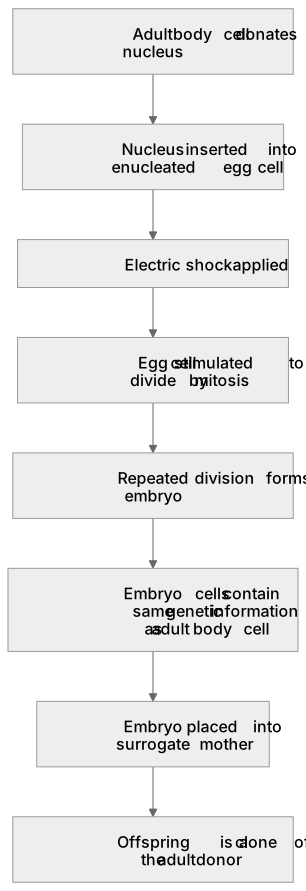
Put it in order
Put these steps in the order they happen.
- 1. Repeated division forms embryo
- 2. Offspring is a clone of the adult donor
- 3. Embryo cells contain same genetic information as adult body cell
- 4. Adult body cell donates nucleus
- 5. Nucleus inserted into enucleated egg cell
- 6. Embryo placed into surrogate mother
- 7. Electric shock applied
- 8. Egg cell stimulated to divide by mitosis
Key words
Say what each word means before you turn the card.
mitosis
Try answering aloud or in your head before turning the card.
embryo
Try answering aloud or in your head before turning the card.
surrogate mother
Try answering aloud or in your head before turning the card.
clone
Try answering aloud or in your head before turning the card.
See every definition
- mitosis
- The type of division by which the egg cell starts to divide after the electric shock, as though it had been fertilised.
- embryo
- A ball of cells produced by repeated division of the reconstructed egg cell.
- surrogate mother
- The mother into which the embryo is later placed, where it develops into a clone of the adult donor.
- clone
- The offspring that results when the embryo develops, being genetically identical to the adult body-cell donor.
Label the diagram
Some boxes have lost their names. Pick the right name for each number.
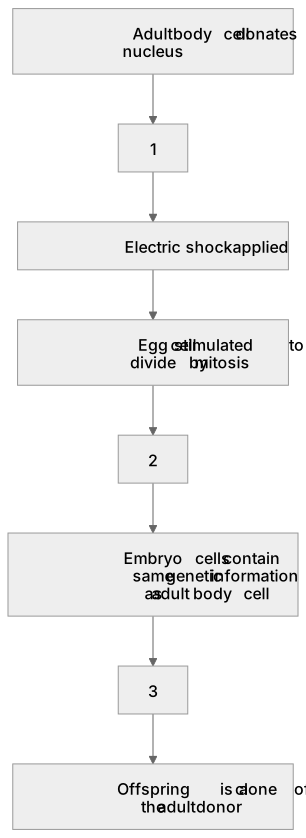
1Box 1
2Box 2
3Box 3
There is more to this lesson
The full lesson goes on to check your understanding and help you earn the marks. Create a free account to carry on, with your progress saved.
A week of Premium from your first lesson · Then the free plan continues · No card, no charge
Test your understanding of Cloning (biology only): An electric shock stimulates the egg cell to divide to form an embryo. • These embryo cells contain the same genetic information as the adult skin cell.
Active recall beats re-reading. Take an instant quiz now to test what you’ve learned and lock it into long-term memory.
A week of Premium from your first lesson · Then the free plan continues · No card, no charge