AQA · GCSE · Biology
Course version: 8461 · Version from Sept 2018
Cuttings: an older, but simple, method used by gardeners to produce many…
Full specification wording
Cloning (biology only): Cuttings: an older, but simple, method used by gardeners to produce many identical new plants from a parent plant.
Cuttings are a traditional form of asexual reproduction used by gardeners to make many genetically identical copies of a chosen parent plant.
Checked against the AQA 8461 specification (opens in a new tab) on .
- Point 2 of 6
- 4 key terms
Study notes
From the checked teaching notes for this specification point.
The idea
Cuttings are a traditional form of asexual reproduction used by gardeners to make many genetically identical copies of a chosen parent plant. A healthy shoot is cut from the parent, lower leaves are removed, and the cut end may be dipped in rooting powder before being planted in damp compost. Because no gametes fuse, the new plant is a clone and inherits the parent's desirable features, such as flower colour or fruit yield. The method is simple, cheap and needs no specialist laboratory, but it relies on the parent being healthy and can spread a viral disease to every cutting. Large numbers of uniform plants can be raised quickly from one parent, which is why growers use cuttings for many ornamental shrubs and houseplants.
What earns the marks
- Cuttings are a form of asexual reproduction, so no gametes fuse and no fertilisation occurs.
- A shoot or piece of stem is cut from the parent plant and planted so that it grows into a new plant.
- The offspring are genetically identical clones of the parent because all cells arise by mitosis from the parent tissue.
- Gardeners use cuttings because the method is simple, inexpensive and produces many identical plants quickly.
- Removing lower leaves and keeping the cutting in warm, damp conditions encourages root growth.
- A limitation is that any disease present in the parent can be passed to all the cuttings.
Common mistakes and how to put them right
Thinking cuttings involve seeds or fertilisation.
Put it right by stressing that cuttings are asexual and produce clones.
Believing the new plant is only partly like the parent.
Put it right by explaining that all its cells come from the parent by mitosis, so it is genetically identical.
Assuming cuttings always succeed.
Put it right by noting that they need suitable warmth, moisture and rooting conditions.
Exam tips
- State clearly that the offspring are genetically identical to the parent, using the term clone.
- Link the method to a practical step, such as cutting a shoot and planting it in damp compost.
- If asked to compare with sexual reproduction, mention the absence of gametes and fertilisation.
Try the lesson
The start of the Cloning (biology only): Cuttings: an older, but simple, method used by gardeners to produce many identical new plants from a parent plant. lesson, made from checked teaching notes for this specification point.
Have a go first
A gardener takes a cutting from a healthy parent plant. What is the main reason gardeners use cuttings?
Listen
Cuttings are a traditional form of asexual reproduction used by gardeners to make many genetically identical copies of a chosen parent plant. A healthy shoot is cut from the parent, lower leaves are removed, and the cut end may be dipped in rooting powder before being planted in damp compost. Because no gametes fuse, the new plant is a clone and inherits the parent's desirable features, such as flower colour or fruit yield. The method is simple, cheap and needs no specialist laboratory, but it relies on the parent being healthy and can spread a viral disease to every cutting. Large numbers of uniform plants can be raised quickly from one parent, which is why growers use cuttings for many ornamental shrubs and houseplants. A strong answer earns marks for these points. Cuttings are a form of asexual reproduction, so no gametes fuse and no fertilisation occurs. A shoot or piece of stem is cut from the parent plant and planted so that it grows into a new plant. The offspring are genetically identical clones of the parent because all cells arise by mitosis from the parent tissue. Gardeners use cuttings because the method is simple, inexpensive and produces many identical plants quickly. A common slip: Thinking cuttings involve seeds or fertilisation. Instead, stressing that cuttings are asexual and produce clones. Exam tip: State clearly that the offspring are genetically identical to the parent, using the term clone.
See it
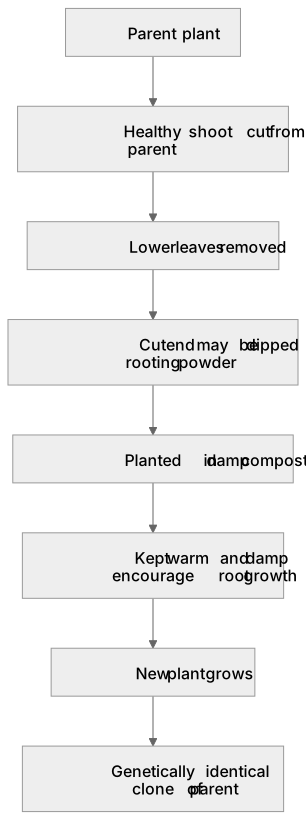
Put it in order
Put these steps in the order they happen.
- 1. Planted in damp compost
- 2. Genetically identical clone of parent
- 3. Kept warm and damp to encourage root growth
- 4. Parent plant
- 5. Healthy shoot cut from parent
- 6. New plant grows
- 7. Lower leaves removed
- 8. Cut end may be dipped in rooting powder
Key words
Say what each word means before you turn the card.
Asexual reproduction
Try answering aloud or in your head before turning the card.
Clones
Try answering aloud or in your head before turning the card.
Cuttings
Try answering aloud or in your head before turning the card.
Rooting powder
Try answering aloud or in your head before turning the card.
See every definition
- Asexual reproduction
- A form of reproduction in which no gametes fuse and no fertilisation occurs, so the new plant is a clone of the parent.
- Clones
- Offspring that are genetically identical to the parent because all their cells arise by mitosis from the parent tissue.
- Cuttings
- A simple method used by gardeners in which a shoot or piece of stem is cut from a parent plant and planted so that it grows into a new plant.
- Rooting powder
- A substance the cut end of a shoot may be dipped in before being planted in damp compost.
Label the diagram
Some boxes have lost their names. Pick the right name for each number.
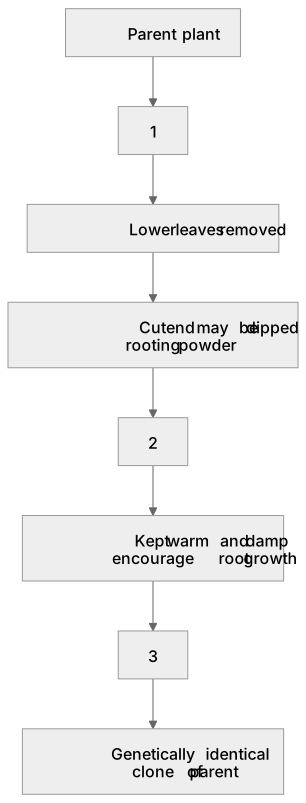
1Box 1
2Box 2
3Box 3
There is more to this lesson
The full lesson goes on to check your understanding and help you earn the marks. Create a free account to carry on, with your progress saved.
A week of Premium from your first lesson · Then the free plan continues · No card, no charge
Test your understanding of Cloning (biology only): Cuttings: an older, but simple, method used by gardeners to produce many identical new plants from a parent plant.
Active recall beats re-reading. Take an instant quiz now to test what you’ve learned and lock it into long-term memory.
A week of Premium from your first lesson · Then the free plan continues · No card, no charge