AQA · GCSE · Biology
Course version: 8461 · Version from Sept 2018
Tissue culture: using small groups of cells from part of a plant to grow…
Full specification wording
Cloning (biology only): Tissue culture: using small groups of cells from part of a plant to grow identical new plants. This is important for preserving rare plant species or commercially in nurseries.
Tissue culture is a cloning method that uses small groups of cells taken from part of a plant, such as a shoot tip or leaf, to grow identical new plants.
Checked against the AQA 8461 specification (opens in a new tab) on .
- Point 1 of 6
Study notes
From the checked teaching notes for this specification point.
The idea
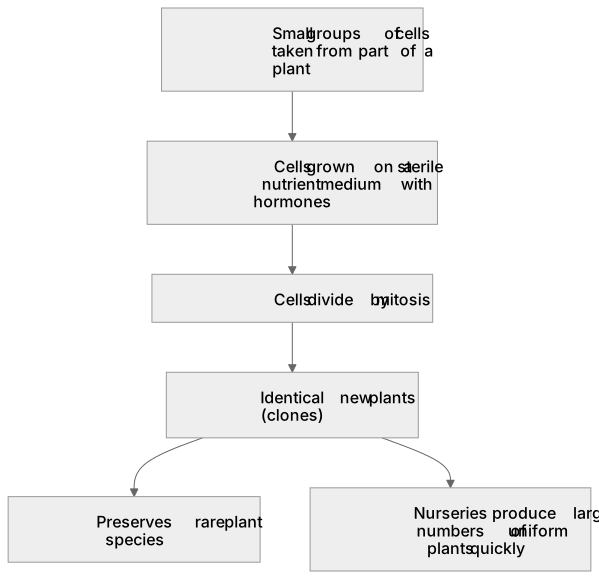
Tissue culture is a cloning method that uses small groups of cells taken from part of a plant, such as a shoot tip or leaf, to grow identical new plants. The cells are grown on a sterile nutrient medium containing hormones, and because they divide by mitosis the new plants are genetically identical clones of the parent. Sterile conditions prevent microorganisms contaminating the culture. Tissue culture is valuable for preserving rare plant species, because many identical plants can be produced from a small amount of material, and commercially in nurseries, where large numbers of uniform plants can be grown quickly.
What earns the marks
- Small groups of cells are taken from part of a plant, such as a shoot tip.
- Cells are grown on a sterile nutrient medium with hormones.
- The cells divide by mitosis to form identical new plants.
- Tissue culture preserves rare plant species because many clones can be grown from limited material.
- Commercially, nurseries use tissue culture to produce large numbers of uniform plants quickly.
Common mistakes and how to put them right
Confusing tissue culture with taking cuttings.
Put it right: Tissue culture uses small groups of cells grown on a medium, not detached stem pieces rooted in soil.
Saying the new plants are genetically different.
Put it right: Mitosis produces genetically identical clones.
Forgetting sterile conditions; correction: contamination by microorganisms would destroy the culture.
Exam tips
- Name the source of cells and the growth medium in your answer.
- State that mitosis makes the new plants identical clones.
- Give one conservation reason and one commercial reason for using tissue culture.
Try the lesson
The start of the Cloning (biology only): Tissue culture: using small groups of cells from part of a plant to grow identical new plants. This is important for preserving rare plant species or commercially in nurseries. lesson, made from checked teaching notes for this specification point.
Have a go first
What is tissue culture used for in plants?
Listen
Tissue culture is a cloning method that uses small groups of cells taken from part of a plant, such as a shoot tip or leaf, to grow identical new plants. The cells are grown on a sterile nutrient medium containing hormones, and because they divide by mitosis the new plants are genetically identical clones of the parent. Sterile conditions prevent microorganisms contaminating the culture. Tissue culture is valuable for preserving rare plant species, because many identical plants can be produced from a small amount of material, and commercially in nurseries, where large numbers of uniform plants can be grown quickly. A strong answer earns marks for these points. Small groups of cells are taken from part of a plant, such as a shoot tip. Cells are grown on a sterile nutrient medium with hormones. The cells divide by mitosis to form identical new plants. Tissue culture preserves rare plant species because many clones can be grown from limited material. A common slip: Confusing tissue culture with taking cuttings. Instead, tissue culture uses small groups of cells grown on a medium, not detached stem pieces rooted in soil. Exam tip: Name the source of cells and the growth medium in your answer.
See it
Label the diagram
Some boxes have lost their names. Pick the right name for each number.
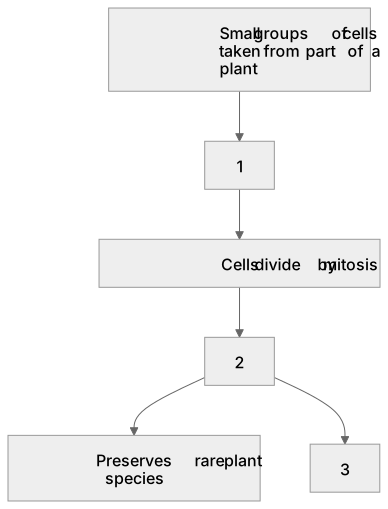
1Box 1
2Box 2
3Box 3
There is more to this lesson
The full lesson goes on to check your understanding and help you earn the marks. Create a free account to carry on, with your progress saved.
A week of Premium from your first lesson · Then the free plan continues · No card, no charge
Test your understanding of Cloning (biology only): Tissue culture: using small groups of cells from part of a plant to grow identical new plants. This is important for preserving rare plant species or commercially in nurseries.
Active recall beats re-reading. Take an instant quiz now to test what you’ve learned and lock it into long-term memory.
A week of Premium from your first lesson · Then the free plan continues · No card, no charge