AQA · GCSE · Biology
Course version: 8461 · Version from Sept 2018
When the embryo has developed into a ball of cells, it is inserted into…
Full specification wording
Cloning (biology only): When the embryo has developed into a ball of cells, it is inserted into the womb of an adult female to continue its development.
This statement describes a stage in adult cell cloning, a technique used to produce a genetically identical copy of an animal.
Checked against the AQA 8461 specification (opens in a new tab) on .
- Point 6 of 6
- 3 key terms
Study notes
From the checked teaching notes for this specification point.
The idea
This statement describes a stage in adult cell cloning, a technique used to produce a genetically identical copy of an animal. After the nucleus is removed from an egg cell and replaced with the nucleus from a body cell of the animal being cloned, the egg is stimulated to divide by mitosis. Once the resulting embryo has grown into a ball of cells, it is transferred into the womb of a surrogate adult female. The womb provides the temperature, nutrients and oxygen the embryo needs, so it can implant and continue developing into a full organism. The surrogate is not the genetic parent; the clone's nuclear DNA comes from the donor body cell. This is how Dolly the sheep was produced.
What earns the marks
- The embryo is produced by mitosis after the donor nucleus is placed into an egg cell whose own nucleus has been removed.
- The embryo must reach the ball-of-cells stage before transfer; it is not inserted as a single cell.
- The embryo is inserted into the womb (uterus) of an adult female, often called the surrogate.
- The surrogate's womb allows the embryo to implant and continue its development to birth.
- The surrogate does not contribute nuclear genetic material, so the offspring is genetically identical to the donor of the body cell.
Common mistakes and how to put them right
Thinking the surrogate mother is the genetic parent.
Put it right by stating that the nucleus comes from the donor body cell, so the clone's nuclear DNA matches the donor.
Believing the embryo is inserted immediately after the nucleus is transferred.
Put it right by noting that it must first divide by mitosis to form a ball of cells.
Confusing this with embryo cloning or with plant cloning.
Put it right by specifying that adult cell cloning uses a body cell nucleus and a surrogate womb.
Exam tips
- Use the correct sequence words: nucleus removed, donor nucleus inserted, mitosis, ball of cells, inserted into womb, development continues.
- Link the womb to its function: it supports implantation and supplies the embryo with what it needs to develop.
- If asked to compare with sexual reproduction, state that no fertilisation occurs and the offspring is genetically identical to the donor.
Try the lesson
The start of the Cloning (biology only): When the embryo has developed into a ball of cells, it is inserted into the womb of an adult female to continue its development. lesson, made from checked teaching notes for this specification point.
Have a go first
During the process of animal cloning, where is the developing embryo inserted so that it can grow into a fetus?
Listen
This statement describes a stage in adult cell cloning, a technique used to produce a genetically identical copy of an animal. After the nucleus is removed from an egg cell and replaced with the nucleus from a body cell of the animal being cloned, the egg is stimulated to divide by mitosis. Once the resulting embryo has grown into a ball of cells, it is transferred into the womb of a surrogate adult female. The womb provides the temperature, nutrients and oxygen the embryo needs, so it can implant and continue developing into a full organism. The surrogate is not the genetic parent; the clone's nuclear DNA comes from the donor body cell. This is how Dolly the sheep was produced. A strong answer earns marks for these points. The embryo is produced by mitosis after the donor nucleus is placed into an egg cell whose own nucleus has been removed. The embryo must reach the ball-of-cells stage before transfer; it is not inserted as a single cell. The embryo is inserted into the womb (uterus) of an adult female, often called the surrogate. The surrogate's womb allows the embryo to implant and continue its development to birth. A common slip: Thinking the surrogate mother is the genetic parent. Instead, stating that the nucleus comes from the donor body cell, so the clone's nuclear DNA matches the donor. Exam tip: Use the correct sequence words: nucleus removed, donor nucleus inserted, mitosis, ball of cells, inserted into womb, development continues.
See it
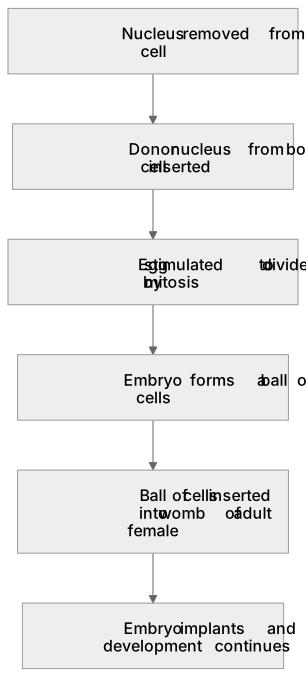
Put it in order
Put these steps in the order they happen.
- 1. Egg stimulated to divide by mitosis
- 2. Donor nucleus from body cell inserted
- 3. Nucleus removed from egg cell
- 4. Embryo implants and development continues
- 5. Ball of cells inserted into womb of adult female
- 6. Embryo forms a ball of cells
Key words
Say what each word means before you turn the card.
Mitosis and embryo development
Try answering aloud or in your head before turning the card.
Surrogate motherhood
Try answering aloud or in your head before turning the card.
Genetic identity
Try answering aloud or in your head before turning the card.
See every definition
- Mitosis and embryo development
- The egg is stimulated to divide by mitosis, and the resulting embryo must first divide to form a ball of cells before it is inserted into the womb.
- Surrogate motherhood
- An adult female into whose womb the ball of cells is inserted so it can implant and continue its development; she is not the genetic parent.
- Genetic identity
- The clone's nuclear DNA comes from the donor body cell, so the offspring is genetically identical to the donor of the body cell.
Label the diagram
Some boxes have lost their names. Pick the right name for each number.
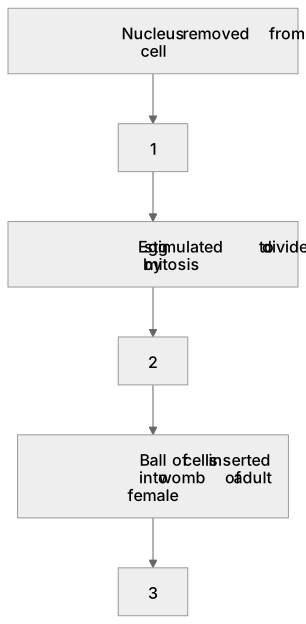
1Box 1
2Box 2
3Box 3
There is more to this lesson
The full lesson goes on to check your understanding and help you earn the marks. Create a free account to carry on, with your progress saved.
A week of Premium from your first lesson · Then the free plan continues · No card, no charge
Test your understanding of Cloning (biology only): When the embryo has developed into a ball of cells, it is inserted into the womb of an adult female to continue its development.
Active recall beats re-reading. Take an instant quiz now to test what you’ve learned and lock it into long-term memory.
A week of Premium from your first lesson · Then the free plan continues · No card, no charge