AQA · GCSE · Biology
Course version: 8461 · Version from Sept 2018
Bacteria may produce poisons (toxins) that damage tissues and make us feel…
Full specification wording
Communicable (infectious) diseases: Bacteria may produce poisons (toxins) that damage tissues and make us feel ill.
Bacteria are single-celled prokaryotes that cause communicable disease.
Checked against the AQA 8461 specification (opens in a new tab) on .
- Point 7 of 8
- 2 key terms
Study notes
From the checked teaching notes for this specification point.
The idea
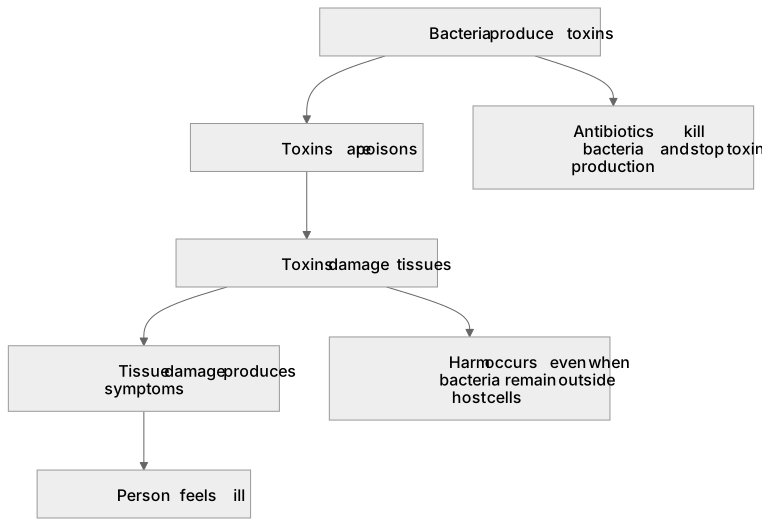
Bacteria are single-celled prokaryotes that cause communicable disease. While some directly invade host cells, many cause harm by releasing toxins — poisonous chemicals that damage tissues and produce symptoms like fever or diarrhoea. For example, in food poisoning, Salmonella multiply in the gut and release toxins that irritate the intestinal lining. The toxin is the harmful product; the feeling of illness is the body's response to tissue damage. This explains why antibiotics, which kill bacteria or inhibit their growth, can treat bacterial infections but are ineffective against viruses. Understanding toxins explains why some bacterial diseases are dangerous even when the bacterial cells remain outside host cells.
What earns the marks
- Bacteria are prokaryotic microorganisms that can cause communicable diseases.
- Some bacteria release toxins (poisons) as metabolic products.
- Toxins damage tissues, for example the lining of the gut or respiratory tract.
- Tissue damage produces symptoms such as fever, pain, vomiting or diarrhoea, making the person feel ill.
- The harm can occur even when bacteria remain outside host cells, because the toxin travels to and affects tissues.
- Antibiotics can kill bacteria and stop toxin production, unlike treatments for viral infections.
Common mistakes and how to put them right
Thinking bacteria always cause harm by entering and destroying cells.
Put it right by stating that many bacteria cause illness through toxins acting outside cells.
Confusing toxins with the bacteria themselves.
Put it right by describing the toxin as a separate poisonous chemical produced by the bacterium.
Assuming all bacteria are pathogens.
Put it right by noting that many bacteria are harmless or beneficial, and only some produce harmful toxins.
Exam tips
- Use the word toxin and link it explicitly to tissue damage and symptoms in the same sentence.
- Give a named example such as food poisoning caused by Salmonella to show application, not just recall.
- When comparing with viruses, state clearly that antibiotics target specific bacterial structures or processes, such as cell walls. Viruses are acellular and lack these structures, and they reproduce inside host cells, which is why antibiotics cannot destroy them.
Try the lesson
The start of the Communicable (infectious) diseases: Bacteria may produce poisons (toxins) that damage tissues and make us feel ill. lesson, made from checked teaching notes for this specification point.
Have a go first
Which substance do some bacteria produce that damages tissues and makes a person feel ill?
Listen
Bacteria are single-celled prokaryotes that cause communicable disease. While some directly invade host cells, many cause harm by releasing toxins — poisonous chemicals that damage tissues and produce symptoms like fever or diarrhoea. For example, in food poisoning, Salmonella multiply in the gut and release toxins that irritate the intestinal lining. The toxin is the harmful product; the feeling of illness is the body's response to tissue damage. This explains why antibiotics, which kill bacteria or inhibit their growth, can treat bacterial infections but are ineffective against viruses. Understanding toxins explains why some bacterial diseases are dangerous even when the bacterial cells remain outside host cells. A strong answer earns marks for these points. Bacteria are prokaryotic microorganisms that can cause communicable diseases. Some bacteria release toxins (poisons) as metabolic products. Toxins damage tissues, for example the lining of the gut or respiratory tract. Tissue damage produces symptoms such as fever, pain, vomiting or diarrhoea, making the person feel ill. A common slip: Thinking bacteria always cause harm by entering and destroying cells. Instead, stating that many bacteria cause illness through toxins acting outside cells. Exam tip: Use the word toxin and link it explicitly to tissue damage and symptoms in the same sentence.
See it
Key words
Say what each word means before you turn the card.
Toxins
Try answering aloud or in your head before turning the card.
Antibiotics
Try answering aloud or in your head before turning the card.
See every definition
- Toxins
- Poisons produced by some bacteria that damage tissues and make us feel ill.
- Antibiotics
- Treatments that kill bacteria or inhibit their growth, and so can treat bacterial infections but are ineffective against viruses.
Label the diagram
Some boxes have lost their names. Pick the right name for each number.
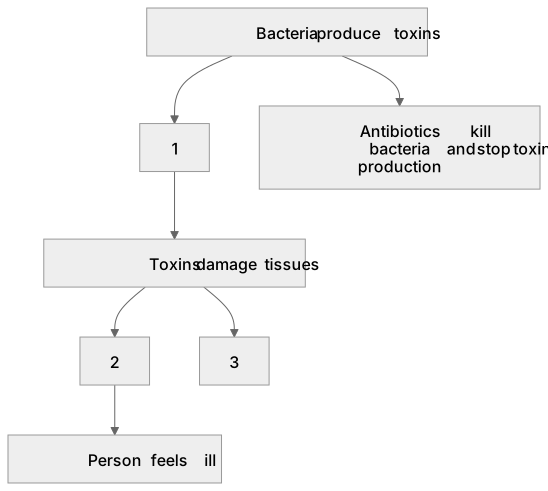
1Box 1
2Box 2
3Box 3
There is more to this lesson
The full lesson goes on to check your understanding and help you earn the marks. Create a free account to carry on, with your progress saved.
A week of Premium from your first lesson · Then the free plan continues · No card, no charge
Test your understanding of Communicable (infectious) diseases: Bacteria may produce poisons (toxins) that damage tissues and make us feel ill.
Active recall beats re-reading. Take an instant quiz now to test what you’ve learned and lock it into long-term memory.
A week of Premium from your first lesson · Then the free plan continues · No card, no charge