AQA · GCSE · Biology
Course version: 8461 · Version from Sept 2018
Bacteria and viruses may reproduce rapidly inside the body.
Full specification wording
Communicable (infectious) diseases: Bacteria and viruses may reproduce rapidly inside the body.
Once inside a host, bacteria and viruses increase in number quickly, and this rapid reproduction explains why symptoms appear soon after infection.
Checked against the AQA 8461 specification (opens in a new tab) on .
- Point 6 of 8
- 3 key terms
Study notes
From the checked teaching notes for this specification point.
The idea
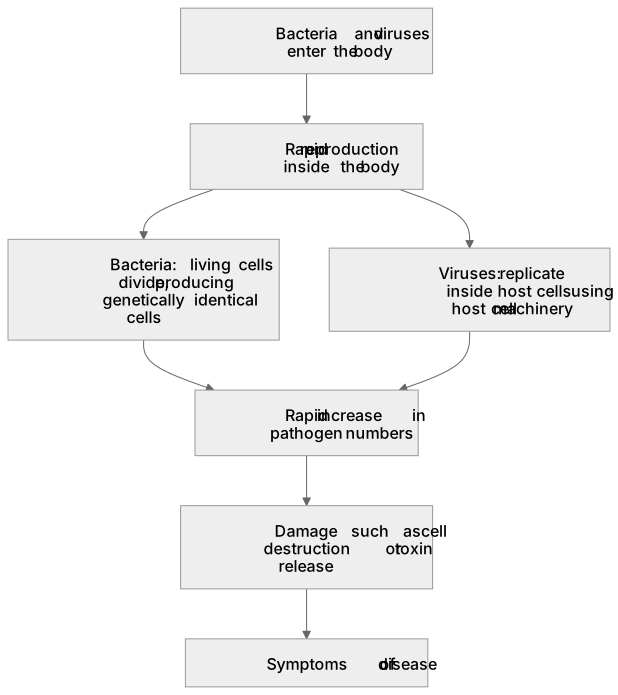
Once inside a host, bacteria and viruses increase in number quickly, and this rapid reproduction explains why symptoms appear soon after infection. Bacteria are living cells that divide by binary fission, so one cell can become two, then four, then eight, giving exponential growth when conditions are favourable. Viruses are not cells; they enter host cells and use the host's machinery to make many copies of themselves, then burst out and infect more cells. The resulting damage and the host immune response produce symptoms.
What earns the marks
- States that bacteria and viruses reproduce rapidly once inside the body.
- Describes bacterial reproduction as cell division, producing genetically identical cells.
- Describes viral reproduction as replication inside host cells using host cell machinery.
- Links rapid reproduction to damage, such as cell destruction or toxin release.
- Explains that rapid increase in pathogen numbers leads to symptoms of disease.
Common mistakes and how to put them right
Saying viruses divide like bacteria.
Put it right by stating viruses replicate inside host cells.
Describing reproduction without linking it to harm.
Put it right by adding how cell damage or toxins cause symptoms.
Assuming reproduction happens outside the body.
Put it right by stating it occurs inside the host.
Exam tips
- Contrast bacterial division with viral replication in one sentence to show understanding.
- Use the term host cell when describing viral reproduction.
- Link rapid reproduction to symptom onset so the explanation answers why the disease develops quickly.
Try the lesson
The start of the Communicable (infectious) diseases: Bacteria and viruses may reproduce rapidly inside the body. lesson, made from checked teaching notes for this specification point.
Have a go first
Once bacteria and viruses have entered the human body, what process allows them to cause the symptoms of an infectious disease?
Listen
Once inside a host, bacteria and viruses increase in number quickly, and this rapid reproduction explains why symptoms appear soon after infection. Bacteria are living cells that divide by binary fission, so one cell can become two, then four, then eight, giving exponential growth when conditions are favourable. Viruses are not cells; they enter host cells and use the host's machinery to make many copies of themselves, then burst out and infect more cells. The resulting damage and the host immune response produce symptoms. A strong answer earns marks for these points. States that bacteria and viruses reproduce rapidly once inside the body. Describes bacterial reproduction as cell division, producing genetically identical cells. Describes viral reproduction as replication inside host cells using host cell machinery. Links rapid reproduction to damage, such as cell destruction or toxin release. A common slip: Saying viruses divide like bacteria. Instead, stating viruses replicate inside host cells. Exam tip: Contrast bacterial division with viral replication in one sentence to show understanding.
See it
Key words
Say what each word means before you turn the card.
Pathogen reproduction
Try answering aloud or in your head before turning the card.
Host-pathogen interaction
Try answering aloud or in your head before turning the card.
Immune response
Try answering aloud or in your head before turning the card.
See every definition
- Pathogen reproduction
- Bacteria and viruses may reproduce rapidly once inside the body, increasing in number quickly.
- Host-pathogen interaction
- Viruses enter host cells and use the host's machinery to make many copies of themselves, then burst out and infect more cells.
- Immune response
- The host immune response, together with the resulting damage, produces symptoms of disease.
Label the diagram
Some boxes have lost their names. Pick the right name for each number.
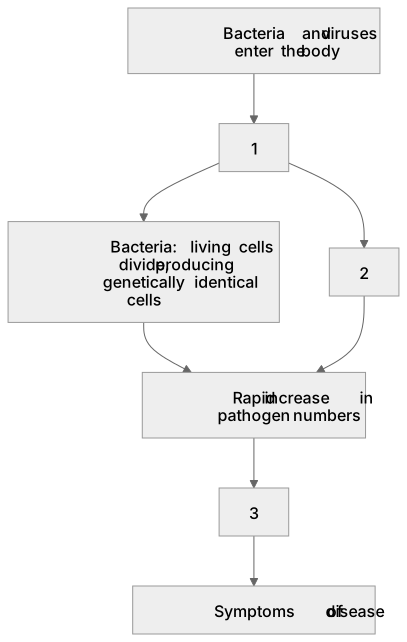
1Box 1
2Box 2
3Box 3
There is more to this lesson
The full lesson goes on to check your understanding and help you earn the marks. Create a free account to carry on, with your progress saved.
A week of Premium from your first lesson · Then the free plan continues · No card, no charge
Test your understanding of Communicable (infectious) diseases: Bacteria and viruses may reproduce rapidly inside the body.
Active recall beats re-reading. Take an instant quiz now to test what you’ve learned and lock it into long-term memory.
A week of Premium from your first lesson · Then the free plan continues · No card, no charge