AQA · GCSE · Biology
Course version: 8461 · Version from Sept 2018
Students should be able to explain how the spread of diseases can be…
Full specification wording
Communicable (infectious) diseases: Students should be able to explain how the spread of diseases can be reduced or prevented.
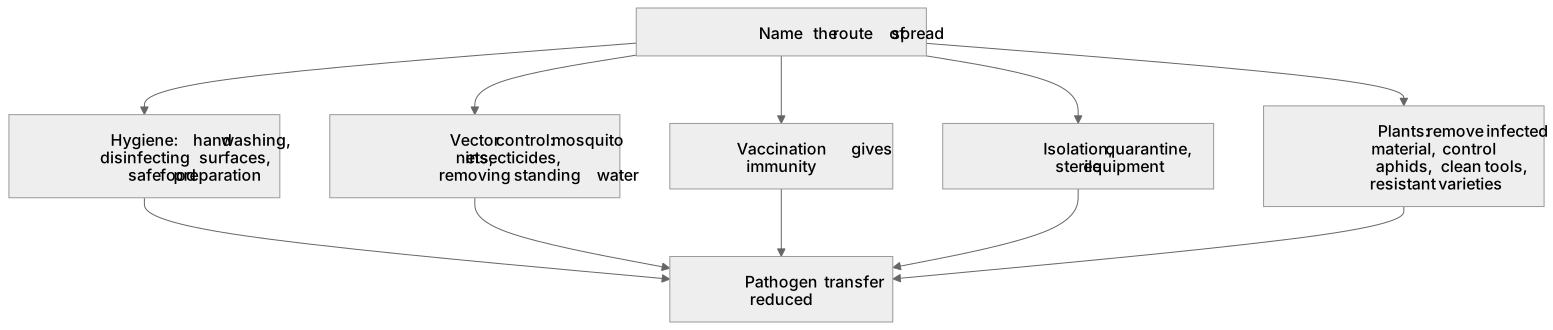
The spread of communicable disease can be reduced or prevented by interrupting the route by which pathogens travel.
Checked against the AQA 8461 specification (opens in a new tab) on .
- Point 2 of 8
- 3 key terms
Study notes
From the checked teaching notes for this specification point.
The idea
The spread of communicable disease can be reduced or prevented by interrupting the route by which pathogens travel. Good hygiene, such as hand washing and safe food preparation, removes pathogens and prevents contamination. Destroying or controlling vectors, for example using mosquito nets and insecticides, stops pathogens reaching new hosts. Vaccination gives immunity so that individuals do not become hosts who pass pathogens on. Isolating infected individuals, quarantining arrivals and using sterile equipment reduce direct and indirect contact. In plants, removing infected material, controlling aphids and using clean tools or disease-resistant varieties limit spread. A useful method is to name the route, then choose a control that blocks that route.
What earns the marks
- Hygiene measures such as hand washing, disinfecting surfaces and safe food preparation reduce pathogen transfer.
- Vector control, including mosquito nets, insecticides and removing standing water, interrupts transmission by vectors.
- Vaccination protects individuals and can reduce the number of hosts available to pass pathogens on.
- Isolation, quarantine and sterile equipment reduce direct and indirect contact between infected and healthy individuals.
- In plants, removing infected material, controlling aphids and using clean tools or resistant varieties reduce spread.
- Each control should be linked to the specific route of spread it interrupts.
Common mistakes and how to put them right
Listing control measures without linking each one to a route of spread, which does not explain how spread is reduced.
Claiming that antibiotics prevent viral diseases.
Put it right: Antibiotics act on bacteria and do not treat or prevent viral infections.
Assuming vaccination gives immediate protection.
Put it right: Immunity develops after the immune response, so it is not instantaneous.
Exam tips
- For each measure, state the route it blocks, such as 'mosquito nets prevent mosquitoes biting and passing on the malaria protist'.
- Use plant and animal examples to show the full range of prevention methods.
- Avoid absolute claims such as 'all diseases can be prevented'; describe reduction or prevention for named examples.
Try the lesson
The start of the Communicable (infectious) diseases: Students should be able to explain how the spread of diseases can be reduced or prevented. lesson, made from checked teaching notes for this specification point.
Have a go first
Which action is most likely to reduce the spread of a disease that is passed on by airborne droplets?
Listen
The spread of communicable disease can be reduced or prevented by interrupting the route by which pathogens travel. Good hygiene, such as hand washing and safe food preparation, removes pathogens and prevents contamination. Destroying or controlling vectors, for example using mosquito nets and insecticides, stops pathogens reaching new hosts. Vaccination gives immunity so that individuals do not become hosts who pass pathogens on. Isolating infected individuals, quarantining arrivals and using sterile equipment reduce direct and indirect contact. In plants, removing infected material, controlling aphids and using clean tools or disease-resistant varieties limit spread. A useful method is to name the route, then choose a control that blocks that route. A strong answer earns marks for these points. Hygiene measures such as hand washing, disinfecting surfaces and safe food preparation reduce pathogen transfer. Vector control, including mosquito nets, insecticides and removing standing water, interrupts transmission by vectors. Vaccination protects individuals and can reduce the number of hosts available to pass pathogens on. Isolation, quarantine and sterile equipment reduce direct and indirect contact between infected and healthy individuals. Exam tip: For each measure, state the route it blocks, such as 'mosquito nets prevent mosquitoes biting and passing on the malaria protist'.
See it
Key words
Say what each word means before you turn the card.
Hygiene and sanitation
Try answering aloud or in your head before turning the card.
Vector control
Try answering aloud or in your head before turning the card.
Vaccination and immunity
Try answering aloud or in your head before turning the card.
See every definition
- Hygiene and sanitation
- Measures such as hand washing, disinfecting surfaces and safe food preparation that remove pathogens and prevent contamination.
- Vector control
- Destroying or controlling vectors, for example using mosquito nets and insecticides, so that pathogens are stopped from reaching new hosts.
- Vaccination and immunity
- Giving immunity so that individuals do not become hosts who pass pathogens on.
Label the diagram
Some boxes have lost their names. Pick the right name for each number.
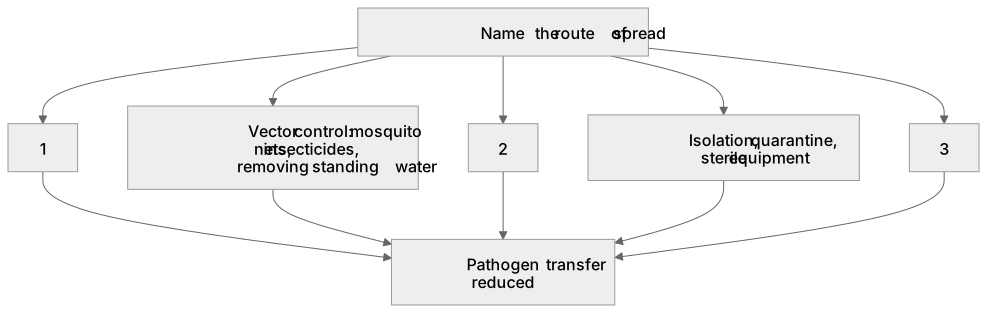
1Box 1
2Box 2
3Box 3
There is more to this lesson
The full lesson goes on to check your understanding and help you earn the marks. Create a free account to carry on, with your progress saved.
A week of Premium from your first lesson · Then the free plan continues · No card, no charge
Test your understanding of Communicable (infectious) diseases: Students should be able to explain how the spread of diseases can be reduced or prevented.
Active recall beats re-reading. Take an instant quiz now to test what you’ve learned and lock it into long-term memory.
A week of Premium from your first lesson · Then the free plan continues · No card, no charge