AQA · GCSE · Biology
Course version: 8461 · Version from Sept 2018
Pathogens are microorganisms that cause infectious disease.
Full specification wording
Communicable (infectious) diseases: Pathogens are microorganisms that cause infectious disease.
A pathogen is any microorganism that causes disease when it enters a host.
Checked against the AQA 8461 specification (opens in a new tab) on .
- Point 3 of 8
- 4 key terms
Study notes
From the checked teaching notes for this specification point.
The idea
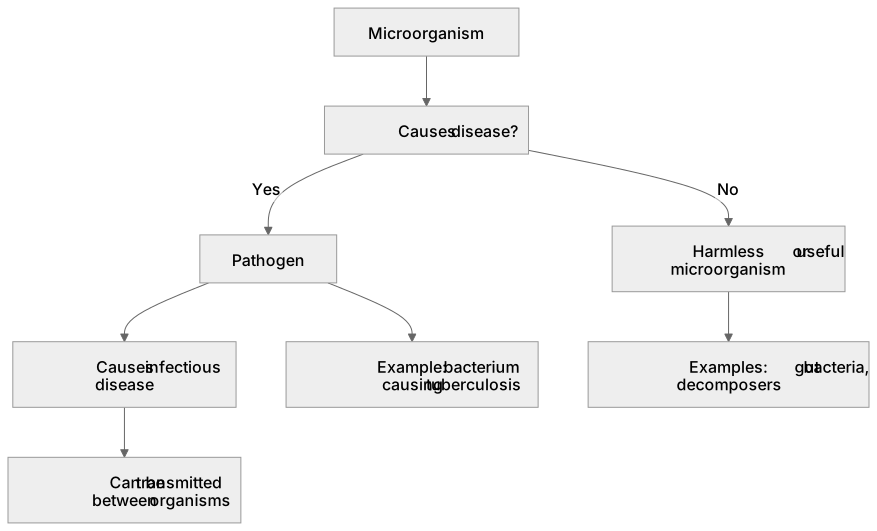
A pathogen is any microorganism that causes disease when it enters a host. The key idea is causation: the microorganism itself, not a toxin in food or a genetic fault, triggers the illness, and the disease can pass from one organism to another. Many microorganisms are harmless or useful, such as gut bacteria and decomposers, so pathogen is a functional label rather than a whole group. For example, the bacterium that causes tuberculosis is a pathogen, whereas the bacteria making yoghurt are not. Recognising a named microorganism as a pathogen therefore requires stating both that it is a microorganism and that it causes disease.
What earns the marks
- Defines a pathogen as a microorganism that causes disease.
- States that the disease caused is infectious, meaning it can be transmitted between organisms.
- Distinguishes pathogens from harmless or beneficial microorganisms such as decomposers and gut bacteria.
- Links a named example, such as the bacterium causing tuberculosis or a virus causing influenza, to disease causation.
- Uses the term correctly when describing how a disease spreads from host to host.
Common mistakes and how to put them right
Calling every microorganism a pathogen.
Put it right by stating that only those causing disease are pathogens.
Confusing infectious with inherited or deficiency disease.
Put it right by linking infectious disease to transmission by a pathogen.
Saying a pathogen is a poison rather than an organism.
Put it right by describing it as a microorganism that causes disease.
Exam tips
- Use the full phrase microorganism that causes disease in definitions to secure the causation idea.
- When naming an example, state the disease as well as the pathogen so the link is explicit.
- Check whether a question asks for a definition or an example, and answer the precise command word.
Try the lesson
The start of the Communicable (infectious) diseases: Pathogens are microorganisms that cause infectious disease. lesson, made from checked teaching notes for this specification point.
Have a go first
Which of the following statements provides the most accurate definition of a pathogen?
Listen
A pathogen is any microorganism that causes disease when it enters a host. The key idea is causation: the microorganism itself, not a toxin in food or a genetic fault, triggers the illness, and the disease can pass from one organism to another. Many microorganisms are harmless or useful, such as gut bacteria and decomposers, so pathogen is a functional label rather than a whole group. For example, the bacterium that causes tuberculosis is a pathogen, whereas the bacteria making yoghurt are not. Recognising a named microorganism as a pathogen therefore requires stating both that it is a microorganism and that it causes disease. A strong answer earns marks for these points. Defines a pathogen as a microorganism that causes disease. States that the disease caused is infectious, meaning it can be transmitted between organisms. Distinguishes pathogens from harmless or beneficial microorganisms such as decomposers and gut bacteria. Links a named example, such as the bacterium causing tuberculosis or a virus causing influenza, to disease causation. A common slip: Calling every microorganism a pathogen. Instead, stating that only those causing disease are pathogens. Exam tip: Use the full phrase microorganism that causes disease in definitions to secure the causation idea.
See it
Key words
Say what each word means before you turn the card.
Pathogen
Try answering aloud or in your head before turning the card.
Infectious disease
Try answering aloud or in your head before turning the card.
Causation of disease
Try answering aloud or in your head before turning the card.
Transmission between hosts
Try answering aloud or in your head before turning the card.
See every definition
- Pathogen
- A microorganism that causes disease when it enters a host.
- Infectious disease
- A disease that can be transmitted between organisms, since infectious means the disease can spread between hosts.
- Causation of disease
- The microorganism itself, not a toxin in food or a genetic fault, triggers the illness.
- Transmission between hosts
- The passing of an infectious disease from one organism to another.
Label the diagram
Some boxes have lost their names. Pick the right name for each number.
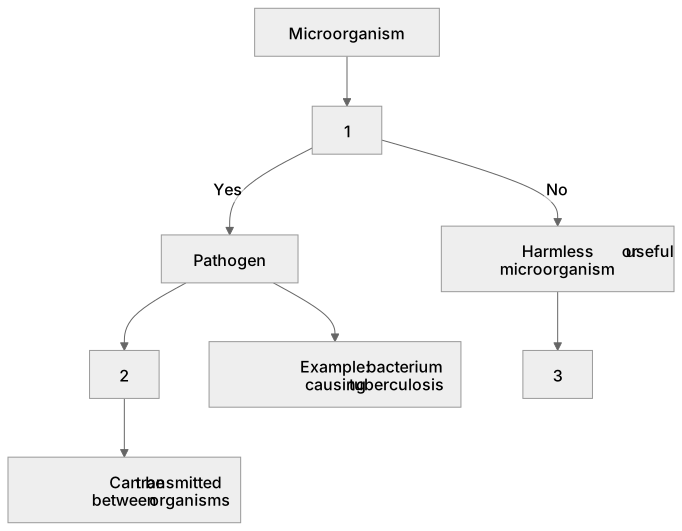
1Box 1
2Box 2
3Box 3
There is more to this lesson
The full lesson goes on to check your understanding and help you earn the marks. Create a free account to carry on, with your progress saved.
A week of Premium from your first lesson · Then the free plan continues · No card, no charge
Test your understanding of Communicable (infectious) diseases: Pathogens are microorganisms that cause infectious disease.
Active recall beats re-reading. Take an instant quiz now to test what you’ve learned and lock it into long-term memory.
A week of Premium from your first lesson · Then the free plan continues · No card, no charge