AQA · GCSE · Biology
Course version: 8461 · Version from Sept 2018
Animals often compete with each other for food, mates and territory.
Full specification wording
Communities: Animals often compete with each other for food, mates and territory.
Animals cannot photosynthesise, so they must obtain energy by eating other organisms.
Checked against the AQA 8461 specification (opens in a new tab) on .
- Point 6 of 11
Study notes
From the checked teaching notes for this specification point.
The idea
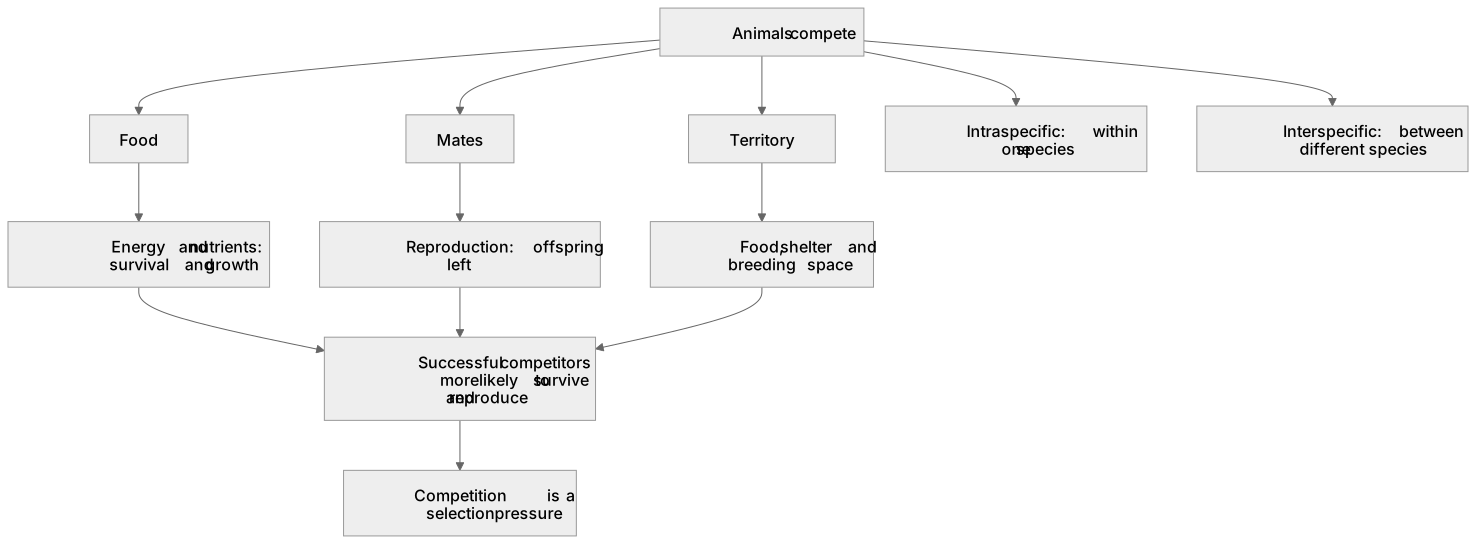
Animals cannot photosynthesise, so they must obtain energy by eating other organisms. Where food is limited, individuals that find and secure more of it survive longer and breed more. Competition also occurs for mates, because an individual that attracts or defends a partner passes on its alleles, and for territory, because a defended area supplies food, shelter and a safe place to raise young. Competition may be between members of the same species, which is intraspecific, or between different species, which is interspecific. A male robin singing to warn rivals away from its patch is defending territory; two lions disputing a carcass are competing for food. The outcome is not random: better competitors are more likely to survive and reproduce, so competition drives natural selection.
What earns the marks
- Animals compete because food, mates and territory are limited resources.
- Food supplies energy and nutrients, so competition for food affects survival and growth.
- Mates are needed for reproduction, so competition for mates affects how many offspring an individual leaves.
- Territory provides food, shelter and breeding space, so defending it improves an animal's chances of success.
- Competition can be intraspecific, within one species, or interspecific, between different species.
- Individuals that compete successfully are more likely to survive and reproduce, so competition is a selection pressure.
Common mistakes and how to put them right
Listing only food and ignoring mates and territory.
Put it right by naming all three resources in the statement.
Describing competition as always involving physical fighting.
Put it right by including non-contact competition such as calling, scent marking or displaying.
Confusing a predator-prey relationship with competition.
Put it right by noting that competitors need the same resource, whereas a predator consumes the prey itself.
Exam tips
- State whether the competition described is intraspecific or interspecific and justify your choice.
- Link each resource to its benefit, for example territory gives shelter and feeding grounds.
- When interpreting graphs, look for a fall in survival or offspring number as population density rises.
Try the lesson
The start of the Communities: Animals often compete with each other for food, mates and territory. lesson, made from checked teaching notes for this specification point.
Have a go first
A pack of wolves patrols a specific area of a forest, marking the boundaries with scent and aggressively chasing away any other wolf packs. Which resource are they primarily competing for?
Listen
Animals cannot photosynthesise, so they must obtain energy by eating other organisms. Where food is limited, individuals that find and secure more of it survive longer and breed more. Competition also occurs for mates, because an individual that attracts or defends a partner passes on its alleles, and for territory, because a defended area supplies food, shelter and a safe place to raise young. Competition may be between members of the same species, which is intraspecific, or between different species, which is interspecific. A male robin singing to warn rivals away from its patch is defending territory; two lions disputing a carcass are competing for food. The outcome is not random: better competitors are more likely to survive and reproduce, so competition drives natural selection. A strong answer earns marks for these points. Animals compete because food, mates and territory are limited resources. Food supplies energy and nutrients, so competition for food affects survival and growth. Mates are needed for reproduction, so competition for mates affects how many offspring an individual leaves. Territory provides food, shelter and breeding space, so defending it improves an animal's chances of success. A common slip: Listing only food and ignoring mates and territory. Instead, naming all three resources in the statement. Exam tip: State whether the competition described is intraspecific or interspecific and justify your choice.
See it
Label the diagram
Some boxes have lost their names. Pick the right name for each number.
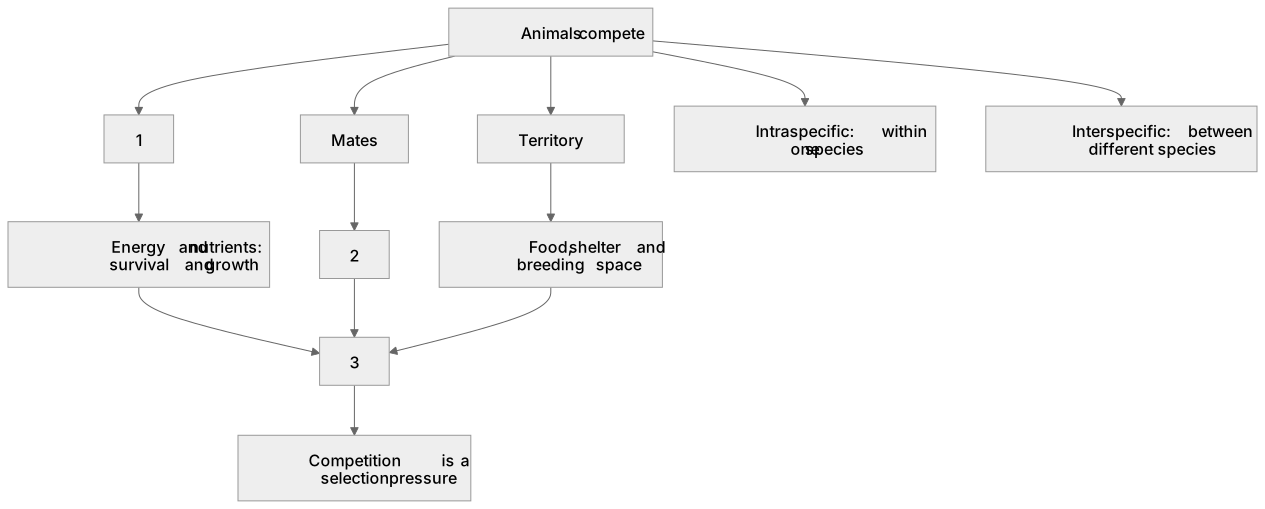
1Box 1
2Box 2
3Box 3
There is more to this lesson
The full lesson goes on to check your understanding and help you earn the marks. Create a free account to carry on, with your progress saved.
A week of Premium from your first lesson · Then the free plan continues · No card, no charge
Test your understanding of Communities: Animals often compete with each other for food, mates and territory.
Active recall beats re-reading. Take an instant quiz now to test what you’ve learned and lock it into long-term memory.
A week of Premium from your first lesson · Then the free plan continues · No card, no charge