AQA · GCSE · Biology
Course version: 8461 · Version from Sept 2018
Within a community each species depends on other species for food,…
Full specification wording
Communities: Within a community each species depends on other species for food, shelter, pollination, seed dispersal etc.
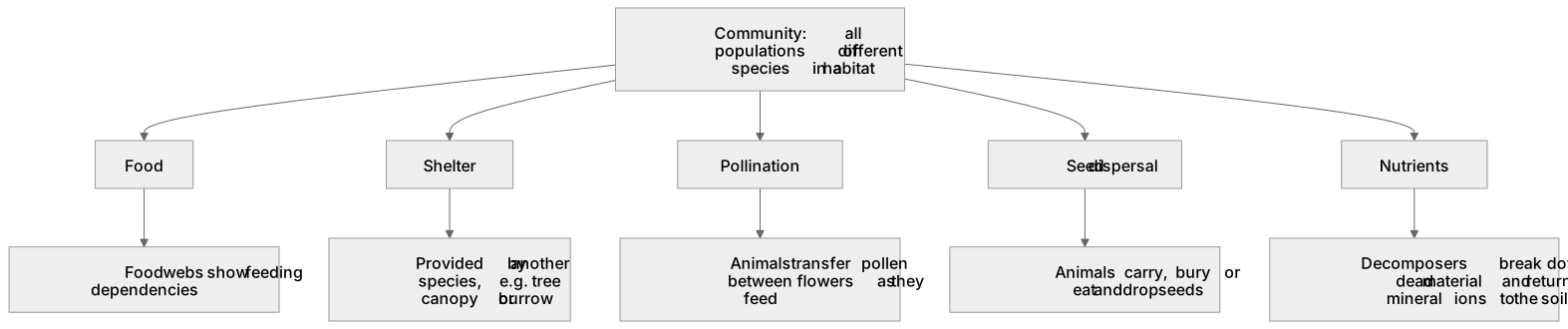
A community is all the populations of different species living together in a habitat, and its members are linked by many dependencies.
Checked against the AQA 8461 specification (opens in a new tab) on .
- Point 7 of 11
- 3 key terms
Study notes
From the checked teaching notes for this specification point.
The idea
A community is all the populations of different species living together in a habitat, and its members are linked by many dependencies. Food webs show feeding links: a consumer depends on its prey, and a predator depends on prey numbers. Shelter may be provided by another species, such as a tree canopy or a badger sett. Flowering plants often depend on insects, birds or mammals for pollination, and many plants rely on animals or wind for seed dispersal. Some species depend on others for nutrients, as decomposers do when they break down dead material. These links mean a community is a network rather than a list. Removing one species can therefore change food supply, shelter, pollination or dispersal for several others, so dependencies are best studied as connections, not isolated pairs.
What earns the marks
- A community consists of all the populations of different species in a habitat.
- Food webs show feeding dependencies, with energy transferred from producers to consumers.
- Shelter can be provided by another species, for example a tree canopy or a burrow.
- Pollination is a dependency in which animals transfer pollen between flowers as they feed.
- Seed dispersal can depend on animals that carry, bury or eat and drop seeds.
- Decomposers depend on dead organisms and waste, returning mineral ions to the soil.
Common mistakes and how to put them right
Treating a community as a single species.
Put it right by defining it as all the populations of different species in a habitat.
Assuming every dependency is a feeding link.
Put it right by including shelter, pollination and seed dispersal.
Confusing a community with a habitat.
Put it right by describing the habitat as the place and the community as the organisms living there.
Exam tips
- Use the phrase depends on and name the specific benefit, such as food, shelter or pollination.
- When asked to complete a food web, check that arrows point in the direction of energy transfer.
- Give named examples, such as bees pollinating flowers or birds dispersing seeds, to make dependencies concrete.
Try the lesson
The start of the Communities: Within a community each species depends on other species for food, shelter, pollination, seed dispersal etc. lesson, made from checked teaching notes for this specification point.
Have a go first
In a community, a bee collects nectar from flowers and the flowers are pollinated at the same time. Which statement best describes how the bee and the flowers depend on each other?
Listen
A community is all the populations of different species living together in a habitat, and its members are linked by many dependencies. Food webs show feeding links: a consumer depends on its prey, and a predator depends on prey numbers. Shelter may be provided by another species, such as a tree canopy or a badger sett. Flowering plants often depend on insects, birds or mammals for pollination, and many plants rely on animals or wind for seed dispersal. Some species depend on others for nutrients, as decomposers do when they break down dead material. These links mean a community is a network rather than a list. Removing one species can therefore change food supply, shelter, pollination or dispersal for several others, so dependencies are best studied as connections, not isolated pairs. A strong answer earns marks for these points. A community consists of all the populations of different species in a habitat. Food webs show feeding dependencies, with energy transferred from producers to consumers. Shelter can be provided by another species, for example a tree canopy or a burrow. Pollination is a dependency in which animals transfer pollen between flowers as they feed. A common slip: Treating a community as a single species. Instead, defining it as all the populations of different species in a habitat. Exam tip: Use the phrase depends on and name the specific benefit, such as food, shelter or pollination.
See it
Key words
Say what each word means before you turn the card.
Interdependence
Try answering aloud or in your head before turning the card.
Food webs and energy transfer
Try answering aloud or in your head before turning the card.
Pollination and seed dispersal
Try answering aloud or in your head before turning the card.
See every definition
- Interdependence
- Each species in a community depends on other species for food, shelter, pollination, seed dispersal and other needs.
- Food webs and energy transfer
- Feeding links in which energy is transferred from producers to consumers, and a consumer depends on its prey.
- Pollination and seed dispersal
- Dependencies in which animals transfer pollen between flowers as they feed, and animals carry, bury or eat and drop seeds.
Label the diagram
Some boxes have lost their names. Pick the right name for each number.
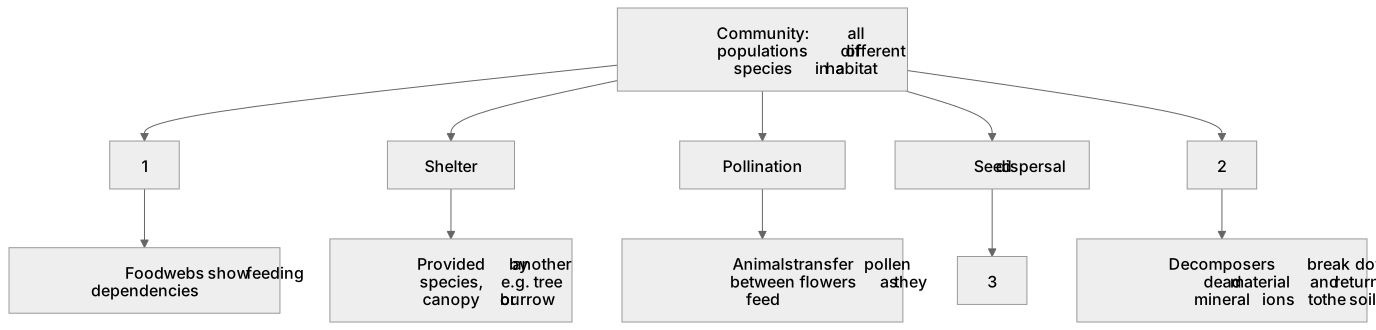
1Box 1
2Box 2
3Box 3
There is more to this lesson
The full lesson goes on to check your understanding and help you earn the marks. Create a free account to carry on, with your progress saved.
A week of Premium from your first lesson · Then the free plan continues · No card, no charge
Test your understanding of Communities: Within a community each species depends on other species for food, shelter, pollination, seed dispersal etc.
Active recall beats re-reading. Take an instant quiz now to test what you’ve learned and lock it into long-term memory.
A week of Premium from your first lesson · Then the free plan continues · No card, no charge