AQA · GCSE · Biology
Course version: 8461 · Version from Sept 2018
(HT only) Ethene controls cell division and ripening of fruits.
Full specification wording
Control and coordination: (HT only) Ethene controls cell division and ripening of fruits.
Ethene (C₂H₄) is a gaseous plant hormone that coordinates fruit ripening and influences cell division.
Checked against the AQA 8461 specification (opens in a new tab) on .
- Point 4 of 7
Study notes
From the checked teaching notes for this specification point.
The idea
Ethene (C₂H₄) is a gaseous plant hormone that coordinates fruit ripening and influences cell division. It is produced by ripening fruit and by damaged or ageing plant tissue. Ethene stimulates enzymes that soften cell walls, convert starches to sugars and produce the characteristic colours and aromas of ripe fruit. It also promotes cell division in some tissues, such as the abscission zone where leaves or fruits separate from the plant. Because ethene is a gas, it diffuses between fruits and can synchronise ripening in a crop. Commercial growers use ethene to ripen fruit such as bananas after transport.
What earns the marks
- Ethene is a gaseous plant hormone involved in fruit ripening.
- Ethene diffuses through the air, so one ripening fruit can trigger ripening in nearby fruit.
- Commercial growers may use ethene to ripen fruit such as bananas after transport.
Common mistakes and how to put them right
Confusing ethene with ethane.
Put it right: Ethene is the plant hormone C₂H₄, while ethane is a different alkane.
Stating that ethene is a respiratory gas.
Put it right: It is a hormone; ripening involves increased respiration but ethene is not the respiratory substrate.
Saying ethene only softens fruit.
Put it right: It also affects cell division, colour, aroma and the separation of fruit from the plant.
Exam tips
- Link each ripening change to an observable effect, such as softening, colour change or sweetness.
- Use the fact that ethene is a gas to explain how ripening spreads through a fruit bowl or crop.
- When comparing plant hormones, contrast ethene with auxin and gibberellin in one clear sentence each.
Try the lesson
The start of the Control and coordination: (HT only) Ethene controls cell division and ripening of fruits. lesson, made from checked teaching notes for this specification point.
Have a go first
What is the function of the plant hormone ethene?
Listen
Ethene (C₂H₄) is a gaseous plant hormone that coordinates fruit ripening and influences cell division. It is produced by ripening fruit and by damaged or ageing plant tissue. Ethene stimulates enzymes that soften cell walls, convert starches to sugars and produce the characteristic colours and aromas of ripe fruit. It also promotes cell division in some tissues, such as the abscission zone where leaves or fruits separate from the plant. Because ethene is a gas, it diffuses between fruits and can synchronise ripening in a crop. Commercial growers use ethene to ripen fruit such as bananas after transport. A strong answer earns marks for these points. Ethene is a gaseous plant hormone involved in fruit ripening. Ethene diffuses through the air, so one ripening fruit can trigger ripening in nearby fruit. Commercial growers may use ethene to ripen fruit such as bananas after transport. Exam tip: Link each ripening change to an observable effect, such as softening, colour change or sweetness.
See it
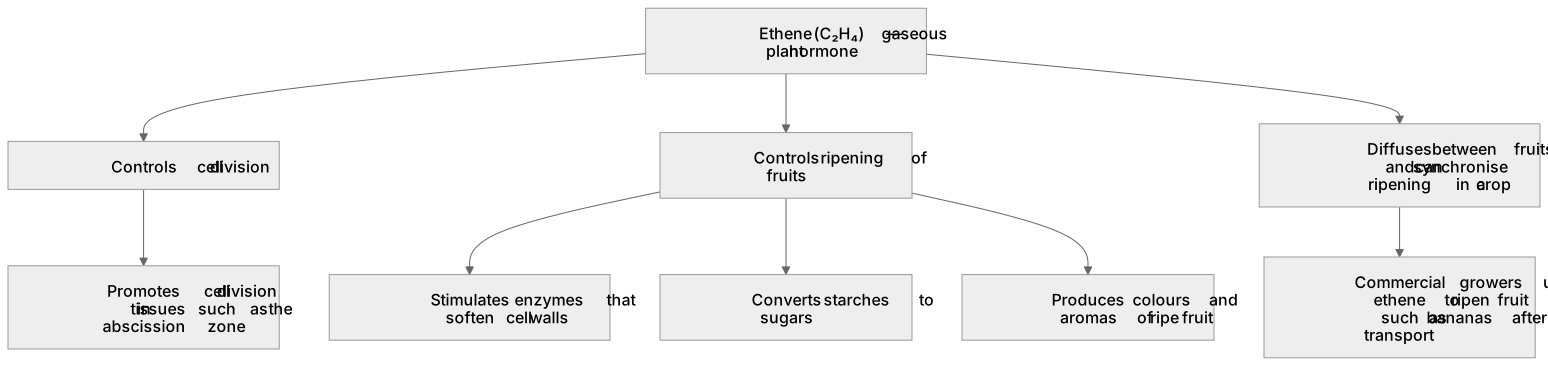
Label the diagram
Some boxes have lost their names. Pick the right name for each number.
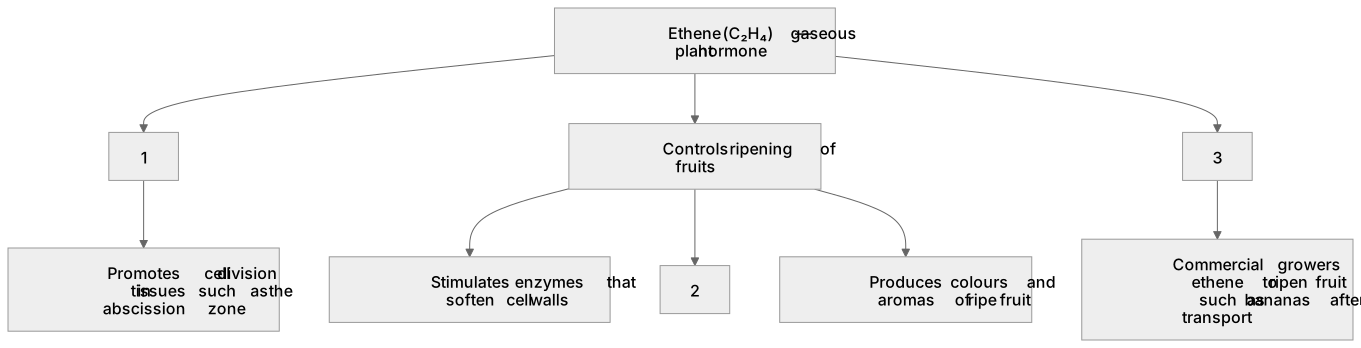
1Box 1
2Box 2
3Box 3
There is more to this lesson
The full lesson goes on to check your understanding and help you earn the marks. Create a free account to carry on, with your progress saved.
A week of Premium from your first lesson · Then the free plan continues · No card, no charge
Test your understanding of Control and coordination: (HT only) Ethene controls cell division and ripening of fruits.
Active recall beats re-reading. Take an instant quiz now to test what you’ve learned and lock it into long-term memory.
A week of Premium from your first lesson · Then the free plan continues · No card, no charge