AQA · GCSE · Biology
Course version: 8461 · Version from Sept 2018
Required practical activity 8: investigate the effect of light or gravity…
Full specification wording
Control and coordination: Required practical activity 8: investigate the effect of light or gravity on the growth of newly germinated seedlings.
In this practical, students grow newly germinated seedlings under controlled conditions and measure how their shoots and roots respond to a directional stimulus.
Checked against the AQA 8461 specification (opens in a new tab) on .
- Point 5 of 7
- 4 key terms
Study notes
From the checked teaching notes for this specification point.
The idea
In this practical, students grow newly germinated seedlings under controlled conditions and measure how their shoots and roots respond to a directional stimulus. For light, seedlings can be placed in a box with a single opening so that light arrives from one side; shoots should bend towards the light, showing positive phototropism. For gravity, seedlings can be grown in a dark, upright container or fixed to a clinostat, then compared with seedlings whose orientation is changed; roots should grow downwards and shoots upwards, showing gravitropism. Whichever variable is chosen, other conditions such as temperature, water and oxygen must be kept the same so the response can be attributed to the stimulus. Results are collected over several days and compared with a control.
What earns the marks
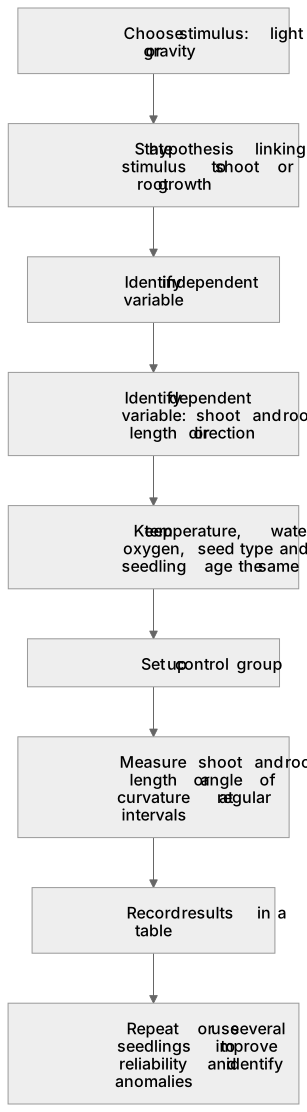
- State a hypothesis linking the chosen stimulus, light or gravity, to the direction of shoot or root growth.
- Identify the independent variable, such as direction of light or orientation relative to gravity.
- Identify the dependent variable, such as length or direction of shoot and root growth.
- Control key variables including temperature, water volume, oxygen supply, seed type and age of seedling.
- Use a control group, for example seedlings grown with light from all directions or in a fixed upright position.
- Measure shoot and root length or angle of curvature at regular intervals and record results in a suitable table.
- Repeat the investigation or use several seedlings to improve reliability and identify anomalies.
Common mistakes and how to put them right
Changing several conditions at once, such as light direction and temperature, so the cause of any response is unclear.
Measuring only once at the end.
Put it right: Growth is a gradual response, so regular measurements over several days are needed.
Assuming roots grow towards light.
Put it right: Roots are generally negatively phototropic and grow away from light, while shoots are positively phototropic.
Exam tips
- Write a clear prediction that names the stimulus, the plant part and the expected direction of growth.
- Describe how you would keep a named variable constant, rather than saying only that conditions were controlled.
- Present results in a table with units and use a line graph to show growth over time.
Try the lesson
The start of the Control and coordination: Required practical activity 8: investigate the effect of light or gravity on the growth of newly germinated seedlings. lesson, made from checked teaching notes for this specification point.
Have a go first
In the required practical on seedling growth, which variable should be changed between the test seedlings when investigating the effect of light?
Listen
In this practical, students grow newly germinated seedlings under controlled conditions and measure how their shoots and roots respond to a directional stimulus. For light, seedlings can be placed in a box with a single opening so that light arrives from one side; shoots should bend towards the light, showing positive phototropism. For gravity, seedlings can be grown in a dark, upright container or fixed to a clinostat, then compared with seedlings whose orientation is changed; roots should grow downwards and shoots upwards, showing gravitropism. Whichever variable is chosen, other conditions such as temperature, water and oxygen must be kept the same so the response can be attributed to the stimulus. Results are collected over several days and compared with a control. A strong answer earns marks for these points. State a hypothesis linking the chosen stimulus, light or gravity, to the direction of shoot or root growth. Identify the independent variable, such as direction of light or orientation relative to gravity. Identify the dependent variable, such as length or direction of shoot and root growth. Control key variables including temperature, water volume, oxygen supply, seed type and age of seedling. Exam tip: Write a clear prediction that names the stimulus, the plant part and the expected direction of growth.
See it
Key words
Say what each word means before you turn the card.
Phototropism
Try answering aloud or in your head before turning the card.
Gravitropism
Try answering aloud or in your head before turning the card.
Independent variable
Try answering aloud or in your head before turning the card.
Dependent variable
Try answering aloud or in your head before turning the card.
See every definition
- Phototropism
- When shoots bend towards light arriving from one side, this shows positive phototropism.
- Gravitropism
- When roots grow downwards and shoots grow upwards, this shows gravitropism.
- Independent variable
- The variable that is changed, such as direction of light or orientation relative to gravity.
- Dependent variable
- The variable that is measured, such as length or direction of shoot and root growth.
Label the diagram
Some boxes have lost their names. Pick the right name for each number.
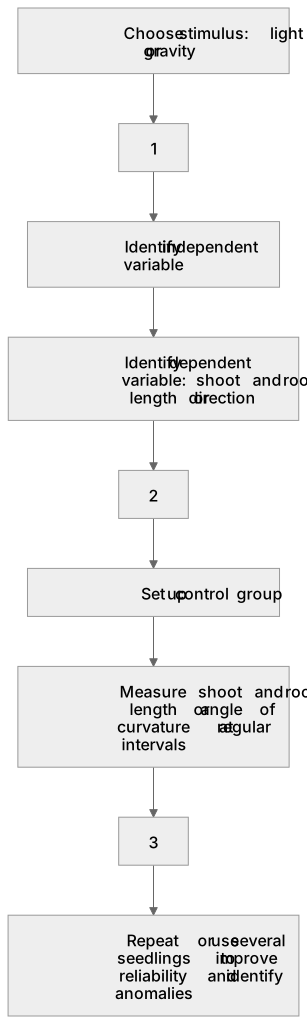
1Box 1
2Box 2
3Box 3
There is more to this lesson
The full lesson goes on to check your understanding and help you earn the marks. Create a free account to carry on, with your progress saved.
A week of Premium from your first lesson · Then the free plan continues · No card, no charge
Test your understanding of Control and coordination: Required practical activity 8: investigate the effect of light or gravity on the growth of newly germinated seedlings.
Active recall beats re-reading. Take an instant quiz now to test what you’ve learned and lock it into long-term memory.
A week of Premium from your first lesson · Then the free plan continues · No card, no charge