AQA · GCSE · Biology
Course version: 8461 · Version from Sept 2018
A non-communicable disease: In some people heart valves may become faulty,…
Full specification wording
Coronary heart disease: a non-communicable disease: In some people heart valves may become faulty, preventing the valve from opening fully, or the heart valve might develop a leak.
Heart valves keep blood flowing in one direction through the heart.
Checked against the AQA 8461 specification (opens in a new tab) on .
- Point 6 of 10
- 4 key terms
Study notes
From the checked teaching notes for this specification point.
The idea
Heart valves keep blood flowing in one direction through the heart. The atrioventricular valves separate the atria from the ventricles, and the semilunar valves sit at the exits of the ventricles. In some people a valve may become faulty. If it cannot open fully, it is narrowed or stiff, so blood cannot flow through easily and the heart must work harder to push blood past it. If a valve develops a leak, it does not close completely, so blood flows backwards instead of moving on. Both faults reduce the efficiency of the heart, may cause breathlessness and tiredness, and can be treated by replacing the valve with a mechanical or biological valve.
What earns the marks
- Heart valves normally keep blood flowing in one direction through the heart.
- A faulty valve may fail to open fully, which restricts the flow of blood through it.
- A faulty valve may leak, allowing blood to flow backwards.
- Symptoms can include breathlessness, tiredness and reduced exercise tolerance.
- Faulty valves can be replaced with mechanical or biological valves.
Common mistakes and how to put them right
Saying a leaky valve blocks blood flow completely.
Put it right: A leak allows backflow, while a valve that cannot open fully restricts forward flow.
Mixing up the atrioventricular and semilunar valves.
Put it right: State that atrioventricular valves lie between atria and ventricles, and semilunar valves lie at the exits of the ventricles.
Thinking faulty valves stop the heart beating.
Put it right: The heart still beats but works less efficiently, causing symptoms such as breathlessness.
Exam tips
- Use the two clear categories from the statement: a valve that cannot open fully restricts flow, and a valve that leaks allows backflow.
- Link each fault to its consequence: restricted flow or backflow means the heart works harder and less blood is pumped efficiently.
- If asked about treatment, name valve replacement and state that mechanical and biological valves are both used.
Try the lesson
The start of the Coronary heart disease: a non-communicable disease: In some people heart valves may become faulty, preventing the valve from opening fully, or the heart valve might develop a leak. lesson, made from checked teaching notes for this specification point.
Have a go first
What may happen to a heart valve if it becomes faulty?
Listen
Heart valves keep blood flowing in one direction through the heart. The atrioventricular valves separate the atria from the ventricles, and the semilunar valves sit at the exits of the ventricles. In some people a valve may become faulty. If it cannot open fully, it is narrowed or stiff, so blood cannot flow through easily and the heart must work harder to push blood past it. If a valve develops a leak, it does not close completely, so blood flows backwards instead of moving on. Both faults reduce the efficiency of the heart, may cause breathlessness and tiredness, and can be treated by replacing the valve with a mechanical or biological valve. A strong answer earns marks for these points. Heart valves normally keep blood flowing in one direction through the heart. A faulty valve may fail to open fully, which restricts the flow of blood through it. A faulty valve may leak, allowing blood to flow backwards. Symptoms can include breathlessness, tiredness and reduced exercise tolerance. A common slip: Saying a leaky valve blocks blood flow completely: the error is confusing a leak with a blockage. Instead, a leak allows backflow, while a valve that cannot open fully restricts forward flow. Exam tip: Use the two clear categories from the statement: a valve that cannot open fully restricts flow, and a valve that leaks allows backflow.
See it
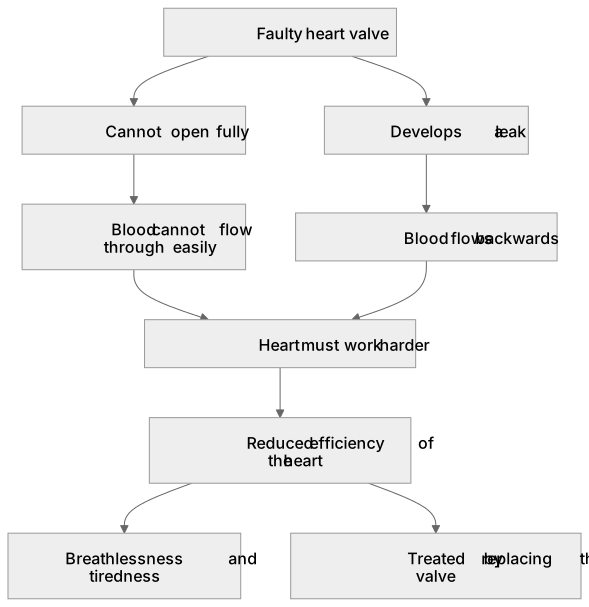
Key words
Say what each word means before you turn the card.
Faulty valve
Try answering aloud or in your head before turning the card.
Leak
Try answering aloud or in your head before turning the card.
Valve replacement
Try answering aloud or in your head before turning the card.
Breathlessness and tiredness
Try answering aloud or in your head before turning the card.
See every definition
- Faulty valve
- A heart valve that may become faulty, preventing the valve from opening fully, or the heart valve might develop a leak.
- Leak
- When a valve develops a leak, it does not close completely, so blood flows backwards instead of moving on.
- Valve replacement
- Faulty valves can be treated by replacing the valve with a mechanical or biological valve.
- Breathlessness and tiredness
- Symptoms that both faults may cause, along with reduced efficiency of the heart.
Label the diagram
Some boxes have lost their names. Pick the right name for each number.
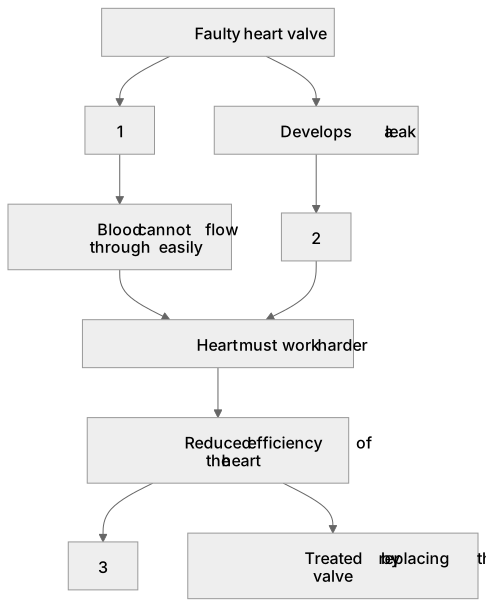
1Box 1
2Box 2
3Box 3
There is more to this lesson
The full lesson goes on to check your understanding and help you earn the marks. Create a free account to carry on, with your progress saved.
A week of Premium from your first lesson · Then the free plan continues · No card, no charge
Test your understanding of Coronary heart disease: a non-communicable disease: In some people heart valves may become faulty, preventing the valve from opening fully, or the heart valve might develop a leak.
Active recall beats re-reading. Take an instant quiz now to test what you’ve learned and lock it into long-term memory.
A week of Premium from your first lesson · Then the free plan continues · No card, no charge