AQA · GCSE · Biology
Course version: 8461 · Version from Sept 2018
AT skills covered by this practical activity: AT 1, 3, 4 and 8.
Full specification wording
Culturing microorganisms (biology only): AT skills covered by this practical activity: AT 1, 3, 4 and 8.
This practical develops four working scientifically skills.
Checked against the AQA 8461 specification (opens in a new tab) on .
- Point 10 of 11
- 4 key terms
Study notes
From the checked teaching notes for this specification point.
The idea
This practical develops four working scientifically skills. AT 1 is use of appropriate apparatus and techniques, here sterile loops, pipettes, discs and agar plates. AT 3 is recording observations and measurements, so you record zone diameters in millimetres in a suitable table. AT 4 is analysis and interpretation, so you compare zones and decide which substance is most effective. AT 8 is making informed judgements about risks, so you use aseptic technique, keep lids on, and follow safe disposal. These skills are assessed through questions about method, measurements, results and safety rather than by a separate practical mark.
For example: You might be asked why the lid is taped and not fully sealed, or how you ensured the comparison was fair.
What earns the marks
- Selects and uses appropriate apparatus, such as sterile discs, forceps and a ruler, for the investigation.
- Records zone diameters in a clear table with units, repeating measurements to improve reliability.
- Analyses results by comparing zone sizes and drawing a conclusion about effectiveness.
- Identifies risks, such as contamination or growth of pathogens, and describes control measures including aseptic technique.
- Explains how the apparatus and method produce valid, reliable data, for example by controlling disc size and incubation conditions.
Common mistakes and how to put them right
Recording measurements without units.
Put it right: Record every zone diameter in millimetres.
Treating a single measurement as reliable.
Put it right: Repeat and calculate a mean.
Ignoring risk assessment; the correction is to state specific hazards and the precautions taken, such as sterilising equipment and sealing plates.
Exam tips
- Link each method step to the skill it demonstrates, such as apparatus choice or risk control.
- Present results in a table with clear headings and units before drawing conclusions.
- Use comparative language when interpreting data, for example larger zone, more effective.
Try the lesson
The start of the Culturing microorganisms (biology only): AT skills covered by this practical activity: AT 1, 3, 4 and 8. lesson, made from checked teaching notes for this specification point.
Have a go first
A student investigates the effectiveness of an antibiotic by measuring the zone of inhibition around a paper disc on an agar plate. The clear zone is not perfectly circular. How should the student measure the diameter to obtain the most accurate result?
Listen
This practical develops four working scientifically skills. AT 1 is use of appropriate apparatus and techniques, here sterile loops, pipettes, discs and agar plates. AT 3 is recording observations and measurements, so you record zone diameters in millimetres in a suitable table. AT 4 is analysis and interpretation, so you compare zones and decide which substance is most effective. AT 8 is making informed judgements about risks, so you use aseptic technique, keep lids on, and follow safe disposal. These skills are assessed through questions about method, measurements, results and safety rather than by a separate practical mark. For example, you might be asked why the lid is taped and not fully sealed, or how you ensured the comparison was fair. A strong answer earns marks for these points. Selects and uses appropriate apparatus, such as sterile discs, forceps and a ruler, for the investigation. Records zone diameters in a clear table with units, repeating measurements to improve reliability. Analyses results by comparing zone sizes and drawing a conclusion about effectiveness. Identifies risks, such as contamination or growth of pathogens, and describes control measures including aseptic technique. A common slip: Recording measurements without units. Instead, record every zone diameter in millimetres. Exam tip: Link each method step to the skill it demonstrates, such as apparatus choice or risk control.
See it
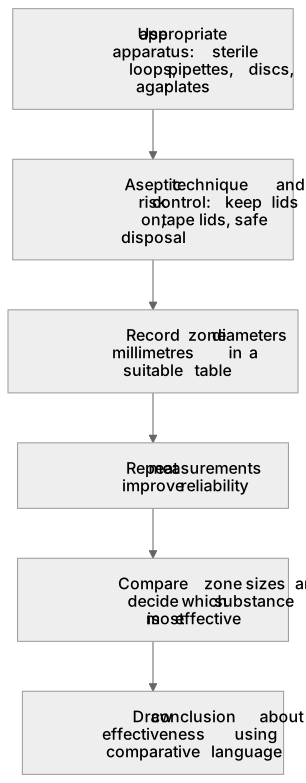
Put it in order
Put these steps in the order they happen.
- 1. Record zone diameters in millimetres in a suitable table
- 2. Aseptic technique and risk control: keep lids on, tape lids, safe disposal
- 3. Use appropriate apparatus: sterile loops, pipettes, discs, agar plates
- 4. Draw conclusion about effectiveness using comparative language
- 5. Compare zone sizes and decide which substance is most effective
- 6. Repeat measurements to improve reliability
Key words
Say what each word means before you turn the card.
Working scientifically skills
Try answering aloud or in your head before turning the card.
Aseptic technique and risk management
Try answering aloud or in your head before turning the card.
Measurement, recording and reliability
Try answering aloud or in your head before turning the card.
Analysis and interpretation of data
Try answering aloud or in your head before turning the card.
See every definition
- Working scientifically skills
- Four skills developed by this practical, covering use of appropriate apparatus and techniques, recording observations and measurements, analysis and interpretation of data, and making informed judgements about risks.
- Aseptic technique and risk management
- Using aseptic technique, keeping lids on and following safe disposal to make informed judgements about risks such as contamination or growth of pathogens.
- Measurement, recording and reliability
- Recording zone diameters in millimetres in a suitable table and repeating measurements to improve reliability.
- Analysis and interpretation of data
- Comparing zones and deciding which substance is most effective, using comparative language such as larger zone, more effective.
Label the diagram
Some boxes have lost their names. Pick the right name for each number.
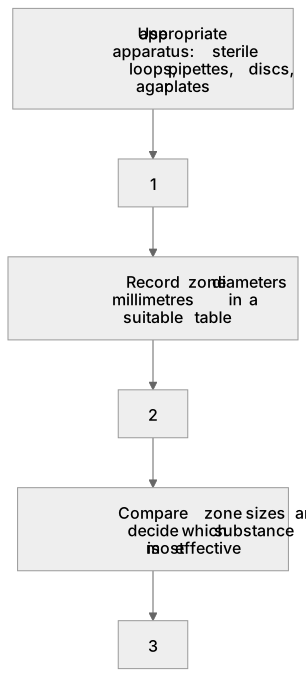
1Box 1
2Box 2
3Box 3
There is more to this lesson
The full lesson goes on to check your understanding and help you earn the marks. Create a free account to carry on, with your progress saved.
A week of Premium from your first lesson · Then the free plan continues · No card, no charge
Test your understanding of Culturing microorganisms (biology only): AT skills covered by this practical activity: AT 1, 3, 4 and 8.
Active recall beats re-reading. Take an instant quiz now to test what you’ve learned and lock it into long-term memory.
A week of Premium from your first lesson · Then the free plan continues · No card, no charge