AQA · GCSE · Biology
Course version: 8461 · Version from Sept 2018
Bacteria can be grown in a nutrient broth solution or as colonies on an…
Full specification wording
Culturing microorganisms (biology only): Bacteria can be grown in a nutrient broth solution or as colonies on an agar gel plate.
Bacteria are cultured in the laboratory to study their growth and behaviour.
Checked against the AQA 8461 specification (opens in a new tab) on .
- Point 2 of 11
- 4 key terms
Study notes
From the checked teaching notes for this specification point.
The idea
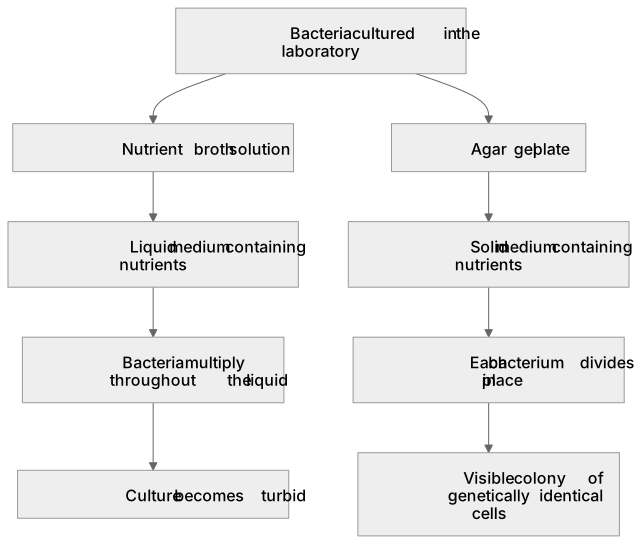
Bacteria are cultured in the laboratory to study their growth and behaviour. Two common methods exist. In a nutrient broth solution, bacteria are suspended in a liquid containing nutrients, so they multiply throughout the liquid and the culture becomes turbid; this suits measuring population growth over time. On an agar gel plate, a solid medium containing nutrients is used, and each bacterium divides in place to form a visible colony, a cluster of genetically identical cells. A colony arises from one original cell, so colonies allow separation and counting of viable cells. For example, a serial dilution of a culture spread on an agar plate can produce countable colonies, whereas the same culture in broth gives an overall cloudiness. Both methods supply nutrients, water and suitable conditions for growth.
What earns the marks
- Nutrient broth is a liquid medium containing nutrients in which bacteria multiply throughout the solution, producing a cloudy suspension.
- Agar gel plates are solid media; bacteria grow on the surface or within the gel, each original cell giving rise to a visible colony.
- A colony is a group of genetically identical bacteria descended from one parent cell, so colonies can be counted to estimate numbers of viable bacteria.
- Broth cultures are useful for growing large numbers of bacteria or measuring growth over time; agar plates are useful for isolating and counting colonies.
- Aseptic technique is needed with both methods to prevent contamination by unwanted microorganisms.
Common mistakes and how to put them right
Thinking bacteria grow only on solid agar.
Put it right: They also grow throughout a liquid nutrient broth, which becomes turbid.
Believing a colony contains many different species.
Put it right: A colony usually arises from one cell and contains genetically identical cells.
Confusing the nutrient source with the physical state of the medium.
Put it right: Both broth and agar supply nutrients, but broth is liquid and agar gel is solid.
Exam tips
- When comparing the two methods, state the physical state of each medium and one advantage of each.
- Use the term colony precisely: a visible cluster of genetically identical cells derived from one parent cell.
- Link the method chosen to the purpose, for example counting colonies on agar or measuring turbidity in broth.
Try the lesson
The start of the Culturing microorganisms (biology only): Bacteria can be grown in a nutrient broth solution or as colonies on an agar gel plate. lesson, made from checked teaching notes for this specification point.
Have a go first
A scientist wants to grow a large volume of bacteria so that the liquid can be tested for cloudiness. Which method of culturing should the scientist choose?
Listen
Bacteria are cultured in the laboratory to study their growth and behaviour. Two common methods exist. In a nutrient broth solution, bacteria are suspended in a liquid containing nutrients, so they multiply throughout the liquid and the culture becomes turbid; this suits measuring population growth over time. On an agar gel plate, a solid medium containing nutrients is used, and each bacterium divides in place to form a visible colony, a cluster of genetically identical cells. A colony arises from one original cell, so colonies allow separation and counting of viable cells. For example, a serial dilution of a culture spread on an agar plate can produce countable colonies, whereas the same culture in broth gives an overall cloudiness. Both methods supply nutrients, water and suitable conditions for growth. A strong answer earns marks for these points. Nutrient broth is a liquid medium containing nutrients in which bacteria multiply throughout the solution, producing a cloudy suspension. Agar gel plates are solid media; bacteria grow on the surface or within the gel, each original cell giving rise to a visible colony. A colony is a group of genetically identical bacteria descended from one parent cell, so colonies can be counted to estimate numbers of viable bacteria. Broth cultures are useful for growing large numbers of bacteria or measuring growth over time; agar plates are useful for isolating and counting colonies. A common slip: Thinking bacteria grow only on solid agar. Instead, they also grow throughout a liquid nutrient broth, which becomes turbid. Exam tip: When comparing the two methods, state the physical state of each medium and one advantage of each.
See it
Key words
Say what each word means before you turn the card.
Nutrient broth
Try answering aloud or in your head before turning the card.
Agar gel plate
Try answering aloud or in your head before turning the card.
Colony
Try answering aloud or in your head before turning the card.
Aseptic technique
Try answering aloud or in your head before turning the card.
See every definition
- Nutrient broth
- A liquid medium containing nutrients in which bacteria multiply throughout the solution, producing a cloudy suspension.
- Agar gel plate
- A solid medium containing nutrients on which bacteria grow on the surface or within the gel, each original cell giving rise to a visible colony.
- Colony
- A visible cluster of genetically identical cells descended from one parent cell, so colonies can be counted to estimate numbers of viable bacteria.
- Aseptic technique
- A method needed with both broth and agar culturing to prevent contamination by unwanted microorganisms.
Label the diagram
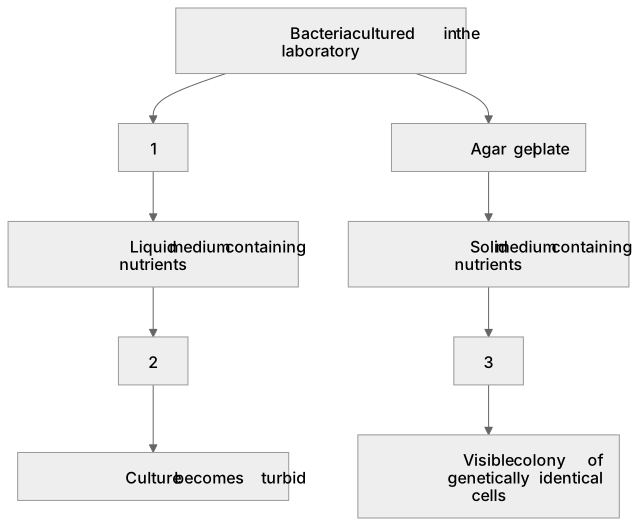
Some boxes have lost their names. Pick the right name for each number.
1Box 1
2Box 2
3Box 3
There is more to this lesson
The full lesson goes on to check your understanding and help you earn the marks. Create a free account to carry on, with your progress saved.
A week of Premium from your first lesson · Then the free plan continues · No card, no charge
Test your understanding of Culturing microorganisms (biology only): Bacteria can be grown in a nutrient broth solution or as colonies on an agar gel plate.
Active recall beats re-reading. Take an instant quiz now to test what you’ve learned and lock it into long-term memory.
A week of Premium from your first lesson · Then the free plan continues · No card, no charge