AQA · GCSE · Biology
Course version: 8461 · Version from Sept 2018
Bacteria multiply by simple cell division (binary fission) as often as once…
Full specification wording
Culturing microorganisms (biology only): Bacteria multiply by simple cell division (binary fission) as often as once every 20 minutes if they have enough nutrients and a suitable temperature.
Bacteria reproduce asexually by binary fission: the single circular chromosome is copied, the cell elongates, and the cell divides into two genetically identical daughter cells.
Checked against the AQA 8461 specification (opens in a new tab) on .
- Point 1 of 11
- 4 key terms
Study notes
From the checked teaching notes for this specification point.
The idea
Bacteria reproduce asexually by binary fission: the single circular chromosome is copied, the cell elongates, and the cell divides into two genetically identical daughter cells. Under ideal conditions, with sufficient nutrients and a suitable temperature, some bacteria can complete this cycle about every 20 minutes, so numbers can double each generation. Starting from one cell, the population after n divisions is 2ⁿ; after 20 minutes there are 2 cells, after 40 minutes 4, after 1 hour 8, and after 3 hours 512. In practice growth slows as nutrients run out and waste products accumulate, so the rate is not maintained indefinitely. In the required practical, students culture bacteria on agar plates using aseptic technique, keeping plates sealed and incubated at a temperature no higher than 25 °C in school laboratories to reduce the risk of growing pathogens.
What earns the marks
- Binary fission is asexual reproduction in which one bacterial cell divides into two genetically identical daughter cells.
- The circular DNA is replicated and the cell divides, so population size doubles each generation under ideal conditions.
- A generation time of about 20 minutes applies only when nutrients are sufficient and the temperature is suitable.
- Population size after n divisions can be calculated as 2ⁿ, or by repeated doubling.
- Growth eventually slows as nutrients are used up and toxic waste products build up.
- Culturing bacteria requires aseptic technique, sterilised equipment and incubation at a safe school temperature, no higher than 25 °C.
Common mistakes and how to put them right
Confusing binary fission with mitosis.
Put it right: Bacteria have no nucleus, so binary fission is not mitosis even though both produce genetically identical cells.
Assuming the 20-minute doubling continues forever.
Put it right: Nutrients become limiting and waste accumulates, so the rate falls.
Calculating population growth by multiplying by the number of divisions instead of using powers of two, which underestimates growth.
Put it right: Use 2ⁿ or repeated doubling.
Exam tips
- Show the doubling sequence or use 2ⁿ, and state the time unit clearly in your answer.
- When asked about conditions, name both sufficient nutrients and a suitable temperature, and explain why each matters.
- In practical questions, mention aseptic technique and the 25 °C maximum incubation temperature for school cultures.
Try the lesson
The start of the Culturing microorganisms (biology only): Bacteria multiply by simple cell division (binary fission) as often as once every 20 minutes if they have enough nutrients and a suitable temperature. lesson, made from checked teaching notes for this specification point.
Have a go first
By which process do bacteria multiply?
Listen
Bacteria reproduce asexually by binary fission: the single circular chromosome is copied, the cell elongates, and the cell divides into two genetically identical daughter cells. Under ideal conditions, with sufficient nutrients and a suitable temperature, some bacteria can complete this cycle about every 20 minutes, so numbers can double each generation. Starting from one cell, the population after n divisions is 2ⁿ; after 20 minutes there are 2 cells, after 40 minutes 4, after 1 hour 8, and after 3 hours 512. In practice growth slows as nutrients run out and waste products accumulate, so the rate is not maintained indefinitely. In the required practical, students culture bacteria on agar plates using aseptic technique, keeping plates sealed and incubated at a temperature no higher than 25 °C in school laboratories to reduce the risk of growing pathogens. A strong answer earns marks for these points. Binary fission is asexual reproduction in which one bacterial cell divides into two genetically identical daughter cells. The circular DNA is replicated and the cell divides, so population size doubles each generation under ideal conditions. A generation time of about 20 minutes applies only when nutrients are sufficient and the temperature is suitable. Population size after n divisions can be calculated as 2ⁿ, or by repeated doubling. Exam tip: Show the doubling sequence or use 2ⁿ, and state the time unit clearly in your answer.
See it
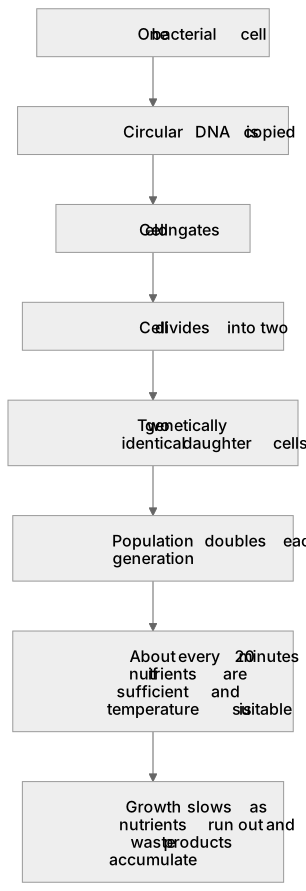
Put it in order
Put these steps in the order they happen.
- 1. Two genetically identical daughter cells
- 2. Growth slows as nutrients run out and waste products accumulate
- 3. Population doubles each generation
- 4. One bacterial cell
- 5. Circular DNA is copied
- 6. About every 20 minutes if nutrients are sufficient and temperature is suitable
- 7. Cell elongates
- 8. Cell divides into two
Key words
Say what each word means before you turn the card.
Binary fission
Try answering aloud or in your head before turning the card.
Exponential population growth
Try answering aloud or in your head before turning the card.
Limiting factors on growth
Try answering aloud or in your head before turning the card.
Aseptic technique and safe culturing
Try answering aloud or in your head before turning the card.
See every definition
- Binary fission
- Asexual reproduction in which one bacterial cell divides into two genetically identical daughter cells, with the circular DNA replicated and the cell dividing.
- Exponential population growth
- Population size after n divisions can be calculated as 2ⁿ, or by repeated doubling, so numbers double each generation under ideal conditions.
- Limiting factors on growth
- Growth eventually slows as nutrients are used up and toxic waste products build up, so the rate is not maintained indefinitely.
- Aseptic technique and safe culturing
- Culturing bacteria requires aseptic technique, sterilised equipment and incubation at a safe school temperature, no higher than 25 °C.
Label the diagram
Some boxes have lost their names. Pick the right name for each number.
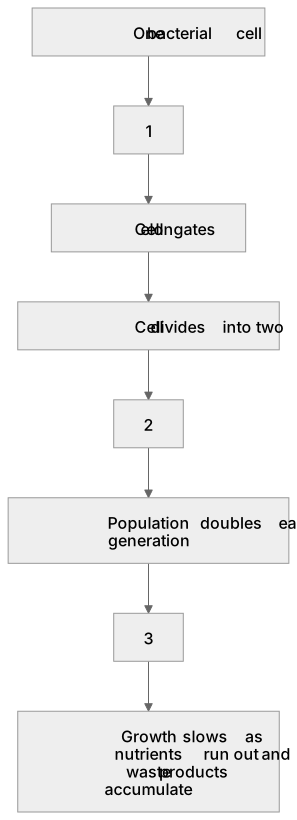
1Box 1
2Box 2
3Box 3
There is more to this lesson
The full lesson goes on to check your understanding and help you earn the marks. Create a free account to carry on, with your progress saved.
A week of Premium from your first lesson · Then the free plan continues · No card, no charge
Test your understanding of Culturing microorganisms (biology only): Bacteria multiply by simple cell division (binary fission) as often as once every 20 minutes if they have enough nutrients and a suitable temperature.
Active recall beats re-reading. Take an instant quiz now to test what you’ve learned and lock it into long-term memory.
A week of Premium from your first lesson · Then the free plan continues · No card, no charge