AQA · GCSE · Biology
Course version: 8461 · Version from Sept 2018
Students should be able to describe how to prepare an uncontaminated…
Full specification wording
Culturing microorganisms (biology only): Students should be able to describe how to prepare an uncontaminated culture using aseptic technique.
Preparing an uncontaminated culture means transferring a known microorganism into sterile medium without introducing others.
Checked against the AQA 8461 specification (opens in a new tab) on .
- Point 4 of 11
- 4 key terms
Study notes
From the checked teaching notes for this specification point.
The idea
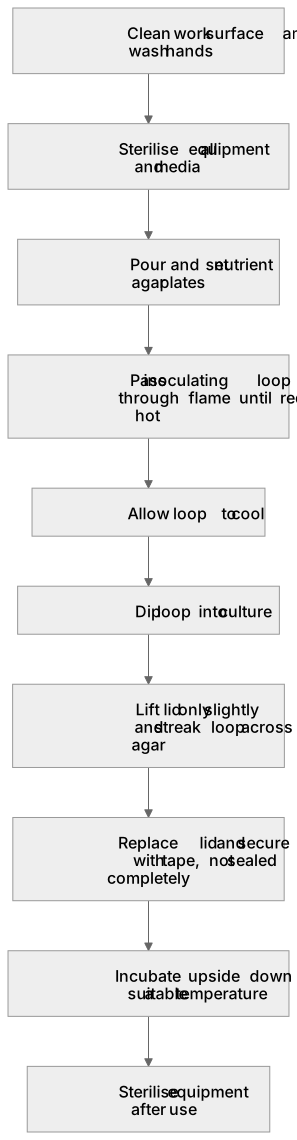
Preparing an uncontaminated culture means transferring a known microorganism into sterile medium without introducing others. Work surfaces are cleaned, hands are washed, and equipment is sterilised before use. Nutrient agar plates are poured and set, and the inoculating loop is passed through a flame until red hot, then cooled. The loop is dipped into the culture, and a streak is made across the agar; the lid is replaced and secured with tape, but not sealed completely, to allow gas exchange and reduce the risk of anaerobic conditions. Plates are incubated upside down at a suitable temperature, typically around 25 °C in school laboratories, to reduce condensation and limit the growth of human pathogens. All equipment is sterilised after use. Throughout, the lid is lifted only slightly and the plate is kept closed when not being inoculated.
What earns the marks
- Sterilise all equipment and media before use, for example by autoclaving or using pre-sterilised plates.
- Clean the work surface and wash hands before starting to reduce contamination.
- Pass the inoculating loop through a flame until it is red hot, then allow it to cool before picking up the microorganism.
- Lift the lid of the agar plate only slightly, streak the loop across the agar, and replace the lid immediately.
- Secure the lid with tape but do not seal it completely, so that gases can exchange and anaerobic conditions are avoided.
- Incubate the plate upside down at a suitable temperature, such as around 25 °C in a school laboratory, and sterilise equipment after use.
Common mistakes and how to put them right
Using a hot loop to pick up the culture.
Put it right: The loop must be cooled first so that the microorganisms are not killed.
Sealing the lid completely with tape.
Put it right: The lid should be taped but not sealed all the way around, to allow gas exchange.
Incubating plates upright; correction: plates are incubated upside down to prevent condensation dripping onto the agar.
Exam tips
- Describe the steps in a logical order, from sterilising equipment to incubating the plate.
- State why each action is done, for example cooling the loop to keep the microorganisms alive.
- Use the term aseptic technique and refer to keeping the lid closed or only slightly open during transfer.
Try the lesson
The start of the Culturing microorganisms (biology only): Students should be able to describe how to prepare an uncontaminated culture using aseptic technique. lesson, made from checked teaching notes for this specification point.
Have a go first
Which action is part of aseptic technique when preparing an uncontaminated culture?
Listen
Preparing an uncontaminated culture means transferring a known microorganism into sterile medium without introducing others. Work surfaces are cleaned, hands are washed, and equipment is sterilised before use. Nutrient agar plates are poured and set, and the inoculating loop is passed through a flame until red hot, then cooled. The loop is dipped into the culture, and a streak is made across the agar; the lid is replaced and secured with tape, but not sealed completely, to allow gas exchange and reduce the risk of anaerobic conditions. Plates are incubated upside down at a suitable temperature, typically around 25 °C in school laboratories, to reduce condensation and limit the growth of human pathogens. All equipment is sterilised after use. Throughout, the lid is lifted only slightly and the plate is kept closed when not being inoculated. A strong answer earns marks for these points. Sterilise all equipment and media before use, for example by autoclaving or using pre-sterilised plates. Clean the work surface and wash hands before starting to reduce contamination. Pass the inoculating loop through a flame until it is red hot, then allow it to cool before picking up the microorganism. Lift the lid of the agar plate only slightly, streak the loop across the agar, and replace the lid immediately. A common slip: Using a hot loop to pick up the culture. Instead, the loop must be cooled first so that the microorganisms are not killed. Exam tip: Describe the steps in a logical order, from sterilising equipment to incubating the plate.
See it
Key words
Say what each word means before you turn the card.
Aseptic technique
Try answering aloud or in your head before turning the card.
Sterilisation and contamination control
Try answering aloud or in your head before turning the card.
Incubation conditions
Try answering aloud or in your head before turning the card.
Practical laboratory skills
Try answering aloud or in your head before turning the card.
See every definition
- Aseptic technique
- The method of preparing an uncontaminated culture by sterilising equipment and media, cleaning work surfaces, washing hands and keeping the lid closed or only slightly open during transfer.
- Sterilisation and contamination control
- All equipment and media are sterilised before use, and all equipment is sterilised after use, to reduce the risk of contamination.
- Incubation conditions
- Plates are incubated upside down at a suitable temperature, typically around 25 °C in school laboratories, to reduce condensation and limit the growth of human pathogens.
- Practical laboratory skills
- The loop is passed through a flame until red hot, then cooled before picking up the microorganism, and the lid is secured with tape but not sealed completely to allow gas exchange.
Label the diagram
Some boxes have lost their names. Pick the right name for each number.
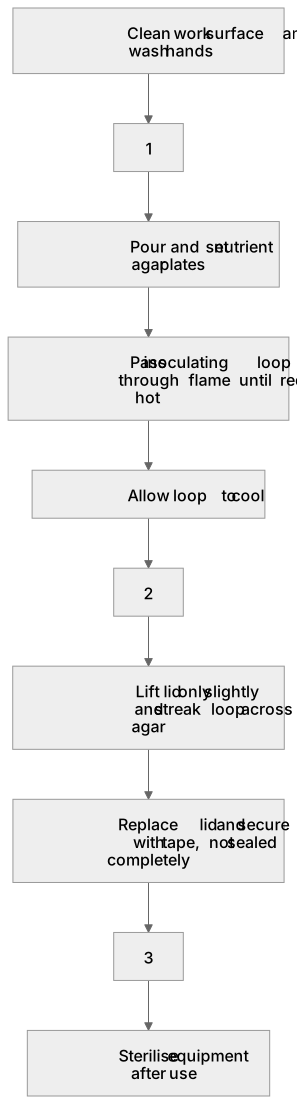
1Box 1
2Box 2
3Box 3
There is more to this lesson
The full lesson goes on to check your understanding and help you earn the marks. Create a free account to carry on, with your progress saved.
A week of Premium from your first lesson · Then the free plan continues · No card, no charge
Test your understanding of Culturing microorganisms (biology only): Students should be able to describe how to prepare an uncontaminated culture using aseptic technique.
Active recall beats re-reading. Take an instant quiz now to test what you’ve learned and lock it into long-term memory.
A week of Premium from your first lesson · Then the free plan continues · No card, no charge